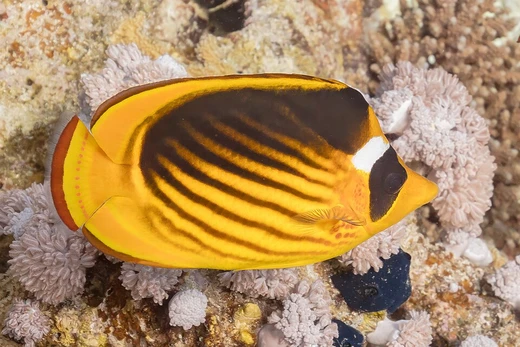
Holacanthus tricolor
Three bold bands of black slice through Caribbean reef light, marking a territorial grazer's home turf.

Holacanthus tricolor, commonly known as the three-color angelfish or three-band angelfish, is a marine ray-finned fish in the family Pomacanthidae. It inhabits coral reef habitats throughout the western Atlantic, including the Caribbean Sea, the Gulf of Mexico, and waters around Bermuda. Adults display a striking pattern of three broad black vertical bands over a blue-green to turquoise body, a coloration that gives the species its binomial epithet *tricolor* (Latin for 'three-colored').
Ecologically, the three-color angelfish occupies a mid-reef niche as an omnivorous grazer and detritivore, feeding on sponges, tunicates, filamentous algae, and small invertebrates. It is typically encountered in pairs or small aggregations on reef slopes and overhangs, where it plays a role in regulating sponge and algal cover and in the nutrient cycling of the reef community.
- Scientific name
- Holacanthus tricolor (Linnaeus, 1766)
- Family
- Pomacanthidae
- Common name
- Three-color angelfish / Three-band angelfish
- Distribution
- Western Atlantic: Caribbean Sea, Gulf of Mexico, Bermuda
- Habitat
- Coral reefs, typically 1–30 m depth
- Diet
- Omnivorous: sponges, tunicates, algae, small invertebrates
- Max length
- ≈ 25 cm (SL)
Lore & Background
The species was originally described by Linnaeus in 1766 as *Thalassoma tricolor* and later transferred to the genus *Holacanthus* as the angelfish radiation in the western Atlantic was better understood. Early natural-history accounts from the 18th and 19th centuries noted the fish's conspicuous banded pattern and its tendency to hold station over reef outcrops, observations that remain consistent with modern field surveys in the Caribbean and Gulf of Mexico.
In reef ecology, *H. tricolor* is considered a mid-level consumer whose foraging on sponge tissue and tunicate mucus helps limit the dominance of any single benthic group on the reef face. Field surveys in the Florida Keys and the Bahamas record the species foraging in pairs, with each individual patrolling a small territory of roughly a few square meters of reef substrate. The pair-bonded behavior distinguishes it from more gregarious pomacanthids and suggests a social structure in which both partners defend the foraging patch against intruders of the same or similar size.
The juvenile phase of *H. tricolor* is markedly different from the adult: young fish are smaller, darker, and often found in shallower, more turbid reef zones or seagrass edges. This ontogenetic shift in habitat and coloration reduces predation pressure during the vulnerable early life stage and is a pattern shared across many Caribbean pomacanthids, as documented in comparative life-history studies of the family.
Reader's Guide
Territorial pair defense on a reef slope (field observation, Caribbean): A conspecific angelfish of similar size approaches the pair's foraging patch. The resident male flares his dorsal and anal fins to full extension, widens his gill covers, and performs a slow lateral display oriented directly toward the intruder. The female positions herself slightly behind and to the side, mirroring the fin-flare. The intruder retreats within 20–30 seconds. Ecological consequence: the pair maintains exclusive access to a finite patch of sponge and tunicate cover, preventing overgrazing by a single individual and preserving microhabitat structure for smaller invertebrates.
Sponge foraging bout (field observation, Florida Keys): The angelfish positions its head against a *Cliona* or *Haliclona* colony, bites a chunk of tissue, and works it with the pharyngeal jaws before swallowing. Repeated bites over 30–60 seconds remove a visible patch. Ecological consequence: localized reduction in sponge cover opens substrate for algal colonization and recruits of small benthic invertebrates, contributing to reef-scale biodiversity turnover.
Juvenile sheltering (field observation, shallower reef, < 5 m): A juvenile *H. tricolor*, noticeably smaller and darker than adults, shelters beneath a table coral or within a crevice, emerging only to take a few bites of filamentous algae before retreating. This behavior contrasts with adult pair-territory holding and reflects predation avoidance. Aquarium-tank anecdote (not a field observation): in a 900-L reef system, a juvenile three-color angelfish was observed hiding behind a live rock for the first two weeks before gradually increasing foraging activity; this is a husbandry observation and does not reflect natural sheltering frequency or duration.
Did You Know?
- The species was originally placed in the genus *Thalassoma* by Linnaeus in 1766 before being transferred to *Holacanthus* as the western-Atlantic angelfish radiation was reclassified.
- Sponge tissue constitutes a significant component of the adult diet, making *H. tricolor* an important consumer in reef sponge community dynamics and a potential vector for sponge-borne symbionts or toxins.
More in Behavior & Ecology
Elsewhere in Diagonal butterflyfish
Spotted an error? Know more?
Reader corrections go straight into our review queue. Suggest an edit · How this site is sourced