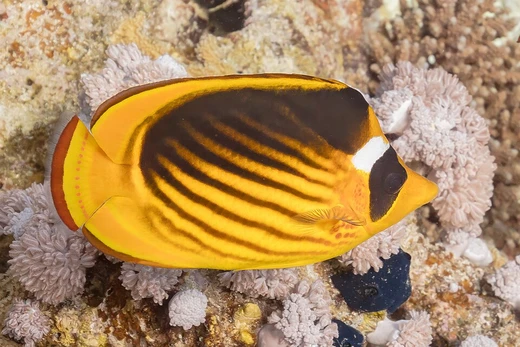
Tetraodon nigroviridis
A slow, sly, green-and-black face that watches you back.

Tetraodon nigroviridis, commonly known as the green spotted puffer, is a small, laterally compressed pufferfish in the family Tetraodontidae. Native to the brackish and freshwater systems of Indochina, the Malay Peninsula, and the Indonesian archipelago, it is one of the most widely traded puffer species in the ornamental aquarium trade. Its vivid green body studded with irregular black spots, combined with a notably expressive face and a habit of interacting with its keeper, has made it a cult favorite among hobbyists.
- Common name
- Green Spotted Puffer
- Scientific name
- Tetraodon nigroviridis
- Family
- Tetraodontidae
- Native range
- Indochina, Malay Peninsula, Indonesia (brackish & freshwater)
- Typical adult size
- 10–15 cm (4–6 in)
- Diet
- Carnivorous (crustaceans, molluscs, small invertebrates)
- Temperament
- Solitary / territorial
Lore & Background
In its native range, Tetraodon nigroviridis inhabits slow-moving rivers, mangrove channels, and coastal estuaries where salinity fluctuates seasonally. It is a benthic-to-midwater forager that feeds on crustaceans, molluscs, and small invertebrates, using its beak-like dentition to crush hard-shelled prey. The species is largely solitary and territorial, and individuals of the same sex are known to fight aggressively. Females are typically larger and plumper than males, and the species is oviparous, laying adhesive eggs on submerged surfaces in the presence of a male.
In the aquarium trade, the green spotted puffer has been a staple since at least the 1990s, prized for its manageable size (typically reaching 10–15 cm / 4–6 in), its bold coloration, and its apparent capacity to recognize a human face at the glass. It is one of the few puffer species that tolerates fully freshwater conditions in captivity, though a brackish phase during juvenile rearing is common in published husbandry literature. Its slow, deliberate swimming and habit of perching on driftwood or rocks give it a distinctly 'characterful' presence that sets it apart from faster, more schooling tankmates.
Reader's Guide
Tank size & setup: A minimum of 60 L (15 gal) per adult is the consensus in published aquaculture literature (e.g., FishBase aquaculture notes, Aquarium Co-Op species guides). Use a fine sand substrate to avoid abrasion, and include driftwood or rockwork for perching. A tight-fitting lid is essential—this species is a known jumper and has been documented escaping unsecured tanks (keeper consensus, multiple forum and journal reports). Keep it alone or with very large, non-aggressive tankmates; it is solitary and will fight same-species rivals.
Water parameters: Temperature 24–28 °C (75–82 °F) is the range most commonly cited in husbandry literature. pH 6.5–8.0 is tolerable; the species is adaptable. Juveniles are often reared in 1–2 ppt salinity per published rearing protocols, but adults thrive in fully freshwater tanks (keeper consensus). A strong mechanical + biological filter is critical because of the high bioload from a carnivorous diet.
Feeding: Offer a varied carnivorous diet—frozen or live shrimp, krill, snails, mussels, and occasional earthworms. Feed 1–2× per day in small portions; overfeeding is the most common mistake leading to obesity and organ damage (published in multiple aquarium-medicine references). Supplement with calcium-rich prey to maintain beak health.
Common mistakes: (1) Keeping it with aggressive or fast-swimming species—stress and injury result. (2) Under-filtering. (3) Feeding only one type of meaty food, leading to nutritional gaps. (4) Leaving the tank uncovered. (5) Expecting it to school—it will not.
Did You Know?
- Tetraodon nigroviridis is one of the few puffer species routinely kept in fully freshwater aquariums as an adult, though juveniles are often reared in lightly brackish water in published husbandry guides.
- Unlike most fish, it possesses four rows of fused teeth (hence 'Tetraodontidae') that grow continuously and are worn down by crushing hard-shelled prey.
- It is a known escape artist in the hobby; it can leap from the water surface and has been reported climbing out of unsecured tanks, a behaviour consistent with its benthic, semi-terrestrial foraging in mangrove channels.
- The species is largely nocturnal and crepuscular in the wild, which is why experienced keepers often feed in the evening and provide dim, low-light conditions to reduce stress.
More in Aquarium Keeping
Elsewhere in Diagonal butterflyfish
Spotted an error? Know more?
Reader corrections go straight into our review queue. Suggest an edit · How this site is sourced