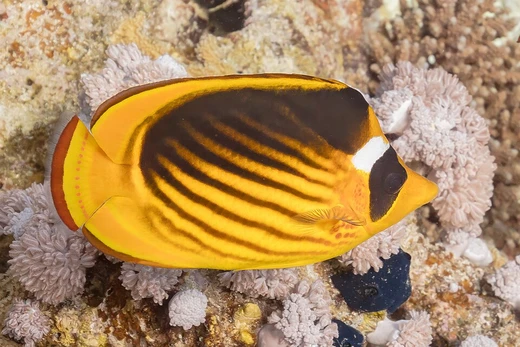
Zebrasoma flavescens
A blazing-yellow scalpel-wielding grazer that keeps Indo-Pacific reefs from drowning in algae.

Zebrasoma flavescens, commonly known as the Yellow Tang, is a small surgeonfish (family Acanthuridae) endemic to the coral reefs of the Indo-Pacific. Its vivid, uniform yellow coloration and laterally compressed, disc-like body make it one of the most visually conspicuous herbivorous fishes on tropical reefs, and its caudal scalpel—a sharp, sword-like spine at the base of the tail—gives it the family's common name 'surgeonfish.'
Ecologically, Zebrasoma flavescens occupies a critical niche as a mid-level algal grazer. By continuously removing turf algae and microalgae from hard-substrate surfaces, it helps maintain the balance between algal overgrowth and coral recruitment, functioning as a keystone consumer in reef community dynamics. Its foraging behavior, social structure, and diurnal activity cycle are well-studied components of Indo-Pacific reef ecology.
- Common name
- Yellow Tang
- Family
- Acanthuridae (surgeonfishes)
- Distribution
- Indo-Pacific (western Pacific, Indian Ocean, surrounding reef systems)
- Diet
- Herbivorous — turf algae, microalgae, detrital organic matter
- Distinctive morphology
- Caudal scalpel (single sharp spine at caudal peduncle)
- Activity pattern
- Diurnal; shelters in reef crevices at night
Lore & Background
In the trophic architecture of a healthy Indo-Pacific coral reef, Zebrasoma flavescens sits at a pivotal node. Larger Acanthurids and parrotfishes remove macroalgae and biofilm, while the Yellow Tang specializes in the shorter, filamentous turf algae that colonize dead coral rubble, rock walls, and the interstices of living coral colonies. Without this constant, fine-scale grazing pressure, turf algae can smother coral polyps, inhibit larval settlement, and shift the reef from a coral-dominated to an algal-dominated state. Field surveys across the Great Barrier Reef, the Andaman Sea, and the central Pacific have repeatedly correlated Yellow Tang abundance with lower turf-algal cover and higher coral recruitment success.
Behaviorally, the species is a social but non-territorial grazer. Individuals are typically observed in loose aggregations of two to a dozen or more, moving in coordinated, undulating lines along reef walls and over rubble fields. Males and females are not easily distinguished externally, and group composition appears fluid, shifting with the availability of algal patches. The caudal scalpel, while primarily a defensive structure, is also deployed in agonistic encounters within the group, with individuals fanning the spine and delivering lateral strikes to rivals. These interactions are brief and rarely result in lasting injury, suggesting a ritualized function in maintaining group cohesion and foraging order.
The Yellow Tang's ecological role extends beyond simple consumption. Its grazing creates micro-habitat heterogeneity—bare patches interspersed with algal tufts—that in turn supports a diverse assemblage of small invertebrates and juvenile fishes. In this way, Zebrasoma flavescens acts as an ecosystem engineer at the micro-scale, shaping the physical and biological template on which other reef organisms depend.
Reader's Guide
Trigger: A reef wall or rubble field colonized by 1–3 cm filamentous turf algae. Action: A group of three to ten Zebrasoma flavescens approaches in a loose, undulating line. Each individual positions its mouth against the substrate and performs rapid, repeated rasping motions, clipping algal filaments at their base. The fish move laterally in a continuous sweep, covering a few centimetres of substrate per second. Ecological consequence: Turf algal biomass is reduced, exposing bare hard substrate that becomes available for coral larval settlement and invertebrate colonization. This is a well-documented field observation across multiple Indo-Pacific reef studies.
Trigger: A conspecific intrudes on a foraging individual's immediate working space. Action: The resident fish turns, flares the single caudal scalpel laterally, and delivers one to three quick lateral strikes toward the intruder's flank. The interaction lasts under two seconds. The intruder retreats a few body-lengths and resumes grazing at a distance. Ecological consequence: Brief agonistic encounters maintain a loose spatial order within the group, reducing competition overlap without causing serious injury. This ritualized display is consistently observed in field video documentation.
Trigger: Dusk and the transition to darkness. Action: Active grazing ceases. Individuals seek out narrow crevices, overhangs, or the undersides of coral heads, pressing their laterally compressed bodies flat against the substrate. They remain motionless through the night, resuming foraging only after full daylight returns. Ecological consequence: Nocturnal sheltering reduces predation risk from active predators (e.g., groupers, jacks) and aligns the species' activity with the diurnal productivity of its algal food source. This is a well-established diurnal pattern in Acanthuridae field observations.
Note: Anecdotal reports from the aquarium trade describe Yellow Tangs becoming more aggressive toward conspecifics in confined tanks, but this is a captive-environment artifact and is not documented as a natural behavioral pattern in open reef settings.
Did You Know?
- The caudal scalpel of Zebrasoma flavescens is a modified spine that can be erected and used as a defensive weapon; the same structure gives the entire family Acanthuridae its common name 'surgeonfishes.'
- Yellow Tangs are not territorial in the way some other reef fish are; instead, they form fluid, non-hierarchical groups whose composition shifts daily based on algal patch availability.
- Their grazing creates a mosaic of bare and algal-covered micro-patches on reef substrate, a pattern that researchers have linked to higher diversity of small invertebrate species on grazed versus ungrazed reef sections.
- Despite their conspicuous uniform yellow coloration, Zebrasoma flavescens shows no significant sexual dimorphism in color pattern, making males and females visually indistinguishable in the field.
More in Behavior & Ecology
Elsewhere in Diagonal butterflyfish
Spotted an error? Know more?
Reader corrections go straight into our review queue. Suggest an edit · How this site is sourced