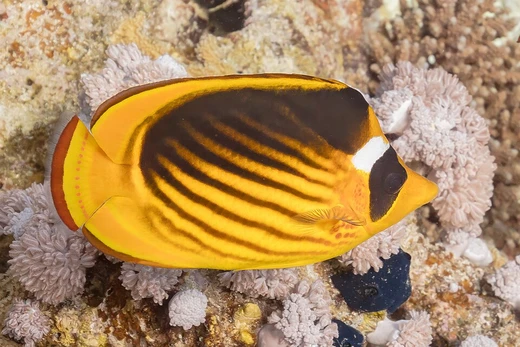
Indo-Pacific
The world's richest marine bioregion, stretching from Africa's shores to the Pacific's edge.

The Indo-Pacific is the largest marine biogeographic region on Earth, encompassing the tropical and subtropical waters of the Indian Ocean and the western Pacific Ocean. It stretches from the eastern coast of Africa and the Red Sea in the west, through the archipelagos of Indonesia, the Philippines, and Papua New Guinea, to the coastlines of Australia and the western edge of the central Pacific in the east. It is widely recognized as the global center of marine biodiversity, harboring the highest concentrations of reef fish, scleractinian coral, and invertebrate species of any oceanic region.
Because the region bridges two ocean basins and contains the Coral Triangle—a zone of extraordinary species richness and endemism—it serves as the primary reference range for hundreds of reef-associated species in taxonomic literature, fisheries records, and conservation assessments. Its warm, shallow, reef-dominated waters underpin some of the most complex benthic communities known in marine biology.
- Region type
- Marine biogeographic region
- Oceans encompassed
- Indian Ocean; Western Pacific Ocean
- Western boundary
- Isthmus of Suez / East African coast
- Eastern boundary
- Western Pacific (central Pacific margin)
- Key biodiversity hotspot
- Coral Triangle (Indonesia, Philippines, Malaysia, East Timor, Papua New Guinea, Solomon Islands)
- Dominant benthic habitat
- Coral reef
- Climate regime
- Primarily tropical; subtropical at southern and northern margins
Lore & Background
The Indo-Pacific's biogeographic identity is shaped by the Indonesian archipelago, which acts both as a barrier and a conduit between the Indian and Pacific Oceans. The Indonesian Throughflow—a major current system that channels warm Indian Ocean water into the Pacific—maintains the thermal and chemical continuity that allows a single, broadly distributed faunal assemblage to occupy waters on both sides of the archipelago. This connectivity is why Indo-Pacific species lists in major taxonomic databases (FishBase, WoRMS, OBIS) routinely span from the Red Sea to Fiji and beyond without a hard faunal break.
The Coral Triangle, identified in early-2000s World Bank and FAO assessments as the epicenter of coral reef biodiversity, concentrates the highest numbers of scleractinian coral species, reef fish species, and invertebrate taxa per unit area recorded anywhere in the world's oceans. The region's productivity is sustained by a combination of upwelling, monsoonal mixing, and the sheer extent of shallow, sunlit reef substrate. Seasonal monsoon winds reverse current directions across the Indian Ocean basin, driving nutrient pulses that sustain the pelagic and benthic food webs on which reef communities depend.
At the southern and northern margins, the Indo-Pacific transitions into subtropical and temperate waters around southern Australia, New Zealand, and the Ryukyu Islands, where reef complexity gives way to kelp forests, seagrass meadows, and rocky-reef assemblages. This latitudinal gradient makes the region a natural laboratory for studying range limits, thermal tolerance, and biogeographic turnover in marine organisms.
Reader's Guide
Coral Triangle (Indonesia, Philippines, Papua New Guinea, Malaysia, East Timor, Solomon Islands) → The core of Indo-Pacific reef biodiversity. Microhabitats span shallow fore-reef (2–15 m) with dense branching Acropora and Porites, mid-slope (15–40 m) with plate corals and gorgonians, and outer-reef drop-offs (40–80 m) with massive boulder corals. This zone shows the widest species overlap between Indian- and Pacific-derived faunas; local absences are rare, and range extensions are typically attributed to larval dispersal via the Indonesian Throughflow.
East African coast & Red Sea (Somalia, Kenya, Tanzania, Saudi Arabia, Egypt) → The westernmost Indo-Pacific expression. Microhabitats include fringing reefs over sand, lagoonal seagrass beds (Halophila, Cymodocea), and the deeper Red Sea shelf (10–50 m) where endemic red-lipped and white-tip reef species occur. The Red Sea faunal element is partially isolated by the Bab el-Mandeb strait, producing a distinct endemic component alongside shared Indo-Pacific taxa.
Great Barrier Reef & southern Australian shelf (Queensland, New South Wales) → The southern temperate-to-tropical transition. Microhabitats range from shallow (3–10 m) mixed hard- and soft-reef communities to sub-tropical rocky reefs (10–30 m) with kelp understory. Range extensions of tropical species southward are documented during warm-water years; conversely, temperate species show limited northward penetration.
Western Pacific open-ocean atolls (Fiji, Kiribati, Marshall Islands) → Isolated lagoonal and outer-reef systems. Microhabitats: lagoon seagrass and sand flats (1–8 m), outer-reef crest (5–15 m), and deep fore-reef (15–50 m). Dispersal limitation is highest here; local absences of mainland-associated species are common, and range extensions typically follow major current events or El Niño–driven larval transport.
Did You Know?
- The Coral Triangle is cited in World Bank and FAO assessments as the global center of coral reef biodiversity, containing a disproportionate share of the world's known scleractinian coral and reef-fish species.
- Monsoonal wind reversals across the Indian Ocean basin drive seasonal nutrient pulses that sustain the pelagic and benthic food webs underlying Indo-Pacific reef communities.
More in Distribution & Habitat
Elsewhere in Diagonal butterflyfish
Spotted an error? Know more?
Reader corrections go straight into our review queue. Suggest an edit · How this site is sourced