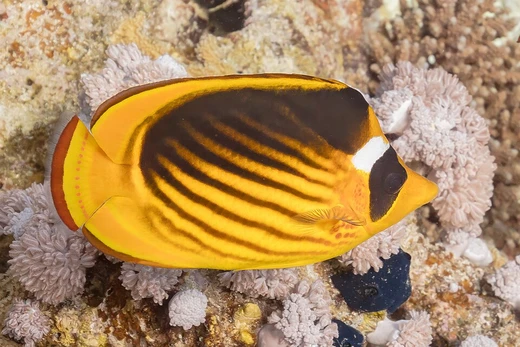
Poecilia reticulata
A tiny livebearer whose dazzling males have made it the world's most popular aquarium fish.

Poecilia reticulata, commonly known as the guppy, is a small, viviparous (livebearing) freshwater fish in the family Poeciliidae. Native to the slow-moving streams and rivers of southern Venezuela, Guyana, and Trinidad and Tobago, it is one of the most widely kept ornamental freshwater fish in the world. Males display strikingly variable coloration and fin morphology, while females are larger and more subdued in color. The species has also become a cornerstone model organism in evolutionary and behavioral ecology, particularly for studying sexual selection and local adaptation.
- Common name
- Guppy
- Scientific name
- Poecilia reticulata
- Family
- Poeciliidae
- Native range
- Southern Venezuela, Guyana, Trinidad and Tobago
- Reproduction
- Viviparous (livebearing)
- Habitat type
- Freshwater (streams, rivers, ponds)
- Diet
- Omnivorous
Lore & Background
The guppy's journey from a handful of South American streams to aquariums on every continent is one of the most remarkable stories in ornamental aquaculture. First described by John Coates Philippi in 1822, the species was collected in the wild and distributed to European and North American hobbyists in the late 19th and early 20th centuries. Decades of selective breeding in captivity produced an extraordinary array of color morphs—metallic blues, fiery reds, iridescent greens, and elaborate sail-like dorsal and caudal fins—far exceeding anything found in natural populations.
Beyond the hobby, Poecilia reticulata has become a premier model in evolutionary biology. Researchers, most notably David Reznick and colleagues, have used wild and captive guppy populations to demonstrate how predation pressure, mate choice, and environmental change shape life-history traits such as size at maturity, reproductive allocation, and coloration. The species' short generation time, high fecundity, and genetic tractability make it uniquely suited for experimental evolution studies that would be impractical in longer-lived vertebrates.
The guppy has also been introduced, deliberately or accidentally, to freshwater systems across the Pacific, Southeast Asia, and Australia. In some of these regions it has established self-sustaining populations and is regarded as a minor invasive species, though its ecological impact is generally considered modest compared to more aggressive introductions.
Reader's Guide
Water temperature: Published aquaculture references and experienced keeper consensus converge on a tropical range of roughly 22–28 °C (72–82 °F). Guppies tolerate short excursions outside this band but sustained extremes stress the immune system. Flag: rapid temperature swings of more than 2 °C per day are a common beginner mistake.
pH and hardness: A slightly neutral-to-alkaline range (approximately pH 6.5–8.0) is the most widely cited in hobbyist literature. Guppies are notably tolerant of moderate variation, but consistently acidic water below 6.0 is a recurring source of chronic stress. Flag: do not chase a single 'ideal' pH; stability matters more than precision.
Tank setup and community: A minimum of 20 L (5 US gal) is the commonly recommended starting volume for a small group. Provide dense planting or fine substrate to offer hiding places, especially for females and juveniles. Guppies do best with peaceful, non-aggressive tankmates. Flag: housing them with cichlids, large barbs, or other fin-nipping species is a frequent error that leads to chronic stress and lost fins.
Feeding: Omnivorous. A varied diet of quality flake or pellet food supplemented 2–3 times weekly with frozen brine shrimp, daphnia, or finely chopped vegetable matter is the standard keeper-consensus regimen. Flag: overfeeding is the most common husbandry mistake; remove uneaten food within a minute to protect water quality.
Sexing and breeding: Males are smaller, more colourful, and possess a modified anal fin (gonopodium) used for internal fertilisation. Females are larger, plainer, and develop a visible gravid spot as a clutch matures. Because guppies are prolific livebearers, a single female can produce a large litter every 4–6 weeks under good conditions. Flag: without a plan for offspring, a small tank can be overwhelmed within weeks. Source: widely stated in published aquaculture guides and long-standing keeper consensus.
Did You Know?
- Poecilia reticulata is one of the primary model organisms in experimental evolutionary ecology, used to study how predation and sexual selection shape colour, size, and reproductive timing within just a few generations.
- Despite being a freshwater species, guppies are sometimes confused with marine fish in casual conversation; they cannot survive in saltwater and should never be placed in a marine or brackish system.
More in Aquarium Keeping
Elsewhere in Diagonal butterflyfish
Spotted an error? Know more?
Reader corrections go straight into our review queue. Suggest an edit · How this site is sourced