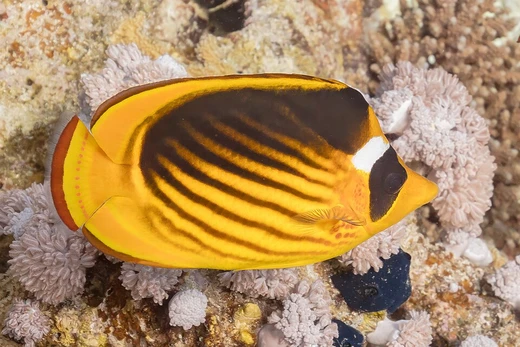
Amphiprion ocellaris
Three white bands, one stubborn little orange fish that owns the anemone.

Amphiprion ocellaris, commonly known as the ocellaris clownfish or false percula clownfish, is a small marine fish in the family Pomacentridae. Native to the western Pacific, it is one of the most widely recognized and traded species in the saltwater aquarium hobby, celebrated for its bold orange-and-white banding and its well-documented mutualistic association with sea anemones.
Unlike its close relative Amphiprion percula (which bears two white bars), A. ocellaris displays three white bands and a more elongated body. It is a dioecious protandrous species—every individual is born male, and in a social group the dominant individual may transition to female. Its hardiness, small adult size, and vivid coloration make it a staple recommendation for hobbyists entering marine keeping.
- Scientific name
- Amphiprion ocellaris
- Common name
- Ocellaris clownfish / False percula
- Family
- Pomacentridae
- Distribution
- Western Pacific (Indonesia, Philippines, surrounding waters)
- Adult size
- ≈ 7–8 cm (2.8–3.1 in)
- Diet
- Omnivorous
- Aquarium type
- Marine (saltwater)
Lore & Background
In the wild, Amphiprion ocellaris is inseparable from its host anemone. The fish secretes a specialized mucus layer that shields it from the anemone's stinging nematocysts, while in return the clownfish deters polyp-eating fish, provides nutrients through its waste, and uses its fins to circulate water over the anemone's tentacles. Field observations in Indonesian and Philippine reef systems (documented in multiple ichthyological surveys) show that a single anemone may shelter a breeding pair plus one or more subordinate males.
The species is a protandrous hermaphrodite. In a typical group the largest individual is the female; if she is removed, the largest remaining male undergoes a sex change within days to weeks, a process involving gonadal remodeling and a shift in behavioral dominance. This social flexibility is a key reason the species thrives in captivity when kept in small social groups.
The ocellaris clownfish gained enormous public visibility after its depiction as the protagonist in the 2003 animated film Finding Nemo. Aquarists and fish-stores report a sustained surge in demand for the species in the years following the film's release, cementing its status as the default 'clownfish' in the global marine trade.
Reader's Guide
Tank size: Experienced keeper consensus and published marine-aquarium handbooks (e.g., FishBase aquarium notes, Ingo Sodtke's marine-reef literature) recommend a minimum of 75 L (≈ 20 US gal) for a single A. ocellaris, with 150 L (≈ 40 gal) or more preferred for a bonded pair. Common mistake: housing a pair in a nano tank under 40 L, which leads to territorial aggression and stunted growth.
Water parameters: Target a temperature of 24–28 °C (75–82 °F), salinity 1.020–1.025 SG, and pH 8.1–8.4. These ranges align with the species' native tropical reef conditions as described in Wikipedia's species article and standard marine-chemistry references. Mistake: chronic salinity below 1.018 SG stresses mucus production and anemone tolerance.
Tank setup: Provide live rock with multiple small caves and crevices; the fish is semi-territorial and will claim a preferred hiding spot. A compatible anemone (e.g., Heteractis, Stichodactyla) is optional in captivity but reduces stress. Mistake: introducing the fish to a bare, open tank with no structure.
Feeding: Omnivorous. Offer a mix of high-quality marine pellets, frozen mysis or brine shrimp, and occasional vegetable matter (spirulina flakes, blanched nori). Feed 2–3 small portions daily. Mistake: feeding exclusively meaty foods, which can cause constipation and poor coloration.
Compatibility: Generally peaceful with most reef tankmates; may nip at slow-moving or long-finned tankmates if understimulated. Keep with a single individual or a bonded pair to minimize intra-specific aggression. (Keeper consensus; see multiple established marine-forum threads and Sodtke, 2007.)
Did You Know?
- Amphiprion ocellaris is the species depicted as Nemo and Marlin in the 2003 Pixar film Finding Nemo, which triggered a measurable spike in marine-aquarium sales of the species worldwide.
- It is distinguished from the similar A. percula by having three white bars (plus a white tail band) rather than two, and by a slightly more elongated, less rounded body.
- All A. ocellaris are born male; the dominant individual in a social group can transition to female, a process called protandrous hermaphroditism.
- The fish's protective mucus layer, which allows it to live among anemone stings, is species-specific—transplanting a clownfish to a new anemone requires a gradual acclimation period of several days.
More in Aquarium Keeping
Elsewhere in Diagonal butterflyfish
Spotted an error? Know more?
Reader corrections go straight into our review queue. Suggest an edit · How this site is sourced