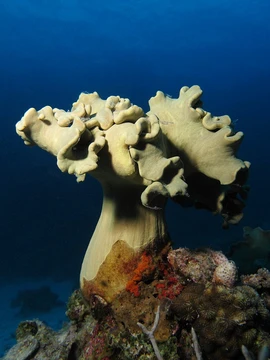
Xenia (coral)
A soft coral that pulses its many-fingered hands to move water.

Xenia is a genus of photosynthetic soft marine coral in the family Xeniidae. It is notable for its unique ability to use its many-fingered 'hands' to pulse or push water away from the colony in a constant, grabbing motion, a behavior that distinguishes it from other corals. Common names include fast-pulse Xenia, and species are sometimes referred to as pulse corals.
Quick Facts
- Taxon
- Xenia
Facts from the source article.
Lore & Background
Xenia corals resemble a mushroom, with 'arms' extending from the top that end in many-fingered 'hands'. This morphology is central to their most distinctive behavior: they pulse or push water away from the colony in a constant, grabbing motion. The genus is photosynthetic, relying on symbiotic algae for energy. The World Register of Marine Species lists 63 species, including Xenia pulsitans, Xenia umbellata, and Xenia viridis, among many others described by authors such as Roxas, Kükenthal, Schenk, and Verseveldt.
Reader's Guide
Xenia's significance lies in its unique pulsing behavior, which is rare among corals and makes it a subject of interest in marine biology. The genus is entirely photosynthetic, meaning it depends on light for energy, and its constant water-moving action may aid in nutrient exchange or waste removal. The extensive species list—63 accepted names—reflects a long history of taxonomic work, with contributions from researchers like Saville Kent, Ehrenberg, and Dana. Despite the many species, the genus is unified by its distinctive morphology and pulsing motion, which has earned it common names like fast-pulse Xenia and pulse corals. Its legacy is as a well-known soft coral in both scientific literature and aquarium husbandry, though the source article does not discuss the latter.
Did You Know?
- Xenia is unique among corals for its ability to use its 'hands' to pulse water away from the colony.
- The genus includes 63 listed species, such as Xenia pulsitans and Xenia umbellata.
- Xenia is photosynthetic, meaning it derives energy from light.
- Common names for Xenia include fast-pulse Xenia and pulse corals.
More in Soft Corals and Leathers 1-24
Spotted an error? Know more?
Reader corrections go straight into our review queue. Suggest an edit · How this site is sourced