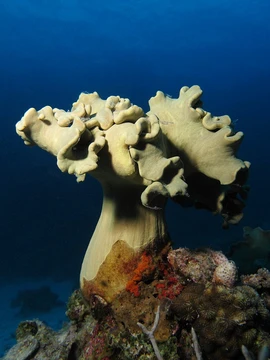
Holaxonia
Former octocorallian suborder now absorbed into Malacalcyonacea.

Holaxonia is a former suborder of Octocorallia, historically placed within the order Gorgonacea (commonly known as gorgonians or sea fans) or alternatively within the broadly conceived order Alcyonacea. Before revisions in 1981 and 1999, Holaxonia usually also included the taxon Calcaxonia, sometimes referred to as restricted Holaxonia. Since a 2022 revision of the Octocorallia, the content of the former Holaxonia has been included in the new order Malacalcyonacea, within which it does not form a monophyletic group and has no name. Two Holaxonian genera, Dendrobrachia and Ideogorgia, are exceptions, having been placed in the order Scleralcyonacea instead.
Quick Facts
- Taxon
- Holaxonia
Facts from the source article.
Lore & Background
Holaxonia was a suborder of Octocorallia, historically classified under the order Gorgonacea (gorgonians or sea fans) or the broadly conceived order Alcyonacea. Before revisions in 1981 and 1999, it usually also included the taxon Calcaxonia, sometimes called restricted Holaxonia. A 2022 revision of the Octocorallia dissolved Holaxonia, placing most of its former members into the new order Malacalcyonacea, where they do not form a monophyletic group and have no formal name. Two genera, Dendrobrachia and Ideogorgia, were instead moved to the order Scleralcyonacea.
Members of Holaxonia are soft corals that are colonial, sessile, and generally tree-like in structure. They lack a hard calcium carbonate skeleton but possess a firm, pliable central axial skeleton made of the fibrous protein gorgonin embedded in a tissue matrix called the coenenchyme. In some genera, this matrix is permeated with a calcareous substance from fused spicules. Holaxonia are characterized by an unspiculated axis and often a soft, chambered central core. Their polyps have eight-fold symmetry, and many species, especially in the families Gorgoniidae and Plexauridae, contain symbiotic photosynthetic algae called zooxanthellae. These soft corals are popular in salt water aquaria.
Reader's Guide
Holaxonia is notable as a former taxonomic grouping that has been superseded by modern revisions. Its historical inclusion of Calcaxonia and its later dissolution in the 2022 revision of Octocorallia highlight the evolving understanding of coral phylogeny. Most of its former members now reside in the order Malacalcyonacea, though they do not form a monophyletic clade and lack a formal name. Two genera, Dendrobrachia and Ideogorgia, were placed in the separate order Scleralcyonacea, underscoring the complexity of octocorallian relationships. The group's vernacular names—sea fan, sea whip, sea rod, and sea blade—reflect the diverse growth forms of its members. Biologically, Holaxonia are characterized by a gorgonin-based axial skeleton, an unspiculated axis, and a soft chambered core, with many species hosting zooxanthellae. Their popularity in salt water aquaria stems from these structural and symbiotic traits. The 2018 listing of families and genera by the World Register of Marine Species provides a snapshot of the group before its taxonomic reclassification.
Did You Know?
- Holaxonia was a former suborder of Octocorallia, placed in the order Gorgonacea or Alcyonacea.
- Before 1981/1999, Holaxonia usually included the taxon Calcaxonia.
- Since a 2022 revision, most Holaxonia content is in the order Malacalcyonacea, where it has no name.
- Two Holaxonian genera, Dendrobrachia and Ideogorgia, were moved to the order Scleralcyonacea.
Taxonomic Identity & the 2022 Reclassification
Holaxonia occupies a shifting position in coral taxonomy, a history that mirrors broader revisions across Octocorallia. Originally treated as a suborder within Alcyonacea, it was grouped alongside Scleraxonia and Calcaxonia under the older order Gorgonacea (commonly called sea fans and sea whips) in every system before 1981. The boundaries of Alcyonacea itself were never stable: some frameworks equated it with just the suborder Alcyoniina, while broader interpretations swept in Stolonifera, Telestacea, and Protoalcyonaria before adding the gorgonian suborders. A landmark 2022 revision of Octocorallia dismantled this structure entirely, redistributing the former Alcyonacea contents into two new orders—Malacalcyonacea and Scleralcyonacea. Holaxonia now sits within Malacalcyonacea, which also absorbs Alcyoniina, Protoalcyonaria, Scleraxonia, and Stolonifera. The reclassification highlights how much our understanding of these colonial cnidarians has evolved, rendering earlier taxonomic treatments historically informative but no longer current.
Skeletal Architecture & the Gorgonin Framework
The defining structural trait of Holaxonia is its reliance on gorgonin, a flexible, horny proteinaceous substance that forms the colony's skeleton. This sets it apart from the closely related suborder Scleraxonia, whose species are supported by tightly grouped calcareous spicules, and from stony corals (Scleractinia) whose mineralized frameworks are fundamentally different in composition. The gorgonin-based skeleton permits a striking range of colony morphologies: erect and fan-shaped, whiplike, bushy, or even encrusting. A single colony can stretch several feet in height and spread while remaining only a few inches thick. Beyond structural function, gorgonin serves as a natural environmental archive. Measurements of gorgonin and calcite within long-lived gorgonian species correlate strongly with seasonal and climatic variation, making these skeletons valuable tools in paleoclimatology and paleoceanography. The inherent flexibility of the gorgonin framework also shapes habitat preference, with more pliable, fan-shaped forms favoring shallow, current-swept waters.
Ecological Role & Feeding Strategies
Each Holaxonia polyp bears eight tentacles that capture plankton and particulate matter in a process called filter feeding, a strategy optimized when the colony's fan is oriented across the prevailing current to maximize water flow. Many species also host symbiotic zooxanthellae, photosynthetic algae that supplement the colony's energy budget and often impart a brownish coloration to the polyps. This dual nutrition strategy allows these corals to thrive in nutrient-rich waters with less intense light, a contrast with stony corals that demand brighter conditions. As integral members of reef ecosystems, Holaxonia colonies shelter a diverse community of organisms, including fish, snails, algae, hydrozoans, bryozoa, and brittle stars; the pygmy seahorse has even evolved to live among specific gorgonian species. Roughly 500 gorgonian species populate the world's oceans, with particular abundance in the shallow waters of the Western Atlantic around Florida, Bermuda, and the West Indies. Their range extends from tropical and subtropical reefs to polar waters and depths of several thousand feet, with morphology shifting predictably along gradients of depth and current strength.
Human Interaction & Conservation Implications
The reef aquarium hobby has created a meaningful intersection between human activity and Holaxonia. Because soft corals grow rapidly in captivity and can be easily divided into new individuals, aquaculture-produced specimens tend to be hardier and less expensive than wild-caught imports. Small cuttings are also less prone to shipping damage and infection compared to stony corals, making them a popular choice for hobbyists. The source material notes that home-grown specimens are generally more adaptable to aquarium conditions and help conserve wild reef populations—a point carrying real weight given the pressure on shallow-water gorgonian beds in the Western Atlantic. In the wild, these colonies face predation, though their sclerites—minute, spiny skeletal elements embedded in the coenenchymal tissue—provide a grainy, spiky texture that deters many predators. Recent research has also overturned the long-held assumption that soft corals cannot contribute to reef construction: the leather-coral genus Sinularia, for example, cements sclerites at its base into alcyonarian spiculite, effectively building new reef substrate.
Frequently Asked Questions
What is Holaxonia?
Holaxonia was a suborder within the octocorallian soft corals and leathers, historically grouped under either Gorgonacea (sea fans) or the broader Alcyonacea. It no longer exists as a formal taxon after a 2022 reorganization of the Octocorallia.
Where was Holaxonia placed before the 2022 revision?
Depending on the classification system, Holaxonia was nested inside the order Gorgonacea or treated as part of the more broadly defined Alcyonacea. Both placements reflected the familiar 'sea fan' or 'soft coral' grouping well known to reef hobbyists.
What happened to Holaxonia in the 2022 revision?
The 2022 overhaul of Octocorallia dissolved Holaxonia as a named group and folded most of its former members into the newly erected order Malacalcyonacea. Within that order, the old Holaxonian lineages do not form a single clade and therefore carry no collective name.
Did Holaxonia used to include Calcaxonia?
Yes—prior to the 1981 and 1999 revisions, Holaxonia typically encompassed the taxon Calcaxonia, a grouping sometimes called 'restricted Holaxonia.' After those earlier revisions, Calcaxonia was separated out and no longer counted as part of Holaxonia.
Are Dendrobrachia and Ideogorgia still considered Holaxonian?
No. These two genera were pulled out of the Holaxonian lineage and reassigned to Scleralcyona during the 2022 revision. They are now treated as exceptions to the broader Malacalcyonacea grouping that absorbed the rest of former Holaxonia.
More in Soft Corals and Leathers 1-24
Spotted an error? Know more?
Reader corrections go straight into our review queue. Suggest an edit · How this site is sourced