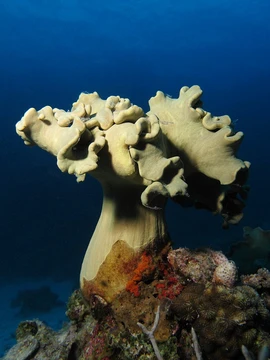
Gorgonian
Soft corals with feather-like tentacles and no stony skeleton.

Gorgonians are a group of octocorals commonly known as sea fans and sea whips. They are colonial animals with eight-fold symmetry, lacking a stony skeleton, and are included within the order Scleralcyonacea (formerly part of the deprecated name Gorgonacea). Their internal skeleton is secreted by the mesoglea, and they are notable for their feather-like tentacles and high phenotypic plasticity.
Quick Facts
- Taxon
- Octocorallia
Facts from the source article.
Lore & Background
Gorgonians, like all octocorals, have existed at least since the Ordovician period, as shown by Maurits Lindström's findings in the 1970s. A 2023 work suggested that the Cambrian fossil Pywackia may represent a Cambrian octocoral, and molecular techniques have pointed to a Precambrian origin for Octocorallia, with a 2021 study placing the origin in the Ediacaran (578 Mya). The name Gorgonacea was historically used but was deprecated around 2022, and these animals are now placed in the order Scleralcyonacea.
Each polyp has eight tentacles, each feather-like with numerous side branches (pinnules). The polyps are embedded in a soft matrix of mesogleal tissue, perforated by channels that interconnect their gastrovascular cavities. The skeletal material, called coenenchyme, is composed of living tissue secreted by wandering amoebocytes and is often reinforced with calcareous or horny material. Gorgonians exhibit high phenotypic plasticity, adapting to dynamic environments with fluctuating temperature and pH, and have shown high recruitment rates after die-off events caused by El Niño events.
Reader's Guide
Gorgonians are significant as a major component of the octocoral group, which comprises over 3,000 species of marine and brackish colonial animals. They are distinguished from stony corals by their eight-fold symmetry and lack of a stony skeleton. Their internal skeleton, secreted by the mesoglea, and their feather-like tentacles are key characteristics. The group includes sea fans and sea whips, which are common in marine environments. Bioluminescence is found in 32 genera of octocorals, a trait estimated to have evolved 540 million years ago, marking the earliest timing of bioluminescence in the marine environment. The phylogenetic relationships within Octocorallia are not well known, though the group is considered monophyletic. Gorgonians' ability to recover after El Niño events highlights their ecological resilience. Their fossil record extends back to the Ordovician, with possible Cambrian and even Ediacaran origins suggested by recent studies.
Did You Know?
- Gorgonians were formerly classified under the now-deprecated name Gorgonacea, deprecated around 2022.
- Each gorgonian polyp has eight feather-like tentacles with numerous side branches called pinnules.
- Bioluminescence in octocorals, including gorgonians, is estimated to have evolved 540 million years ago.
Taxonomic History and the 2022 Restructuring
Alcyonacea, also known by the synonyms Alcyonaria and Alcyonarida, long occupied a central place in the classification of Octocorallia. For decades, taxonomists debated how broadly to draw the boundaries of this group. In the narrowest interpretation, it encompassed only what other systems called the suborder Alcyoniina. A middle-ground view added Stolonifera, Telestacea, and Protoalcyonaria—taxa that some authors had elevated to independent orders. The broadest definition swept in Scleraxonia, Holaxonia, and Calcaxonia, which before 1981 had been grouped together as the separate order Gorgonacea (or Gorgonaria), the source of the familiar names sea fans and sea whips. All of this changed with a 2022 revision of Octocorallia. The entire former content of Alcyonacea was redistributed into two new orders: Malacalcyonacea, which absorbed the bulk of the group, and Scleralcyonacea, which received a smaller portion. Together, these two orders now constitute Octocorallia, rendering the old Alcyonacea a historical rather than an active taxonomic category.
Skeletal Architecture and Colony Form
The physical structure of these colonial cnidarians varies dramatically depending on the suborder involved. Members of Holaxonia build their internal framework from gorgonin, a flexible, horny protein that is unique to this group and sets their skeletons apart from the calcium-carbonate structures of stony corals. In Scleraxonia, support comes instead from tightly packed calcareous spicules. Across the broader group, colonies take on an astonishing range of shapes: erect and branching like a fan, whiplike and sinuous, bushy and dense, or even flat and encrusting along hard substrates. A single colony might stretch several feet in height and spread yet remain only a few inches thick. Many display vivid coloration in shades of purple, red, or yellow. Embedded within the fleshy coenenchymal tissue are tiny spiny structures called sclerites, which lend the polyps a grainy, spiky texture that discourages predators while providing structural reinforcement. These minute skeletal elements also serve as critical diagnostic characters for identifying species within the group.
Feeding Strategies and Habitat Niche
Each individual polyp in a gorgonian colony extends eight tentacles to capture plankton and suspended particulate matter from the surrounding water. This filter-feeding strategy is most effective when the colony's fan is oriented perpendicular to the prevailing current, maximizing the volume of water and therefore food swept across the polyps. Many species also harbor symbiotic photosynthetic algae called zooxanthellae within their tissues, which supplement their diet through photosynthesis; colonies bearing these algae typically display a brownish hue. Beyond passive filtration, most soft corals actively consume free-floating zooplankton drifting through the water column. They thrive in nutrient-rich environments where light intensity is moderate rather than extreme. Distribution spans the full depth range of the oceans, from shallow tropical and subtropical waters to polar regions and depths of several thousand feet. Fan-shaped, flexible forms dominate shallow, high-current zones, while taller, stiffer, thinner colonies favor deeper, calmer settings. Roughly five hundred species are recognized worldwide, with particularly dense populations in the Western Atlantic around Florida, Bermuda, and the West Indies.
Scientific Value and the Aquarium Trade
Gorgonians and their relatives carry significance well beyond their ecological roles. Because the gorgonin and calcite deposited in the skeletons of long-lived species record seasonal and climatic fluctuations in their growth rate and chemical composition, researchers use these structures as natural archives for paleoclimatology and paleoceanography. In reef ecology, recent findings have overturned the assumption that soft corals cannot contribute to reef construction: colonies of the leather-coral genus Sinularia have been shown to cement their sclerites at the base, consolidating them into a structure called alcyonarian spiculite, effectively making them reef builders. In the hobbyist world, soft corals are prized for reef aquariums because small cuttings survive shipping better than stony corals and are less prone to infection. They grow rapidly in captivity and can be easily divided into new individuals, making aquaculture-grown specimens both more adaptable and less expensive than wild-caught imports. This practice also reduces pressure on wild populations. Photosynthetic gorgonians in particular can be maintained successfully in home aquaria, offering hobbyists a living window into reef ecology.
Frequently Asked Questions
What is a Gorgonian?
Gorgonians are colonial soft corals in the class Octocorallia, best known to reef hobbyists as sea fans and sea whips. They are defined by eight-fold symmetry, a lack of a stony skeleton, and an internal framework secreted by the mesoglea layer.
How do Gorgonians differ from hard (stony) corals?
Where stony corals deposit a calcium carbonate skeleton, Gorgonians rely on a flexible internal structure produced by their mesoglea. Each polyp also bears eight feather-like tentacles rather than the six found on scleractinians, a hallmark of the Octocorallia class.
How old is the Gorgonian lineage?
The earliest fossil evidence pointing to Gorgonians was identified by Maurits Lindström in the 1970s and dates to the Ordovician period. Bioluminescence within the group is estimated to have appeared roughly 540 million years ago.
Which taxonomic orders do Gorgonians fall under?
Gorgonians span two recognized orders within Octocorallia: Malacalcyonacea and Scleralcyonacea. The older, now-deprecated grouping called Gorgonacea once combined these before modern taxonomic revisions split them apart.
Why do Gorgonians grow in so many different shapes?
Gorgonians exhibit high phenotypic plasticity, so a single species can form fan, whip, or branching colonies depending on local current and light conditions. This shape-shifting is exactly why common names like sea fan, sea whip, and blue coral all point to Gorgonian groups.
More in Soft Corals and Leathers 1-24
Spotted an error? Know more?
Reader corrections go straight into our review queue. Suggest an edit · How this site is sourced