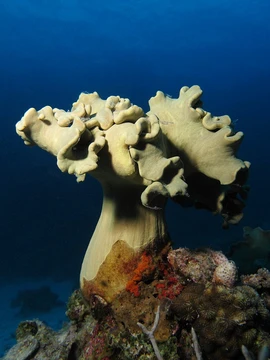
Scleraxonia
A suborder of corals with calcified spicule or fibre axes.

Scleraxonia is a suborder of corals belonging to the phylum Cnidaria. The skeletal axis of these corals is built from calcified spicules, organic fibers, or a combination of both; these components can be separate, linked, or fused together. The suborder contains nine recognized families and more than thirty genera. Among these, four families—Anthothelidae, Briareidae, Coralliidae, and Subergorgiidae—include some deep-water species, while two families, Paragorgiidae and Parisididae, are found exclusively in deep water. The families and genera within Scleraxonia are: Anthothelidae (including Alertigorgia, Anthothela, Briareopsis, Erythropodium, Iciligorgia, Lateothela, Solenocaulon, Stereogorgia, Tubigorgia, and Williamsium), Briareidae (Briareum, Lignopsis, and Pseudosuberia), Coralliidae (Corallium, Hemicorallium, and Paracorallium), Melithaeidae (Asperaxis and Melithaea), Paragorgiidae (Paragorgia and Sibogagorgia), Parisididae (Parisis), Spongiodermidae (Callipodium, Diodogorgia, Homophyton, Sclerophyton, Titanideum, and Tripalea), Subergorgiidae (Annella, Rosgorgia, and Subergorgia), and Victorgorgiidae (Victorgorgia).
Quick Facts
- Taxon
- Scleraxonia
Facts from the source article.
Lore & Background
Members of Scleraxonia are characterized by a skeletal axis made of calcified spicules, organic fibres, or a combination of both. These components may be separate, linked, or fused together. The suborder contains nine recognized families and over thirty genera. Among these, four families—Anthothelidae, Briareidae, Coralliidae, and Subergorgiidae—include some deep-water species, while two families—Paragorgiidae and Parisididae—are exclusively deep water. The article lists numerous genera within each family, such as Alertigorgia, Briareum, Corallium, Melithaea, Paragorgia, Parisis, and Victorgorgia, among others.
Reader's Guide
Scleraxonia is a suborder of corals within the phylum Cnidaria, distinguished by its skeletal axis composition of calcified spicules, organic fibres, or both, which may be separate, linked, or fused. The suborder encompasses nine recognized families and over thirty genera, indicating a moderate diversity within this group. Notably, four families—Anthothelidae, Briareidae, Coralliidae, and Subergorgiidae—contain some deep-water species, while two families—Paragorgiidae and Parisididae—are exclusively deep water, highlighting the ecological range from shallow to deep environments. The listing of genera such as Corallium, Melithaea, and Paragorgia suggests these corals are of interest for their structural and biological characteristics. The article does not provide further details on their significance or legacy beyond these taxonomic and distributional facts.
Did You Know?
- Scleraxonia is a suborder of corals in the phylum Cnidaria.
- Its skeletal axis may be made of calcified spicules, organic fibres, or both.
- Four families in Scleraxonia contain some deep-water species.
Taxonomic Identity and the 2022 Reclassification
Scleraxonia occupies a complex position in the classification of octocorallian corals. Historically, it was recognized as a suborder nested within the broader grouping Alcyonacea, which itself was treated as an order or suborder under Octocorallia. In the broadest taxonomic schemes, Alcyonacea encompassed not just the soft-coral suborder Alcyoniina but also Stolonifera, Telestacea, Protoalcyonaria, and the three suborders Scleraxonia, Holaxonia, and Calcaxonia—the latter three having previously been classified together as the separate order Gorgonacea, also known as Gorgonaria or Gorgonaria. The 2022 revision of Octocorallia fundamentally reorganized this arrangement: the former content of Alcyonacea was redistributed primarily into the new order Malacalcyonacea, with a smaller portion absorbed into Scleralcyonacea. These two orders now collectively constitute Octocorallia. Scleraxonia is explicitly listed among the taxonomic synonyms of Malacalcyonacea, confirming its absorption into that new framework and rendering the older Alcyonacea grouping a historical artifact of pre-2022 systematics.
Skeletal Architecture and Structural Distinction
What sets Scleraxonia apart from its close relatives is its skeletal composition. While the suborder Holaxonia builds its framework from a flexible, horny protein called gorgonin, Scleraxonia species are supported by a skeleton composed of tightly grouped calcareous spicules. This mineral-based architecture gives the colonies a fundamentally different structural character from the more pliable gorgonin-based forms found in Holaxonia. Across the broader soft-coral group, minute spiny skeletal elements known as sclerites serve dual purposes: they provide internal support and impart a spiky, grainy texture to the flesh that deters predators. In Scleraxonia, these calcareous spicules are densely packed to form the primary structural axis of the colony. Some species within the group also exhibit an encrusting growth habit, spreading over substrates rather than forming the erect, fan-like, or whiplike shapes seen in other octocorallians. Colony morphology can range from flattened and branching to bushy or encrusting, with individual colonies reaching several feet in height and spread while remaining only a few inches in thickness.
Feeding Ecology and Environmental Niche
Scleraxonia polyps, like those of related gorgonian groups, possess eight tentacles used to capture plankton and particulate matter from the water column in a process known as filter feeding. Colonies maximize this intake by orienting their fan-shaped or branching structure across prevailing currents, ensuring continuous water flow past the polyps. Many species also host symbiotic photosynthetic algae called zooxanthellae, which supplement nutritional needs through photosynthesis; colonies bearing these algae tend to display brownish polyp coloration. Despite this photosynthetic partnership, most soft corals readily consume free-floating zooplankton and thrive in nutrient-rich waters with less intense light than stony corals require. Scleraxonia and related gorgonians are found primarily in shallow tropical and subtropical waters, though some occur at depths of several thousand feet. In shallower, high-current environments, colonies tend to be more fan-shaped and flexible, while deeper, calmer habitats favor taller, thinner, and stiffer forms. The branching architecture of these colonies also shelters a diverse community of hydrozoans, bryozoans, brittle stars, and even pygmy seahorses.
Scientific Utility and Aquarium Relevance
The calcareous and proteinaceous skeletal materials found in long-lived gorgonian species, including those within Scleraxonia, have proven valuable to paleoclimatology and paleoceanography. Because skeletal growth rate and chemical composition are highly correlated with seasonal and climatic variation, measurements of gorgonin and calcite within these structures serve as natural archives of past ocean conditions. Beyond their scientific value, soft corals of this type play a significant role in reef ecosystems, providing habitat for fish, snails, algae, and numerous other marine organisms. Recent findings have also challenged the long-held assumption that soft corals cannot contribute to reef construction: colonies of the leather-coral genus Sinularia can cement sclerites at their base into a consolidated substrate called alcyonarian spiculite, effectively acting as reef builders. In the aquarium hobby, soft corals are popular because small cuttings survive shipping better than stony corals, grow quickly in captivity, and can be easily divided into new individuals, making aquaculture-grown specimens both hardier and more affordable than wild-collected material.
Frequently Asked Questions
What is Scleraxonia?
Scleraxonia is a suborder within the phylum Cnidaria that groups together soft corals and leathers whose internal structural framework is built from calcified spicules, organic fibers, or a mix of the two. Those structural elements may exist as separate pieces, be connected to one another, or be fully fused into a single axis.
How many families and genera does Scleraxonia include?
The suborder is currently divided into nine recognized families, which together encompass more than thirty distinct genera.
Which Scleraxonia families contain deep-water species?
Four families—Anthothelidae, Briareidae, Coralliidae, and Subergorgiidae—have at least some members that inhabit deep-water environments.
Are there Scleraxonia families found only in deep water?
Yes. Paragorgiidae and Parisididae are the two families within the suborder whose members are restricted exclusively to deep-water habitats.
What distinguishes Scleraxonia's skeletal structure from other coral groups?
Rather than relying on a solid calcium carbonate skeleton like stony corals, Scleraxonia members build their internal axis from calcified spicules, organic fibers, or a combination of both, with those components sometimes separate, sometimes linked, and sometimes fully fused together.
More in Soft Corals and Leathers 1-24
Spotted an error? Know more?
Reader corrections go straight into our review queue. Suggest an edit · How this site is sourced