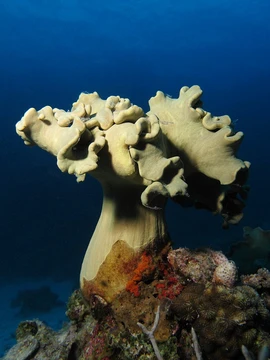
Alcyonium digitatum
A temperate soft coral forming finger-like colonies.

Alcyonium digitatum, also called dead man's fingers, is a soft coral belonging to the family Alcyoniidae. Its range includes the northern Atlantic Ocean and other temperate regions like the South Pacific. The coral forms colonies that look like clumps of fleshy, finger-shaped lobes in shades of yellow, white, or cream. A crust of many sclerites covers the surface layer. When the polyps feed, they extend their white, translucent bodies from the leathery surface, making the colony appear furry.
Along the Atlantic coasts of northwestern Europe, dead man's fingers can be found from Portugal up to Norway. A 2020 seafloor mapping project led by explorer Klaus Thymann recently discovered it in the previously uncharted waters of Jammerbugt Bay off northwestern Denmark. The species also lives in parts of Canada, the northeastern United States, the Gulf of Maine, the Bay of Fundy, and the northern waters of New Zealand. Colonies attach to bedrock, boulders, stones, and sometimes the shells of crabs or gastropods. They thrive where water movement is strong and sunlight is too weak for algae to dominate, usually in the sublittoral zone down to about fifty metres. Around Britain and Ireland, this coral is common, while the similar but much rarer species *Alcyonium glomeratum* and *Alcyonium hibernicum* are unlikely to be confused with it.
Most colonies of dead man's fingers are either entirely male or female, though a few hermaphrodite colonies exist. Growth happens mainly in the first half of the year; by late summer, the polyps become inactive, and algae and hydroids growing on the surface turn the base tissue reddish or brownish. During this time, gonads develop, and spawning occurs in December and January. Populations coordinate their gametogenesis and spawning. Fertilization is external, and the embryos float for a few days before becoming free-swimming larvae. Most larvae soon settle on a suitable surface and grow into new polyps, but some remain in the zooplankton longer, dispersing over wide areas. Colonies can live up to twenty years. Polyps extend their tentacles to feed at various times of day, using cilia to gather plankton from the water and absorbing oxygen simultaneously.
Quick Facts
- Taxon
- Alcyonium digitatum
Facts from the source article.
Lore & Background
Dead man's fingers is a colonial coral whose individual polyps are white and translucent, projecting from the leathery surface when feeding and giving the colony a furry appearance. The colonies are nearly always either male or female, although a small number of hermaphrodite colonies are found. Colony growth occurs mainly in the first half of the year, with the polyps becoming inactive in late summer and the base tissue turning reddish or brownish due to the growth of algae and hydroids on the surface. At this time the gonads are developing, and spawning occurs in December and January; populations have been found to synchronize their gametogenesis and spawning activities. Fertilisation takes place externally, and the embryos float for a few days before developing into free-swimming larvae. Most soon settle on a suitable substrate, but a few may remain in the zooplankton for some time and disperse over a wide area. Colonies have been known to live for twenty years.
Reader's Guide
Alcyonium digitatum is common around the coasts of Britain and Ireland, where two related species—Alcyonium glomeratum and Alcyonium hibernicum—are also found but are much rarer, making misidentification unlikely. The polyps live in colonies attached to bedrock, boulders, stones, and occasionally the shells of crabs and gastropods. They are most plentiful in areas with strong water movement and where there is insufficient sunlight for algae to predominate. The species was most recently discovered in the uncharted waters of Jammerbugt bay off the north-west coast of Denmark by a 2020 seafloor mapping project led by explorer Klaus Thymann. The polyps feed at various times of the day with their tentacles extended, acting as suspension feeders that gather plankton from the water with the help of cilia and absorb oxygen at the same time. Its presence across both the northern Atlantic and temperate waters such as the South Pacific highlights its adaptability, while its long-lived colonies and synchronized spawning contribute to its ecological role in sublittoral zones.
Did You Know?
- Dead man's fingers colonies are nearly always either male or female, though a small number of hermaphrodite colonies are found.
- The species was discovered in the uncharted waters of Jammerbugt bay off Denmark by a 2020 seafloor mapping project led by Klaus Thymann.
- The polyps become inactive in late summer, and the base tissue turns reddish or brownish due to algae and hydroid growth.
Frequently Asked Questions
What is Alcyonium digitatum?
Alcyonium digitatum is a temperate soft coral in the family Alcyoniidae, most often recognized by its common name, dead man's fingers. It builds colonies of soft, fleshy lobes that resemble a cluster of thick fingers.
What does dead man's fingers coral look like when it's feeding?
The colony's surface is a leathery crust in shades of yellow, white, or cream, covered with tiny sclerites. When the polyps extend their white, translucent bodies to feed, the whole colony takes on a distinctly furry appearance.
Where can I find Alcyonium digitatum in the wild?
It inhabits the sublittoral zone down to roughly fifty metres along the Atlantic coasts of northwestern Europe from Portugal to Norway, parts of Canada, the northeastern U.S. coast, the Gulf of Maine, the Bay of Fundy, and the northern waters of New Zealand.
When does Alcyonium digitatum reproduce?
Spawning takes place during the winter months of December and January.
How long does a dead man's fingers colony live?
A single colony can persist for up to twenty years before it dies off.
More in Soft Corals and Leathers 1-24
Spotted an error? Know more?
Reader corrections go straight into our review queue. Suggest an edit · How this site is sourced