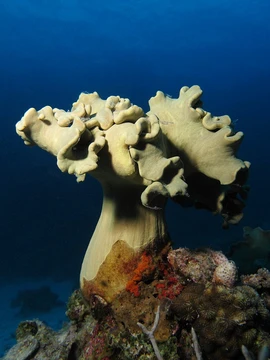
Alcyoniidae
Leathery or soft corals with two polyp types.

Alcyoniidae is a family of leathery or soft corals in the phylum Cnidaria. A colony of leathery coral is stiff, hard and inflexible, composed of tiny polyps projecting from a shared leathery tissue. Members of the family may have two kinds of polyps: autozooids with long trunks and eight tiny branched tentacles, and siphonozooids that remain below the surface to pump water for the colony.
Quick Facts
- Taxon
- Alcyoniidae
Facts from the source article.
Lore & Background
Leathery corals occur globally in temperate and tropical seas. They are often pioneer reef species and are found in wave-exposed areas of reef crests, less turbid waters in lagoons, on steep slopes, under overhangs and at depths of thirty metres or even deeper. The autozooids only emerge when the colony is fully submerged. Different genera have different proportions of the two kinds of polyps.
Leathery coral polyps include endosymbiotic algae called zooxanthellae. The algae undergo photosynthesis and produce sugars from sunlight, which is shared with the host; the host provides the algae with minerals and shelter. Periodically, the surface layer of the leathery tissue is shed, which seems to be a mechanism for ridding the colony of unwanted algal growth. In a study on the Great Barrier Reef, the population of these corals was very stable, with little predation, low rates of growth, reproduction and mortality, and few new colonies appearing or disappearing over a three-year period.
Reader's Guide
The family Alcyoniidae is notable for its leathery, stiff colonies that are composed of tiny polyps embedded in a shared leathery tissue. Its two distinct polyp types—autozooids and siphonozooids—allow the colony to feed and circulate water. The autozooids, which bear eight tiny branched tentacles, emerge only when submerged, while siphonozooids remain below the surface to pump water. This structural specialization is a key characteristic of the family. Leathery corals are globally distributed in temperate and tropical seas, often acting as pioneer species on reef crests, lagoons, slopes, and overhangs down to depths of thirty meters or more. Their biology is shaped by a symbiotic relationship with zooxanthellae, which provide sugars via photosynthesis in exchange for minerals and shelter. The periodic shedding of the surface layer helps control unwanted algal growth. A study on the Great Barrier Reef found that Alcyoniidae populations are very stable, with low predation, growth, reproduction, and mortality rates, and minimal turnover of colonies over three years. The family includes nine recognized genera, such as Alcyonium, Anthothela, and Bellonella.
Did You Know?
- Members of Alcyoniidae may have two kinds of polyps: autozooids and siphonozooids.
- Leathery corals periodically shed the surface layer of their tissue to remove unwanted algal growth.
- A study on the Great Barrier Reef found that Alcyoniidae populations were very stable over a three-year period.
Taxonomy, Morphology, and Habitat
Sarcophyton glaucum, commonly called toadstool leather coral or rough leather coral, occupies a well-defined position within the animal kingdom. It sits in the phylum Cnidaria, the class Anthozoa, and the family Alcyoniidae, which contains seven recognized genera. Within that family, Sarcophyton stands out as one of the most widespread members, with S. glaucum itself ranging from the Red Sea all the way to the western Pacific. Unlike stony corals, this species lacks a rigid calcium carbonate skeleton; instead, it is a soft, sessile organism whose identity is confirmed by the tiny calcareous sclerites embedded in its tissue. Each polyp bears exactly eight tentacles, and colonies are strictly monospecific, meaning a single colony contains only one species. Individuals can reach roughly 80 centimeters in length and typically anchor themselves on reef flats, in sheltered lagoons, or along seaward slopes spanning intertidal and subtidal zones. The Red Sea holds particular significance here, as it is the native range for roughly forty percent of the 180 known soft coral species worldwide, and S. glaucum ranks among the most prevalent members of Alcyoniidae in those waters.
Symbiotic Microbiome and Chemical Defenses
Far from being a solitary organism, Sarcophyton glaucum hosts a dense community of microorganisms that play a critical role in its survival. These symbiotic microbes serve as a biological shield, defending the coral against pathogenic invaders while potentially contributing essential nutrients to the host tissue. Research into the bacterial communities associated with this species has identified members of the phylum Firmicutes, Gamma proteobacteria, and Actinobacteria, each displaying measurable antimicrobial activity. This finding has led scientists to propose that soft corals of this type could serve as screening platforms for discovering new antibiotic-producing bacteria. Beyond the bacterial residents, the coral's own chemical arsenal includes cembrane terpenes that guard against a broad spectrum of threats: insect and pest damage, inflammatory responses, viral attack, and the accumulation of biofouling organisms. Together, these layered defenses—microbial, chemical, and structural—paint a picture of a remarkably well-protected organism thriving in competitive reef environments.
Pharmaceutical and Biochemical Promise
The pharmaceutical industry has taken a keen interest in Sarcophyton glaucum because of the remarkable bioactive compounds it produces. Most notably, this coral synthesizes sarcophytol A, a diterpenoid that has been recognized for its ability to inhibit tumor growth. Broader analyses of its cembranoid content have confirmed similar tumor-suppressing properties, while additional metabolite studies have revealed antimicrobial, antifungal, and neuroprotective effects. A study specifically examining bioactive cembranoids isolated from Red Sea specimens of S. glaucum concluded that several of the compounds warrant further investigation as potential candidates for cancer research and treatment. Chemical profiling across sixteen Sarcophyton species has uncovered a wide spectrum of biological activities, reinforcing the genus's value as a source of novel therapeutic leads. The antibacterial properties documented in the coral's associated bacteria further expand its relevance to drug discovery, suggesting that the entire biological system—coral tissue, resident microbes, and their shared chemistry—may hold untapped medicinal potential.
Aquaculture, Genetics, and Photobiology
Sarcophyton glaucum has become a prominent species in coral aquaculture, and researchers have made meaningful progress in understanding how to cultivate it outside its natural habitat. Genetic work by Costa and colleagues used mitochondrial protein sequence analyses to divide the species into six distinct clades, revealing hidden diversity within what was once considered a single taxon. In the realm of photobiology, a study examining leather coral fragments stocked under low light in a recirculated aquaculture system tested how varying Photosynthetically Active Radiation (PAR) levels influence growth and survival. The results were encouraging: S. glaucum was capable of growing and surviving even at low PAR intensities, and its photobiological performance was not impaired under those conditions. Interestingly, the concentration of coral endosymbionts actually increased when light levels were reduced. These findings carry practical implications, suggesting that low-light conditions can be deliberately employed in ex situ culturing programs, potentially lowering energy costs and making large-scale propagation of this species more feasible for reef restoration and commercial aquaculture.
Frequently Asked Questions
Who is Alcyoniidae?
Alcyoniidae is a family of soft, leathery corals in the phylum Cnidaria, built from countless tiny polyps embedded in a shared, stiff leathery tissue. The family is represented by nine recognized genera found in oceans worldwide.
What are Alcyoniidae's powers or role in the colony?
Each colony runs on two specialized polyp types: autozooids, which stretch out long trunks tipped with eight small branched tentacles to capture food, and siphonozooids, which stay tucked below the surface to pump water through the tissue. This split labor lets the coral feed and circulate nutrients at the same time.
Where does Alcyoniidae live?
Alcyoniidae colonies inhabit both temperate and tropical seas around the globe, typically at depths up to 30 metres or even deeper. They are not restricted to a single region, making them one of the more widely distributed soft-coral families.
What is Alcyoniidae's secret survival trick?
Many members of the family harbour zooxanthellae, endosymbiotic algae that live inside their tissues and supply extra energy through photosynthesis. Paired with the tentacle-feeding autozooids, this dual strategy keeps the colony well-fed whether light is abundant or scarce.
Why is Alcyoniidae important to the reef ecosystem?
With nine genera spread across a huge range of habitats, Alcyoniidae adds significant three-dimensional structure to soft-coral reefs. Their leathery colonies create nooks and surfaces that shelter a wide variety of smaller marine organisms, boosting local biodiversity.
More in Soft Corals and Leathers 1-24
Spotted an error? Know more?
Reader corrections go straight into our review queue. Suggest an edit · How this site is sourced