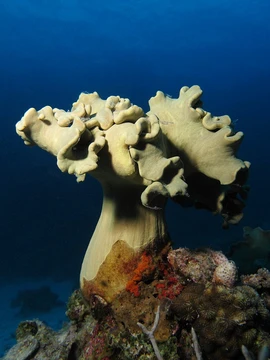
Alcyonacea
A former order of soft corals now reclassified into Malacalcyonacea and Scleralcyonacea.

Alcyonacea, also known as soft corals or alcyonacians, is a former order of Octocorallia that has been reclassified following a 2022 revision. In its broadest sense, the order includes not only the suborder Alcyoniina but also the taxa Stolonifera, Telestacea, Protoalcyonaria, Scleraxonia, Holaxonia, and Calcaxonia, the latter three formerly classified as the separate order Gorgonacea (gorgonians or sea fans). This grouping is now considered a historical, outdated taxonomic treatment, with its content largely placed into the new orders Malacalcyonacea and Scleralcyonacea.
Quick Facts
- Taxon
- Alcyonacea
Facts from the source article.
Lore & Background
Alcyonacea are sessile colonial cnidarians found throughout the world's oceans, especially in deep sea, polar waters, tropics, and subtropics. They are commonly known as soft corals, with their polyps embedded within a fleshy mass of coenenchymal tissue. The term 'gorgonian coral' applies to species that produce a mineralized skeletal axis composed of calcite and gorgonin. Colonies are normally erect, flattened, branching, and reminiscent of a fan, though some are whiplike, bushy, or encrusting. They may be brightly colored, often purple, red, or yellow.
The structure of a gorgonian colony varies: in the suborder Holaxonia, skeletons are formed from flexible gorgonin; in Scleraxonia, skeletons are supported by tightly grouped calcareous spicules. Soft corals contain minute, spiny skeletal elements called sclerites, which give support and deter predators. Unlike stony corals, most soft corals thrive in nutrient-rich waters with less intense light and use symbiotic photosynthetic zooxanthellae as a major energy source. They are integral members of the reef ecosystem, providing habitat for fish, snails, algae, and other marine species.
Reader's Guide
Alcyonacea, though now a historical taxonomic grouping, remains significant for understanding the diversity of octocorals. The order once encompassed all species known as gorgonian corals, which produce a hard skeleton made from gorgonin, a protein unique to the group. These corals are notable for their ecological roles: each gorgonian polyp has eight tentacles that catch plankton through filter feeding, and some contain zooxanthellae for photosynthesis. Gorgonians are found primarily in shallow waters, with fan-shaped flexible forms in strong currents and taller, stiffer forms in deeper calmer waters. They host diverse fauna, including hydrozoa, bryozoa, brittle stars, and pygmy seahorses such as Hippocampus bargibanti and Hippocampus denise. Gorgonians produce unusual organic compounds, particularly diterpenes, which are candidates for new drugs and may serve as chemical defenses against predators like flamingo tongue snails, nudibranchs, fireworms, and butterflyfishes. Measurements of gorgonin and calcite in long-lived species are useful in paleoclimatology and paleoceanography. In the reef aquarium hobby, soft corals are easily collected and propagated, with aquaculture specimens often hardier and less expensive than wild imports. The 2022 revision reclassified the content of Alcyonacea into the orders Malacalcyonacea and Scleralcyonacea, reflecting ongoing advances in octocoral taxonomy.
Did You Know?
- The order Alcyonacea was reclassified in 2022, with its content placed into the new orders Malacalcyonacea and Scleralcyonacea.
- About 500 different species of gorgonians are found worldwide, particularly abundant in the shallow waters of the Western Atlantic, including Florida, Bermuda, and the West Indies.
- Two species of pygmy seahorse, Hippocampus bargibanti and Hippocampus denise, are obligate residents on gorgonians.
Taxonomic Complexity and the 2022 Revision
Alcyonacea has long been one of the most taxonomically tangled groups within Octocorallia. Depending on the classification system in use, the order could refer to just the suborder Alcyoniina, expand to include Stolonifera, Telestacea, and Protoalcyonaria, or in its broadest interpretation encompass even the former order Gorgonacea, the gorgonians and sea fans. This ambiguity persisted for decades, with authors disagreeing on whether Scleraxonia, Holaxonia, and Calcaxonia belonged under Alcyonacea or remained as the separate Gorgonacea. The situation was finally resolved in a 2022 revision of Octocorallia, which dissolved Alcyonacea as a standalone order entirely. Its former members were redistributed into two new orders: Malacalcyonacea, which absorbed the bulk of the group, and Scleralcyonacea, which received a smaller portion. Today, these two orders together constitute the entirety of Octocorallia, rendering the old Alcyonacea name a historical artifact rather than an active taxonomic category.
Skeletal Architecture and the Gorgonin Revolution
The internal architecture of what were once broadly called Alcyonacea reveals a remarkable diversity of structural strategies. In the suborder Holaxonia, colonies are reinforced by a flexible, horny protein called gorgonin, a substance entirely unique to this group and fundamentally distinct from the calcium carbonate skeletons of stony corals. Scleraxonia species, by contrast, rely on tightly packed calcareous spicules for support, while other members encrust substrates much like hard corals. Across the group, tiny spiny elements called sclerites permeate the tissue, lending a grainy, spiky texture that deters predators and aids species identification. A particularly striking recent finding overturned a long-held assumption: colonies of the leather-coral genus Sinularia can actually cement sclerites together at their base, forming a consolidated structure known as alcyonarian spiculite. This discovery reclassified at least some soft corals as genuine reef builders, challenging the earlier belief that they could not lay lasting foundations for future coral growth.
Feeding Ecology and Symbiotic Partnerships
Each individual polyp within a gorgonian colony extends exactly eight tentacles into the surrounding water, capturing plankton and suspended particulate matter in a process known as filter feeding. To maximize this food supply, fan-shaped colonies orient their broad surfaces directly across prevailing currents, ensuring a steady stream of nutrient-laden water passes over their polyps. Beyond active predation, many gorgonians maintain a symbiotic relationship with photosynthetic algae called zooxanthellae, which reside within the tissue and supplement the colony's energy budget through photosynthesis; individuals hosting these algae typically display a brownish coloration. The ecological role of these corals extends far beyond their own metabolism. Their branching structures provide critical habitat for a wide array of organisms, including hydrozoans, bryozoans, brittle stars, fish, snails, and algae. The pygmy seahorse, for instance, has evolved to live entirely within specific gorgonian species, relying on their branches for both shelter and camouflage.
Scientific Utility and the Aquarium Trade
The long-lived skeletal growth of gorgonians has made them valuable tools in paleoclimatology and paleoceanography. Because the rate and chemical composition of gorgonin and calcite deposition are tightly correlated with seasonal and climatic shifts, researchers can read these skeletons like tree rings to reconstruct past ocean conditions. In the aquarium hobby, soft corals have become increasingly popular because small cuttings survive transport far better than stony corals, which are more vulnerable to infection and physical damage during shipping. This practical advantage, however, carries an ecological cost: wild populations in the shallow Western Atlantic, particularly around Florida, Bermuda, and the West Indies, where roughly 500 gorgonian species thrive, face pressure from collection. Aquaculture offers a meaningful alternative, as soft corals grow rapidly in captivity, divide easily into new individuals, and tend to be hardier and less expensive than wild imports. Home-grown specimens also reduce the need to harvest from living reefs, supporting both the hobby and conservation.
Frequently Asked Questions
Who is Alcyonacea?
Alcyonacea is a former taxonomic order within the class Octocorallia that grouped together soft corals, leathers, and the organisms once called gorgonians or sea fans. It bundled several suborders—Alcyoniina, Stolonifera, Telestacea, Protoalcyonaria, Scleraxonia, Holaxonia, and Calcaxonia—under a single name. Today the name is regarded as a historical label rather than a valid current classification.
What are Alcyonacea's powers/role?
Members of this group construct their frameworks from calcite reinforced with the protein gorgonin, giving them a flexible yet durable structure. They are most commonly found in shallow Western Atlantic waters around Florida, Bermuda, and the West Indies, though a few species have been documented at depths of several thousand feet.
Why is Alcyonacea important?
The grouping encompassed roughly 500 distinct gorgonian species distributed across the world's oceans, making it a major contributor to coral-reef biodiversity. Their calcite-and-gorgonin skeletons created complex three-dimensional habitat that supported a wide array of other marine organisms.
Who are Alcyonacea's closest family members?
In the 2018 treatment the order contained six suborders: Alcyoniina, Calcaxonia, Holaxonia, Protoalcyonaria, Scleraxonia, and Stolonifera (which included Telestacea). The last three had previously been recognized as the separate order Gorgonacea before being folded into this broader grouping.
More in Soft Corals and Leathers 1-24
Spotted an error? Know more?
Reader corrections go straight into our review queue. Suggest an edit · How this site is sourced