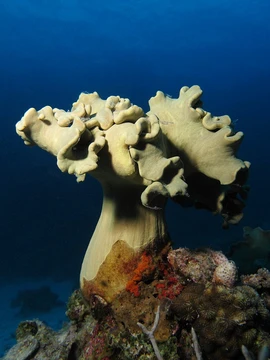
Calcaxonia
Former octocoral suborder, now largely placed in Scleralcyonacea.

Calcaxonia is a former suborder of octocorals, known informally as restricted Holaxonia from 1981 to 1999. It was classified under the order Gorgonacea or the broadly conceived order Alcyonacea, and was formally erected in 1999. In a 2022 revision of Octocorallia, most of its taxa were placed into the newly created order Scleralcyonacea, with the genus Isis moved to Malacalcyonacea.
- Informal name period
- 1981–1999
- Formal erection year
- 1999
- Former classification
- suborder of Gorgonacea or Alcyonacea
- 2022 revision order
- Scleralcyonacea (most taxa); Isis to Malacalcyonacea
- Notable excluded families
- Ellisellidae, Dendrobrachiidae, possibly Chelidonisididae
Lore & Background
Calcaxonia was known only under the informal name restricted Holaxonia from 1981 until its formal erection in 1999. Before that, it was usually included inside the suborder Holaxonia. Its composition included families such as Chrysogorgiidae, Primnoidae, Ellisellidae, and others, with several taxa reclassified over time—for example, Dendrobrachiidae was moved from Holaxonia to Calcaxonia before 2019, and Chelidonisididae was previously part of Isididae or incertae sedis before 2021. In 2022, a major revision of Octocorallia transferred almost all former Calcaxonia taxa into the new order Scleralcyonacea, forming one unnamed clade. However, Ellisellidae and Dendrobrachiidae (and possibly Chelidonisididae) were placed in other clades within Scleralcyonacea. The genus Isis was excluded entirely, placed in the order Malacalcyonacea. In 2019, G. C. Williams proposed that the name Calcaxonia be applied to the whole clade which, since 2022, has been known as Scleralcyonacea, i.e.
Reader's Guide
Calcaxonia's significance lies in its role as a transitional taxonomic concept in octocoral systematics. It was formally recognized only in 1999, after nearly two decades under an informal name, and its composition shifted repeatedly as families were reclassified—for instance, Dendrobrachiidae was moved from Holaxonia, and several families like Keratoisididae and Mopseidae were split from Isididae in 2021. The 2022 revision fundamentally reorganized these taxa into the new order Scleralcyonacea, with Calcaxonia itself becoming obsolete. The exception of the genus Isis, placed in a different order, highlights the complexity of coral phylogeny. The 2019 proposal to expand Calcaxonia to encompass a larger clade was not adopted, underscoring the ongoing debate in octocoral classification. Its legacy is as a stepping stone toward the current understanding of deep-sea coral relationships.
Did You Know?
- In the 2022 revision, almost all former Calcaxonia taxa form one unnamed clade within Scleralcyonacea.
- The genus Isis was excluded from Scleralcyonacea and placed in the order Malacalcyonacea.
Taxonomic Identity & Nomenclatural History
Calcaxonia is a suborder of octocorallian cnidarians whose nomenclatural history reflects the shifting boundaries of coral taxonomy. It was formerly known as "restricted Holaxonia," a name that signals its close relationship to the broader Holaxonia suborder. For decades, Calcaxonia existed as one of three suborders—alongside Scleraxonia and Holaxonia—that collectively constituted the independent order Gorgonacea (also called Gorgonarida or Gorgonaria). This arrangement persisted in all taxonomic systems until 1981, after which the three suborders were absorbed into the broader order Alcyonacea under its most inclusive interpretation. The common English terms "gorgonians" or "sea fans" traditionally referred to this entire assemblage, though the formal taxonomic home of Calcaxonia has shifted multiple times. Today, its placement is further complicated by the 2022 revision of Octocorallia, which dissolved Alcyonacea as a standalone order entirely, leaving Calcaxonia's ordinal affiliation contingent on which competing framework a researcher adopts.
The 2022 Taxonomic Restructuring
In 2022, a major revision of the order Octocorallia fundamentally altered the taxonomic landscape for Calcaxonia and its close relatives. The former order Alcyonacea, which in its broadest interpretation had encompassed Calcaxonia alongside Scleraxonia, Holaxonia, Alcyoniina, Stolonifera, Telestacea, and Protoalcyonaria, was effectively dissolved. Its constituent taxa were redistributed into two newly recognized orders: Malacalcyonacea and, to a lesser degree, Scleralcyonacea. Together, these two orders now constitute the entirety of Octocorallia. This restructuring means that Calcaxonia no longer occupies a stable, universally agreed-upon ordinal position, and its precise placement within Malacalcyonacea or Scleralcyonacea depends on which taxonomic framework a given researcher follows. The revision underscores how fluid the classification of soft and gorgonian corals remains, with multiple competing systems still in active circulation across the literature.
Anatomical & Structural Context
As a suborder within the gorgonian and soft coral framework, Calcaxonia shares a colonial body plan with its sister taxa. Individual polyps—each bearing eight tentacles for filter-feeding—aggregate into erect, branching, fan-shaped, or whiplike colonies that can span several feet in diameter while remaining only a few inches thick. Structural support varies across the broader group: some suborders rely on a flexible proteinaceous substance called gorgonin, while others are reinforced by tightly packed calcareous spicules. Across the group, minute spiny skeletal elements known as sclerites provide partial rigidity and give the flesh a grainy, spiky texture that discourages predation. In the Holaxonia lineage, to which Calcaxonia was formerly linked under the name "restricted Holaxonia," the gorgonin-based skeleton is a defining feature. The gorgonin and calcite content in long-lived specimens has proven valuable for paleoclimatological reconstruction, as skeletal growth rates correlate strongly with seasonal and climatic shifts.
Ecological Role & Global Distribution
Colonies belonging to the Calcaxonia lineage and its close relatives are distributed throughout the world's oceans, with particular abundance in the shallow waters of the Western Atlantic, including the coasts of Florida, Bermuda, and the West Indies. While roughly 500 gorgonian species are recognized globally, these organisms are not confined to tropical reefs; they also thrive in deep-sea environments, polar waters, and subtropical zones. Their ecological function extends well beyond their own survival: the branching architecture of a colony provides critical habitat for fish, snails, algae, hydrozoans, bryozoans, brittle stars, and even pygmy seahorses that nestle among the branches. Most species supplement their eight-tentacled filter feeding with photosynthetic zooxanthellae, a symbiosis especially important in nutrient-rich, lower-light conditions where stony corals struggle. This dual energy strategy positions them as integral contributors to reef biodiversity and overall ecosystem structure.
Frequently Asked Questions
What is Calcaxonia?
Calcaxonia is a former suborder of octocorals that was formally erected in 1999. Before that, the same grouping had circulated informally under the name "restricted Holaxonia" from 1981 onward.
Where did Calcaxonia sit in the octocoral tree?
It was nested under either the order Gorgonacea or the broadly defined order Alcyonacea, depending on the classification scheme in use at the time.
What happened to Calcaxonia in the 2022 revision?
Most of its constituent taxa were absorbed into the newly created order Scleralcyonacea, while the genus Isis was reassigned to Malacalcyonacea, effectively dissolving the old suborder.
Which families were notably left out of Calcaxonia?
Ellisellidae and Dendrobrachiidae were explicitly excluded, and Chelidonisididae may also have been set aside from the group.
Why did Calcaxonia matter to octocoral taxonomy?
It gave a formal, published name to a subset of holaxonian octocorals that researchers had been treating as a coherent clade since 1981, bridging the gap between informal usage and official nomenclature until the 2022 reorganization.
More in Soft Corals and Leathers 1-24
Spotted an error? Know more?
Reader corrections go straight into our review queue. Suggest an edit · How this site is sourced