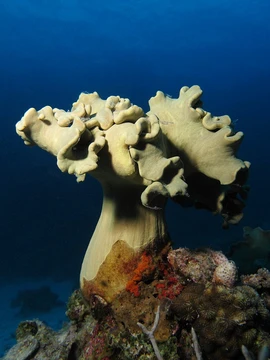
Scleralcyonacea
An order of Octocorallia uniting calcified and pennatulacean corals.

Scleralcyonacea is an order within the class Octocorallia. Its name comes from the Greek word for "hard" and the former coral order Alcyonacea, reflecting that most of its members have either a calcium carbonate axial skeleton or sclerites fused with calcitic material.
This order brings together several traditional groups: Calcaxonia (except the genus *Isis*), Pennatulacea, and Helioporacea, along with parts of Scleraxonia and Stolonifera, and the genera *Ideogorgia* and *Parasphaerasclera*. A clade combining mainly Calcaxonia, Pennatulacea, and Helioporacea was first identified (though not named) in a 2006 study and later studies, often called the Calcaxonia-Pennatulacea clade. In 2019, G. C. Williams suggested optionally naming this clade Calcaxonia (sensu lato), but this was not adopted by other authors.
The phylogenetic study by McFadden et al. in 2022 formally assigned the name Scleralcyonacea and the rank of order to this clade. That study divided Octocorallia into two monophyletic lineages, establishing them as the orders Scleralcyonacea and Malacalcyonacea. Scleralcyonacea was found to contain: all taxa formerly in the order Pennatulacea (now superfamily Pennatuloidea), the order Helioporacea (now family Helioporidae sensu lato), and the suborder Calcaxonia (including Dendrobrachia), except the genus *Isis*; plus parts of the suborders Scleraxonia and Stolonifera; and the genera *Ideogorgia* (from Holaxonia) and *Parasphaerasclera* (from Alcyoniina). The genus *Isis*, historically placed within Calcaxonia near Keratoisididae and Mopseidae, was found to be unrelated, with differences in internode growth patterns being phylogenetically informative.
Scleralcyonacea includes the monophyletic sea pens (superfamily Pennatuloidea) along with 21 other families and two genera of uncertain placement (*incertae sedis*).
Quick Facts
- Taxon
- Scleralcyonacea
Facts from the source article.
Lore & Background
The clade combining primarily Calcaxonia, Pennatulacea and Helioporacea was identified but not named as early as a 2006 study and in several later studies; it was usually called informally the Calcaxonia-Pennatulacea clade or the Pennatulacea-Calcaxonia clade. In 2019, G. C. Williams proposed optionally calling this clade Calcaxonia (sensu lato), but other authors did not adopt this naming proposal. The phylogenetic study McFadden et al. 2022 assigned the name Scleralcyonacea and the rank of an order to this clade, finding Octocorallia to be divided into two monophyletic lineages, which the study established as the orders Scleralcyonacea and Malacalcyonacea.
The order was named after Greek σκληρός (sklēros, meaning 'hard') and the former coral order Alcyonacea, as most of its members contain either an axial skeleton made of calcium carbonate or sclerites fused with calcitic material. Scleralcyonacea contains all taxa formerly assigned to the order Pennatulacea (superfamily Pennatuloidea), to the order Helioporacea (family Helioporidae sensu lato) and to the suborder Calcaxonia (inclusive of Dendrobrachia), except the genus Isis. It also includes a part of the suborder Scleraxonia and of the (sub)order Stolonifera, and the genera Ideogorgia (from Holaxonia) and Parasphaerasclera (from Alcyoniina). The genus Isis, historically placed within Calcaxonia, was found to be unrelated, with the difference in internode growth patterns identified as phylogenetically informative.
Reader's Guide
The establishment of Scleralcyonacea in the 2022 study by McFadden et al. represents a significant reclassification within Octocorallia, dividing the class into two monophyletic lineages. This order unites a broad range of soft corals and leathers that share a common ancestry, including sea pens (Pennatuloidea), blue corals (Helioporacea), and many calcaxonian taxa, while excluding the genus Isis due to phylogenetic evidence from internode growth patterns. The name itself reflects the hard, calcified elements—either axial skeletons or fused sclerites—that characterize most members. The order's composition resolves long-standing informal groupings (the Calcaxonia-Pennatulacea clade) that had been recognized since at least 2006 but lacked formal taxonomic status. By incorporating parts of Scleraxonia and Stolonifera, as well as the genera Ideogorgia and Parasphaerasclera, Scleralcyonacea provides a more natural classification based on molecular phylogenetics. Its legacy lies in clarifying the evolutionary relationships among these diverse octocorals, offering a framework for future studies of their biology, ecology, and conservation.
Did You Know?
- The order includes all taxa formerly assigned to Pennatulacea, Helioporacea, and Calcaxonia except the genus Isis.
- The genus Isis was excluded because its internode growth patterns differed from other Calcaxonia.
- The clade was informally called the Calcaxonia-Pennatulacea clade before being formally named in 2022.
The 2022 Taxonomic Split
For decades, the group known as Alcyonacea—commonly called soft corals or alcyonacians—occupied a single order or suborder position within Octocorallia, though taxonomists never agreed on how broadly to draw its boundaries. In the narrowest reading it matched what other systems labelled the suborder Alcyoniina. A middle interpretation added Stolonifera, Telestacea, and Protoalcyonaria, while the broadest definition swept in Scleraxonia, Holaxonia, and Calcaxonia, taxa that before 1981 had been treated as the entirely separate order Gorgonacea, the sea fans and sea whips. The 2022 revision of Octocorallia finally resolved much of this ambiguity by dissolving Alcyonacea as a standing order. Its former content was redistributed into two new orders: Malacalcyonacea, which absorbed the larger share, and Scleralcyonacea, which received a smaller portion. Together these two orders now constitute the entirety of Octocorallia. The old synonyms Alcyonaria and Alcyonarida persist in the literature, and the pre-2022 treatment described in many references should be regarded as a historical snapshot rather than a current framework.
Skeletal Architecture and Structural Diversity
The organisms now distributed between Malacalcyonacea and Scleralcyonacea display a remarkable range of internal support structures. In the lineage historically called Holaxonia, colonies are propped up by a flexible, horny protein known as gorgonin—a molecule unique to this group and quite distinct from the calcium carbonate skeletons of true stony corals. The Scleraxonia lineage, by contrast, relies on tightly clustered calcareous spicules for structural integrity, while some members adopt an encrusting growth form reminiscent of coral. Across the broader soft-coral assemblage, tiny spiny elements called sclerites are embedded in the coenenchymal tissue, lending the flesh a grainy, spiky texture that discourages predators and serving as a key diagnostic tool for species identification. One particularly striking finding is that colonies of the leather-coral genus Sinularia can cement these sclerites at their base, consolidating them into a hard substrate called alcyonarian spiculite, effectively turning a soft coral into a genuine reef builder.
Feeding Ecology and Symbiotic Partnerships
Each individual polyp in these colonial cnidarians bears exactly eight tentacles, which it extends to capture plankton and suspended particulate matter from passing water—a strategy known as filter feeding. Colonies maximise this intake by orienting their fan-shaped or whiplike bodies directly across prevailing currents, ensuring a steady flow of food-laden water through the polyp-bearing surface. Beyond animal prey, many species harbour photosynthetic zooxanthellae within their tissues, a symbiotic arrangement that supplements their diet with energy derived from sunlight; colonies rich in these algae typically display brownish polyps. Unlike stony corals, these organisms generally flourish in nutrient-rich waters receiving less intense illumination, making them well suited to a wide range of habitats. They are found from sunlit shallow reefs down to depths of several thousand feet, with morphology tracking environment: broad, flexible fans dominate energetic shallow zones, while taller, thinner, stiffer forms persist in deeper, calmer waters.
Reef Habitat, Conservation, and Scientific Utility
Colonies of these corals—often reaching several feet in height and spread yet only a few inches thick—serve as critical structural habitat within reef ecosystems. Fish, snails, algae, hydrozoans, bryozoans, brittle stars, and even pygmy seahorses are known to shelter among the branches, making each colony a micro-ecosystem in its own right. Roughly five hundred gorgonian species are documented worldwide, with particularly dense populations in the shallow Western Atlantic around Florida, Bermuda, and the West Indies. In the reef-aquarium trade, small cuttings of soft corals are favoured over stony corals because they tolerate shipping stress better, and aquaculture-grown specimens tend to be hardier and less expensive than wild-caught imports, reducing pressure on natural reefs. Scientifically, the gorgonin and calcite deposited in the skeletons of long-lived gorgonians record seasonal and climatic variation in their growth rate and composition, offering paleoclimatologists and paleoceanographers a valuable archive of past ocean conditions.
Frequently Asked Questions
What is Scleralcyonacea?
Scleralcyonacea is a taxonomic order within the class Octocorallia that groups together calcified soft corals and sea pens. It was formally established by McFadden and colleagues in 2022 to capture shared evolutionary relationships among lineages that had previously been scattered across several older groupings.
Where does the name Scleralcyonacea come from?
The name fuses the Greek root for "hard" with the former coral order name Alcyonacea, a deliberate nod to the fact that most members possess either a calcium carbonate axial skeleton or sclerites bound with calcitic material.
Which traditional coral groups are folded into Scleralcyonacea?
The order unites Calcaxonia (minus the genus Isis), Pennatulacea, Helioporacea, portions of Scleraxonia and Stolonifera, plus the genera Ideogorgia and Parasphaerasclera. Altogether it spans 21 families along with two genera of uncertain placement, and it includes the superfamily Pennatuloidea.
Who described Scleralcyonacea and when?
McFadden et al. published the order in 2022, giving a formal name to a clade that had been identified in earlier phylogenetic analyses but never received its own taxonomic label.
Why is the genus Isis excluded from Scleralcyonacea?
Although Isis is a Calcaxonian coral, it was deliberately carved out of the order during its 2022 description, so it does not fall under Scleralcyonacea even though its close relatives do.
More in Soft Corals and Leathers 1-24
Spotted an error? Know more?
Reader corrections go straight into our review queue. Suggest an edit · How this site is sourced