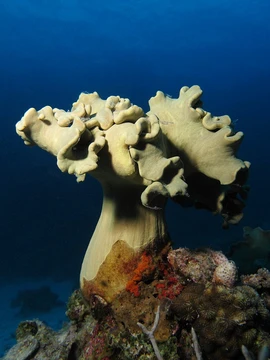
Alcyonium acaule
A colonial soft coral forming fleshy lobes on shaded Mediterranean rocks.

Alcyonium acaule is a soft coral belonging to the family Alcyoniidae. It grows in clumps of fleshy, finger-like lobes that can be yellow, pink, brown-red, or brown-orange, reaching up to 20 centimeters in height. The entire surface, from base to lobe tips, is covered with whitish polyps. Like other soft corals, it uses a hydrostatic skeleton to keep its shape.
This species is found in the Mediterranean Sea and extends slightly into the Atlantic along the coasts of Portugal and Spain. It lives on shaded rocks at depths between 12 and 135 meters, avoiding direct light and preferring overhangs or caves. It often forms dense groups, frequently alongside the yellow cluster anemone (*Parazoanthus axinellae*). These habitats also host other suspension feeders such as sponges, cnidarians, bryozoans, and tunicates, with coralline algae encrusting the rock. Competition for space is common. In a two-year study, some small colonies disappeared, and overall growth was minimal. Many colonies reduced feeding in summer, with up to ninety percent becoming dormant.
Quick Facts
- Taxon
- Alcyonium acaule
Facts from the source article.
Lore & Background
Alcyonium acaule is a colonial coral that forms clumps of fleshy, finger-like lobes in shades of yellow, pink, brown-red, or brown-orange. The colony can reach a height of 20 cm, and its surface is entirely covered by whitish polyps from the base to the tips of the lobes. Like all soft corals, it relies on its hydrostatic skeleton to maintain its form.
This species is endemic to the Mediterranean Sea, with its range extending slightly into the Atlantic Ocean along the Portuguese and Spanish Atlantic coasts. It is usually found between 12 and 135 m deep and is sciophilous, avoiding direct light and preferring shaded areas such as overhangs or caves.
In the Mediterranean, Alcyonium acaule frequently forms dense aggregations, often in association with the yellow cluster anemone (Parazoanthus axinellae). Other organisms in these biodiverse habitats include suspension feeders such as sponges, cnidarians, bryozoans, and tunicates, and the rock is encrusted with coralline algae. Competition for space occurs among these organisms.
Reader's Guide
Alcyonium acaule is significant as a characteristic soft coral of Mediterranean shaded rocky habitats, where it forms dense aggregations that contribute to biodiversity. Its association with the yellow cluster anemone (Parazoanthus axinellae) and other suspension feeders highlights its role in complex benthic communities. The species is notable for its ability to form colonies up to 20 cm tall, with polyps covering the entire surface. A two-year research study observed that small colonies sometimes disappeared, overall colony growth was minimal, and many colonies reduced feeding activity during summer, with up to ninety percent becoming dormant. This dormancy suggests an adaptive response to seasonal conditions. The species' preference for shaded areas and its reliance on a hydrostatic skeleton are key aspects of its biology. Its distribution, endemic to the Mediterranean with a slight Atlantic extension, underscores its regional ecological importance.
Did You Know?
- Alcyonium acaule can reach a colony height of 20 cm.
- Its polyps are whitish and cover the entire colony surface from base to tips.
- Up to ninety percent of colonies may become dormant during summer.
Frequently Asked Questions
What is Alcyonium acaule?
It is a colonial soft coral in the family Alcyoniidae that forms soft, finger-like lobes into clumpy colonies. These colonies can reach roughly 20 cm in height and are native to the Mediterranean Sea and parts of the eastern Atlantic.
Where does Alcyonium acaule live?
This species attaches to shaded rock surfaces, overhangs, and cave walls, typically between 12 and 135 meters deep. Its range covers the Mediterranean and extends slightly into the Atlantic along the coasts of Portugal and Spain, where it avoids direct sunlight.
What color is Alcyonium acaule?
The fleshy lobes can appear yellow, pink, brown-red, or brown-orange depending on the colony. The entire surface, from the base to the very tips of the lobes, is covered with small whitish polyps.
How does Alcyonium acaule hold its shape without a hard skeleton?
Like other soft corals, it depends on a hydrostatic skeleton—internal water pressure within its tissues—to keep the lobes upright and firm. This replaces the rigid calcium-carbonate framework that hard corals use.
How big does an Alcyonium acaule colony get?
A mature colony reaches a maximum height of about 20 centimeters. It grows as a clump of soft, finger-like lobes rather than as a single tall structure.
More in Soft Corals and Leathers 1-24
Spotted an error? Know more?
Reader corrections go straight into our review queue. Suggest an edit · How this site is sourced