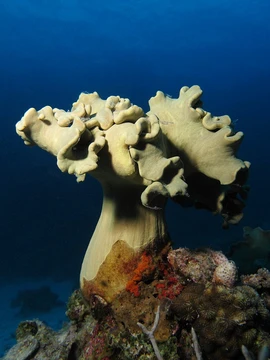
Alcyonium coralloides
A soft coral that shifts from encrusting rock to parasitic overgrowth.

Alcyonium coralloides, called false coral, is a soft coral that lives in colonies and belongs to the family Alcyoniidae. Its most striking feature is how differently it grows depending on location: along the northeastern Atlantic coast it forms sheets or small lobes on rock surfaces, but in the Mediterranean Sea it acts as a parasite, spreading over and killing sea fans.
The Russian naturalist Peter Simon Pallas first described this species in 1766, giving it the name Parerythropodium coralloides. Later, scientists looked at its growth forms, the shape of its tiny skeletal spicules, and the channels running through its coenenchyme—the tissue that connects the polyps—and decided it belonged in the genus Alcyonium, so it was renamed Alcyonium coralloides.
This coral is abundant in the Mediterranean but less common along the Atlantic coast of Western Europe and in the English Channel, with Scotland marking its northern limit. In the Atlantic, colonies stay small and attach directly to vertical rock faces, under overhangs, and inside caves. In the Mediterranean, they usually grow on sea fans like Eunicella, Paramuricea, and Leptogorgia, as well as on the tunicate Microcosmus and on coralline algae. Commonly colonised hosts include Eunicella singularis, Eunicella cavolinii, Eunicella verrucosa, Paramuricea clavata, and Leptogorgia sarmentosa.
Growth habits vary. In the Atlantic, the coral sometimes forms red encrusting sheets over rock, dotted with white or yellow polyps and occasionally bare patches. More often it appears as short, finger-like lobes up to 4 cm long, pale pink with white polyps. It rarely encrusts sea fans there. In the Mediterranean, the coral typically spreads as an encrusting layer over the surface of a gorgonian. Because the sea fan has a rigid skeleton, Alcyonium coralloides doesn’t need its own supportive skeleton, but it does have spicules in its surface layers that make it feel rough. Colony colour is often purple, though white, pink, or yellow forms occur; the white and pink ones, mostly found in deep water, are considered mutants. Polyps are usually white, cream, or yellow, up to 5 mm long, and generally larger than those of the sea fan it overgrows. The coral is considered parasitic because it kills the sea fan’s tissues and clings to the underlying skeleton, though how it does this is not understood.
Quick Facts
- Taxon
- Alcyonium coralloides
Facts from the source article.
Lore & Background
This soft coral was first described in 1766 by the Russian naturalist Peter Simon Pallas, who named it Parerythropodium coralloides. It was later moved to the genus Alcyonium based on its growth forms, spicule nature, and coenenchyme passages. In the Atlantic, colonies are small and grow directly on vertical rock faces, under overhangs, and in caves, often as encrusting sheets or short finger-like lobes up to 4 cm long. In the Mediterranean, it typically encrusts sea fans such as Eunicella, Paramuricea, and Leptogorgia, as well as the tunicate Microcosmus and coralline algae. The mechanism by which it kills its host's tissues is not understood.
Reader's Guide
Alcyonium coralloides is significant for its dual ecological roles: as a benign encruster on Atlantic rocks and as a parasitic overgrower on Mediterranean gorgonians. In the Mediterranean, it kills the tissues of sea fans and adheres to their skeletons, gaining elevation above the substrate to enhance water flow and plankton capture. Its reproduction differs between regions: Mediterranean populations are either male or female and undergo sexual reproduction with a short gametogenesis period of five to six months, while Atlantic populations reproduce mainly by parthenogenesis, brooding embryos internally. This difference may explain the patchy distribution in the Atlantic versus abundance in the western Mediterranean. The species also shows color variation, with white and pink forms in deep water considered mutants. Its ability to colonize multiple host species and its parasitic strategy make it a notable example of adaptive growth in soft corals.
Did You Know?
- Alcyonium coralloides was first described in 1766 by Peter Simon Pallas as Parerythropodium coralloides.
- In the Mediterranean, it is parasitic and overgrows sea fans, killing their tissues by an unknown mechanism.
- Atlantic colonies reproduce mainly by parthenogenesis, while Mediterranean populations reproduce sexually.
- White and pink forms of this coral occur in deep water and are considered mutants.
Frequently Asked Questions
What is Alcyonium coralloides?
Alcyonium coralloides, commonly called false coral, is a colonial soft coral in the family Alcyoniidae. It is best known for adopting dramatically different growth strategies depending on the region where it lives.
How does Alcyonium coralloides grow?
Along the northeastern Atlantic coast it typically forms flat sheets or small lobes directly on rock surfaces. In the Mediterranean, by contrast, it behaves as a parasite, spreading across and ultimately killing sea fan corals.
Who first described Alcyonium coralloides?
The Russian naturalist Peter Simon Pallas originally described the species in 1766 under the name Parerythropodium coralloides. Later taxonomists reassigned it to its current genus after examining growth form, spicule morphology, and other structural traits.
How large does Alcyonium coralloides get?
Individual lobes of the colony reach a maximum length of about 4 cm (roughly 1.6 inches). Each individual polyp measures approximately 5 mm, or 0.2 inches, in length.
Why is Alcyonium coralloides considered notable among soft corals?
Its ability to shift from a benign rock-encrusting form to a destructive parasitic overgrowth makes it a striking example of phenotypic plasticity within the Alcyoniidae. This ecological flexibility has drawn particular attention from marine ecologists studying coral competition in the Mediterranean.
More in Soft Corals and Leathers 1-24
Spotted an error? Know more?
Reader corrections go straight into our review queue. Suggest an edit · How this site is sourced