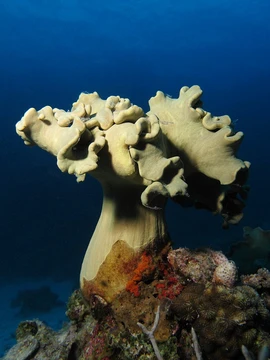
Taiaroa tauhou
A solitary deep-water octocoral from New Zealand's Taiaroa Canyon.

Taiaroa tauhou is a species of deep-water, solitary marine octocoral and the sole member of the genus Taiaroa and the family Taiaroidae. It is notable for being a non-colonial octocoral, a trait that led to the re-establishment of the suborder Protoalcyonaria in 1976, and for its later reclassification into the order Malacalcyonacea in 2022.
Quick Facts
- Grandparent Authority
- Bayer & Muzik, 1976
- Taxon
- Taiaroa tauhou
Facts from the source article.
Lore & Background
In 1973, a new species of solitary octocoral was dredged from the seabed off the Otago Peninsula, New Zealand, at a depth of 720 m. Initially mistaken for a burrowing sea anemone, it was given to marine biologist Dr. Cadet Hand, who recognized it as an octocoral and sought the assistance of Dr. Frederick Bayer. Bayer named it Taiaroa tauhou, with the genus referring to the submarine canyon where it was found and the species epithet being the Maori word for 'strange'. In 1976, the suborder Protoalcyonaria was re-established to accommodate this species and further specimens, though this higher-level taxon had originally been erected in 1894 for non-colonial octocorals and had later become redundant. In 2022, the species was reclassified into the newly erected order Malacalcyonacea.
Taiaroa tauhou has a tall, cylindrical body held in soft substrate by numerous filaments encrusted with sediment. The anthocodia, bearing eight pinnate tentacles and the mouth, can retract into the rigid anthostele, which is strengthened by spindle-shaped calcareous sclerites and has eight longitudinal ridges. The largest individual examined measured 36.5 mm in total length and 6.5 mm in diameter, with a retractible anthocodia of 14.5 mm. The body wall is opaque and beige.
The species reproduces solely by sexual reproduction. One individual contained both eggs and spermaries, suggesting possible hermaphroditism, but other individuals contained only eggs or were exclusively male. It is unclear whether the gonads in the bisexual individual were attached to the body wall. The article notes that males may liberate spermaries that are ingested by females, resulting in internal fertilization, which would mean the animals are not hermaphroditic.
Reader's Guide
Taiaroa tauhou holds significance as the sole species in the genus Taiaroa and the family Taiaroidae, making it a unique lineage among deep-water octocorals. Its discovery in 1973 and formal description in 1976 by Bayer and Muzik prompted the re-establishment of the suborder Protoalcyonaria, a taxon originally created in 1894 for non-colonial octocorals but later abandoned when its members were transferred elsewhere. This reclassification highlights the ongoing debate about whether such solitary forms are truly non-colonial or merely juvenile stages of colonial species. The species' later move to the order Malacalcyonacea in 2022 reflects continued taxonomic refinement. Its biology also presents unresolved questions: while one specimen contained both eggs and spermaries, others were single-sex, and the mechanism of fertilization remains uncertain—whether internal fertilization via ingested spermaries occurs, or whether the species is hermaphroditic. These ambiguities underscore the challenges in understanding deep-sea coral reproduction. The species' habitat in the Taiaroa submarine canyon off New Zealand, at a depth of 720 meters, and its anchoring by sediment-encrusted filaments, illustrate adaptations to soft substrates in the deep sea.
Did You Know?
- Taiaroa tauhou was first mistaken for a burrowing sea anemone when dredged in 1973.
- Its species name 'tauhou' is the Maori word for 'strange'.
- The largest examined individual had a total length of 36.5 mm and a diameter of 6.5 mm.
More in Soft Corals and Leathers 1-24
Spotted an error? Know more?
Reader corrections go straight into our review queue. Suggest an edit · How this site is sourced