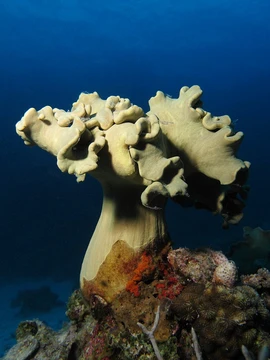
Sinularia flexibilis
A soft coral known for chemical defenses and biomedical potential.

Sinularia flexibilis, also called flexible leather coral, slimy leather coral, or spaghetti finger leather coral, is a soft coral first described in 1833. Its colonies are flexible and branching, getting energy from symbiotic algae known as zooxanthellae through photosynthesis. These corals live in Indo-Pacific reef environments, where they play an important ecological role. They are also studied for producing biologically active compounds that have antimicrobial and pharmaceutical potential.
The coral’s body is soft and leathery, with flexible lobes growing from a central stalk. It belongs to the class Octocorallia, meaning its polyps have eightfold symmetry, and to the family Alcyoniidae. Unlike hard corals, it lacks a calcium carbonate exoskeleton but has an internal skeleton made of sclerites, which provide support and protection. Colony colors—yellow, brown, or green—depend on the density of the symbiotic algae. Morphological variation is common in this genus due to environmental factors and species diversity.
This species is found in shallow tropical waters across the Indo-Pacific, including coral reefs off Southeast Asia and the Great Barrier Reef. It lives at depths of 0 to 30 meters, in salinities of 30 to 40 PSU, and temperatures between 20 and 30 degrees Celsius. Larvae attach to hard substrates in shallow reef areas, and under favorable conditions, the coral can form dense aggregations that dominate benthic communities. Moderate water flow helps nutrient exchange and supports growth and photosynthesis.
The coral has a mutualistic relationship with photosynthetic dinoflagellates called zooxanthellae. These algae live inside the coral’s tissues and provide energy through photosynthesis, fueling growth and metabolism. In return, the coral offers the algae protection, sunlight access, and nutrients from its metabolic waste. Environmental factors influence how efficiently this partnership works, affecting photosynthetic performance and overall coral health.
Ecologically, Sinularia flexibilis provides habitat for small marine organisms and shapes community structure. It competes with other bottom-dwelling organisms for space and can become dominant under certain conditions. Colony growth and survival depend on size: smaller colonies grow faster but have higher death rates, while larger ones may grow less or split.
Quick Facts
- Taxon
- Sinularia flexibilis
Facts from the source article.
Lore & Background
Sinularia flexibilis was first described by Quoy and Gaimard in 1833. It has a soft, leathery body with flexible lobes extending from a central stalk, and its polyps display eightfold symmetry, placing it in the class Octocorallia. The coral lacks a calcium carbonate exoskeleton but has an internal skeleton made of sclerites, providing structural support and protection. Colonies are usually yellow, brown, or green, depending on the density of symbiotic algae, and morphological variation is common within the genus due to environmental influences.
The species inhabits shallow, tropical reef environments in the Indo-Pacific region, including coral reef systems off Southeast Asia and the Great Barrier Reef, at depths between 0-30 meters. It forms a mutualistic relationship with photosynthetic dinoflagellates called zooxanthellae, which live within its tissues and provide energy through photosynthesis. In return, the coral provides the algae with protection, access to sunlight, and nutrients from its metabolic waste. The efficiency of this relationship is influenced by environmental factors.
Reader's Guide
Sinularia flexibilis plays an important ecological role in reef communities by providing habitat for small marine organisms and influencing community structure. It competes with other benthic organisms for space and can become dominant under favorable conditions. The species reproduces both sexually through synchronized mass spawning and asexually through fission and fragmentation, contributing to genetic diversity and population expansion. Its abundance is influenced by environmental factors such as water flow, which enhances nutrient exchange and supports growth and photosynthesis.
The coral is also studied for its production of secondary metabolites, particularly diterpenes, which function in chemical defense against predators, microbial infection, and overgrowth by competing organisms. These compounds have shown antimicrobial activity against Gram-positive bacteria, as well as anti-inflammatory and cytotoxic properties, suggesting potential use in drug development. Recent research indicates that microbial communities associated with Sinularia flexibilis may influence the production of these compounds, expanding its relevance in marine biotechnology. Additionally, the species is commonly kept in marine aquariums due to its resilience and adaptability, though it requires specific lighting and water flow to support its symbiotic algae.
Did You Know?
- It produces diterpenes that exhibit antimicrobial activity against Gram-positive bacteria.
- The species reproduces both sexually through mass spawning and asexually through fission and fragmentation.
More in Soft Corals and Leathers 1-24
Spotted an error? Know more?
Reader corrections go straight into our review queue. Suggest an edit · How this site is sourced