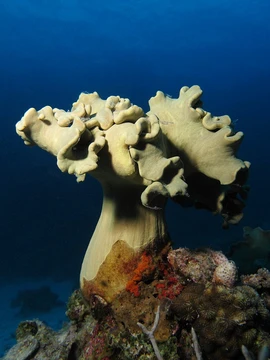
Sarcophyton glaucum
A soft coral from the Red Sea to the western Pacific.

Sarcophyton glaucum, called toadstool leather coral or rough leather coral, is a soft coral species ranging from the Red Sea to the western Pacific Ocean. It is classified under phylum Cnidaria, class Anthozoa, and family Alcyoniidae. In the Red Sea, it stands out as one of the most abundant soft corals in its family; that sea hosts 40% of the world’s 180 known soft coral species.
Like other Alcyoniidae, this coral lacks a hard exoskeleton. It is sessile, and scientists identify it by the calcareous sclerites on its surface. Its polyps each have eight tentacles. Sarcophyton corals form monospecific colonies, commonly found in intertidal, subtidal, and near-shore reef flat zones. Individual S. glaucum can reach 80 cm (31 in) across, typically on reef flats, in lagoons, or on seaward slopes. The coral hosts a variety of microorganisms that shield it from pathogens and may also supply nutrients.
Researchers often use Sarcophyton corals in pharmaceutical studies. S. glaucum produces sarcophytol A, a diterpenoid with tumor-inhibiting properties. Analyses of its cembranoids also show tumor-inhibiting activity, and its metabolites have demonstrated antimicrobial, antifungal, and neuroprotective effects. One study concluded that several compounds isolated from S. glaucum warrant further investigation for cancer treatment. Other research has found antibacterial properties: a study on bacteria associated with S. glaucum identified antibiotic-producing microbes from phyla such as Firmicutes, Gammaproteobacteria, and Actinobacteria. Chemical surveys of 16 Sarcophyton species revealed additional biological activities, including protection against insects, pests, inflammation, viruses, and biofouling, largely due to cembrane terpenes.
S. glaucum is also important in aquaculture. Genetic analysis by Costa et al. divided the species into six clades based on mitochondrial protein sequences. A study on its photobiology tested how low light affects growth and survival, since light is essential for coral health. Results showed that S. glaucum can grow and survive under low Photosynthetically Active Radiation (PAR) without negative effects on its photobiology; in fact, endosymbiont concentrations increased under those conditions. This suggests low PAR can be used for ex situ culturing of the species.
Quick Facts
- Taxon
- Sarcophyton glaucum
Facts from the source article.
Lore & Background
Sarcophyton glaucum belongs to the genus Sarcophyton, one of seven known genera of Alcyoniidae. In the Red Sea, it is one of the most prevalent soft corals of this family. The Red Sea is native to 40% of the known 180 species of soft corals. Soft corals like S. glaucum lack a hard exoskeleton; they are sessile and identified taxonomically by calcareous sclerites on their exoskeletons. Sarcophyton have polyps with eight tentacles. These corals build monospecific colonies, typically found in intertidal, subtidal, and near-shore reef flat habitats. Individual S. glaucum corals grow up to 80 cm, usually on reef flats, in lagoons, and on seaward slopes. Within the coral are many microorganisms that protect the host against pathogens and may supply nutrients.
Reader's Guide
Sarcophyton glaucum is significant in pharmaceutical research as a producer of sarcophytol A, a diterpenoid with tumor-inhibiting bioactivity. Analysis of its cembranoids has shown tumor-inhibiting properties, and its metabolites have demonstrated antimicrobial, antifungal, and neuroprotective activities. A study concluded that several isolated compounds from S. glaucum can be further investigated for cancer research and treatment. Other studies have shown antibacterial properties; bacteria associated with S. glaucum, including those from the phylum Firmicutes, Gamma proteobacteria, and Actinobacteria, have antimicrobial properties. Chemical analyses of 16 Sarcophyton species revealed a range of biological activities, including protection against insects, pests, inflammation, viruses, and biofouling. S. glaucum is also prominent in aquaculture. It can be separated into six clades based on mitochondrial protein sequences. Research on photobiology showed that S. glaucum can grow and survive under low Photosynthetically Active Radiation (PAR) intensities, with increased endosymbiont concentrations, suggesting low PAR can be used in ex situ culturing.
Did You Know?
- Sarcophyton glaucum is also known as toadstool leather coral or rough leather coral.
- It can grow up to 80 cm (31 in) in size.
More in Soft Corals and Leathers 1-24
Spotted an error? Know more?
Reader corrections go straight into our review queue. Suggest an edit · How this site is sourced