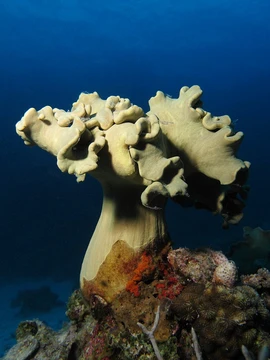
Rhytisma fulvum
A pioneering soft coral that broods its young.

Rhytisma fulvum, called the sulphur leather coral, is a colonial soft coral belonging to the family Alcyoniidae. It was first described in 1775 by the Swedish naturalist Peter Forsskål. This species is zooxanthellate and appears in two colour forms—yellowish-brown and grey—which are not considered taxonomically distinct. It grows as an encrusting sheet over the substrate, sometimes merging with adjacent colonies. Its polyps are small, arranged in rows, and each sits on a cone-shaped stalk.
The coral is native to the Indo-Pacific region, from the Red Sea, Zanzibar, and Madagascar east to Indonesia, Papua New Guinea, and the Great Barrier Reef in Australia. It lives on reefs at depths between 3 and 40 metres. As a pioneering species, it is among the first to settle in areas where corals have died or on damaged parts of reefs.
Colonies are either male or female. In the Red Sea, breeding occurs from late June to early August. Oocytes develop for about ten months before spawning, while sperm sacs mature over seven months. Males release sperm into the water in a spawning event tied to the lunar phase, with shallow-water colonies spawning earlier in the year than deeper ones. Fertilisation happens inside the polyps of female colonies. The embryos are brooded on the colony’s surface, held in sticky mucus. After roughly six days, the planula larvae are released and soon settle on the seabed. Each polyp in a female colony produces about twenty eggs—a relatively low number—but brooding helps protect the developing larvae from predators.
In the Red Sea, this soft coral is often eaten by the nudibranch *Marionia levis*. The sea slug’s appearance closely matches the coral’s surface, with its gills mimicking the feeding polyps, providing excellent camouflage. Its presence is only revealed when the coral is touched, causing the polyps to retract and exposing the nudibranch. About a quarter of the *R. fulvum* colonies examined were found to host this slug.
Quick Facts
- Genus
- Rhytisma (coral)
- Species
- fulvum
Facts from the source article.
Lore & Background
Rhytisma fulvum was first described by the Swedish naturalist Peter Forsskål in 1775. It is a zooxanthellate, encrusting species that forms sheets over the substrate, which may mesh together. Its polyps are small and packed in rows, each raised on a cone-shaped peduncle. The species has two color morphs—yellowish-brown and grey—with no taxonomic difference between them.
Its range extends from the Red Sea, Zanzibar and Madagascar to Indonesia, Papua New Guinea and the Great Barrier Reef in Australia. It grows on reefs at depths between 3 and 40 m. As a pioneering species, it is one of the first to colonize areas where corals have died or damaged parts of reefs.
In the Red Sea, breeding occurs from late June to early August. Oocytes mature for about ten months and sperm sacs for seven months. Male colonies release sperm in a spawning event synchronized with the moon phase; shallow-water colonies spawn earlier than deep-water ones. Fertilization occurs inside female polyp cavities, and embryos are brooded on the colony surface in sticky mucus. After about six days, planula larvae are liberated and settle. Each female polyp produces about twenty eggs—a low number compensated by brooding, which maximizes larval survival.
Reader's Guide
Rhytisma fulvum is significant as a pioneering species that helps recolonize damaged reef areas, playing an early role in reef recovery. Its brooding reproductive strategy, though producing few eggs per polyp, enhances larval survival by protecting developing embryos on the colony surface. The species is also notable for its symbiotic relationship with zooxanthellae and for hosting the nudibranch Marionia levis, which is camouflaged to resemble the coral's surface. In the Red Sea, about a quarter of investigated colonies harbored this nudibranch. The coral's two color morphs—yellowish-brown and grey—are taxonomically identical. Its description by Peter Forsskål in 1775 marks an early scientific record of this soft coral. The species' depth range of 3 to 40 m and its distribution across the Indo-Pacific, from the Red Sea to the Great Barrier Reef, underscore its adaptability. The synchronized spawning tied to lunar phases and the difference in timing between shallow and deep colonies highlight its ecological complexity.
Did You Know?
- Rhytisma fulvum was first described by Swedish naturalist Peter Forsskål in 1775.
- It is a pioneering species that colonizes areas where corals have died or damaged reefs.
- Female colonies brood embryos on their surface in sticky mucus for about six days.
- The nudibranch Marionia levis preys on this coral and is camouflaged to resemble its surface.
More in Soft Corals and Leathers 1-24
Spotted an error? Know more?
Reader corrections go straight into our review queue. Suggest an edit · How this site is sourced