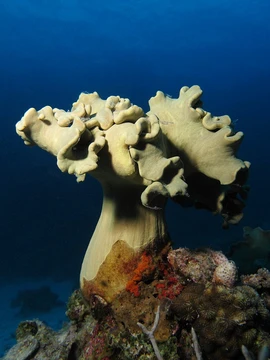
Mopsea
A genus of branching corals with feather-like pinnae, found off Australia.

Mopsea is a genus of coral in the family Mopseidae, comprising two species: Mopsea encrinula and Mopsea triaknema. These corals are found around the coasts of Australia at depths of 60 to 220 metres. Colonies are orange-brown, grow up to about 30 centimetres, and feature multiple branches with feather-shaped structures. The genus is notable for its complex taxonomic history, including a 1993 ruling by the International Commission on Zoological Nomenclature to resolve the type species, and a 2021 molecular phylogeny that reassigned it from Isididae to the family Mopseidae.
Quick Facts
- Taxon
- Mopsea
- Type Species Authority
- Lamarck, 1815
Facts from the source article.
Lore & Background
Mopsea was originally erected by Jean Vincent Félix Lamouroux in 1816 as part of the family Isididae, containing two species previously assigned to Isis: Mopsea encrinula and Mopsea dichotoma. The genus name likely derives from 'one of the Sirens', a variant spelling of Molpe. Controversy over the identity of M. dichotoma's type specimen, possibly belonging to an unrelated melithaeid genus, led to a 1993 ruling by the International Commission on Zoological Nomenclature designating M. encrinula as the type species. A later reassessment divided most described species into other genera, leaving only M. encrinula and the newly described M. triaknema. In 2021, molecular phylogenetics showed Isididae to be polyphyletic, and Mopsea was reassigned to the family Mopseidae.
Colonies have a branching structure in a single plane, with fine twigs (pinnae) originating from principal branches in a feather-like pattern. Branches consist of horny nodes separated by calcareous internodes; internodes bear tooth-like spines along ridges. Polyps are white, covered in spine-bearing sclerites less than 0.2 millimetres long, and are equally distributed on branches and pinnae. The two species are distinguished primarily by the shape of their oral sclerites: M. encrinula has several sclerites of various shapes per octant, while M. triaknema has a single large triradial sclerite dominating each octant. Coenenchyme sclerites also differ between species.
Reader's Guide
Mopsea's significance lies in its role as a case study in taxonomic revision within octocorals. The genus was originally placed in Isididae, but molecular phylogenetics in 2021 revealed that family to be polyphyletic, leading to the creation of the family Mopseidae, with Mopsea as the type genus. The long-standing confusion over its type species—debated between M. encrinula and M. dichotoma—was resolved only by an ICZN ruling in 1993, which designated M. encrinula as the type species. This decision also confirmed the lectotype designated by researcher Philip Alderslade. The genus was further refined in a 1998 study that found it paraphyletic, reducing it from many species to just two. The distinction between the two extant species relies on subtle sclerite morphology, a character that usually shows little variation within a single genus, as noted by Alderslade. Mopsea thus illustrates how historical misidentifications and evolving phylogenetic methods can reshape coral taxonomy.
Did You Know?
- Mopsea was originally named after 'one of the Sirens', likely a variant spelling of Molpe.
- The two species, M. encrinula and M. triaknema, are distinguished primarily by the shape of their oral sclerites.
- The type species was not settled until a 1993 ruling by the International Commission on Zoological Nomenclature.
- A 2021 molecular phylogeny showed the family Isididae to be polyphyletic, leading to Mopsea's reassignment to Mopseidae.
More in Soft Corals and Leathers 1-24
Spotted an error? Know more?
Reader corrections go straight into our review queue. Suggest an edit · How this site is sourced