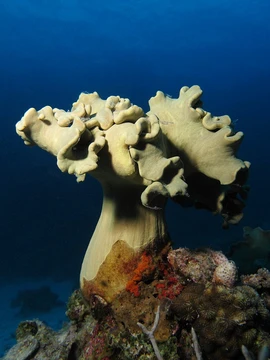
Maasella
A cryptic soft coral of the Mediterranean and Atlantic.

Maasella is a monotypic genus of soft coral in the family Paralcyoniidae, containing only the species Maasella edwardsi. It is notable for its cryptic nature, blending into its surroundings, and for being more common and widespread than previously thought.
Quick Facts
- Taxon
- Maasella edwardsi
Facts from the source article.
Lore & Background
Maasella edwardsi forms small groups in which polyps are linked by stolons. The anthocodia, the upper part of the polyp, can be fully retracted into the stiff, lower anthostele, which is broader and stiffened by calcareous spicules sometimes visible as white markings. Each polyp has eight pinnate tentacles, each with ten to thirteen short pinnules on each side, and a maximum diameter of 2.6 centimetres. It is usually golden brown or greenish-brown, sometimes with a green or transparent white oral disc.
First described in 1888 by French zoologist Henri de Lacaze-Duthiers from the western Mediterranean Sea, the species was considered rare but is now recognized as more common and widespread. It normally grows on rock and among coralline algae at depths of 2 to 50 metres. In 2014, it was detected for the first time in the Aegean Sea, where specimens were found on rocky substrate and on rhizomes of the seagrass Posidonia oceanica.
Breeding may be triggered by summer warming of the sea or related to the phase of the moon. It is unclear whether fertilization occurs inside or outside the polyps, but early larval development takes place on the outside surface of the coral, which may allow a greater number of larvae to be brooded and provide relative protection from abrasion.
Reader's Guide
Maasella edwardsi holds significance as a cryptic species that was once considered rare but is now understood to be more common and widespread across the Mediterranean Sea and adjoining Atlantic Ocean. Its ability to blend into its background, growing on rock and among coralline algae, contributes to its underdetection. The species was first described in 1888 by Henri de Lacaze-Duthiers, and its range was expanded in 2014 with the first detection in the Aegean Sea, where it was found on rocky substrate and seagrass rhizomes. Biologically, its reproductive strategy is notable: breeding may be triggered by summer warming or lunar phases, and larvae are brooded on the coral's outer surface rather than internally, potentially allowing for larger broods and reduced abrasion. Additionally, three novel sesquiterpene lactones—edwardsolides A, B, and C—have been isolated from this soft coral, indicating potential for further biochemical research. The species remains a subject of ongoing study, particularly regarding its distribution and reproductive biology.
Did You Know?
- Maasella is monotypic, containing only the species Maasella edwardsi.
- Three novel sesquiterpene lactones called edwardsolides A, B, and C have been isolated from this coral.
- It was first detected in the Aegean Sea in 2014.
More in Soft Corals and Leathers 1-24
Spotted an error? Know more?
Reader corrections go straight into our review queue. Suggest an edit · How this site is sourced