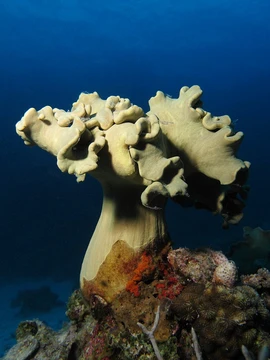
Litophyton arboreum
A soft coral with maternal symbiont transfer and medical potential.

Litophyton arboreum, commonly known as broccoli coral, is a soft coral (octocoral) found from the Red Sea to the Western Pacific. It grows up to 80 cm, usually on seaward reef slopes or hard bottoms, and its color varies from pale olive-green to yellow or grey. It is notable for its unique reproductive strategy involving maternal transfer of Symbiodinium, a rare phenomenon among corals, and for its production of the antimicrobial and anticancer compound litopharbol.
Quick Facts
- Taxon
- Litophyton arboreum
Facts from the source article.
Lore & Background
Litophyton arboreum was originally classified in 1775 by the Swedish Linnaean naturalist Peter Forsskål. As of 2016, the entire genus Litophyton was reclassified using phylogenetic data, in contrast to its original morphological classification. The species is an anthozoan in the order Alcyonacea, family Nephtheidae. It is commonly found in the Red Sea, where its coverage varies widely by location: in the Gulf of Umm al-Rashrash Nature Reserve it can compose up to 36% of living soft coral coverage, while in other Red Sea locations such as the South and Center Muqebla regions it composes as little as 3%. A 1997 reef transect study showed that octocorals like L. arboreum compose under 20% of soft coral coverage on both reef flats and upper fore-reefs in the Gulf of Umm al-Rashrash, off the East coast of the Sinai Peninsula. In the Gulf of Aqaba off the Jordanian coast, L. arboreum is found in well developed reefs that lack spur and groove patterns due to calm waters.
Reader's Guide
Litophyton arboreum is significant for its reproductive biology and potential medical applications. It is a gonochoric planulae brooder, meaning individual colonies have separate sexes and reproduce by broadcasting gametes. A 1992 study revealed that in L. arboreum spawning events, gametes released for fertilization were already associated with Symbiodinium, indicating maternal transfer of these endosymbiotic dinoflagellates during oogenesis. This is a rare strategy among corals, as most scleractinian reef-building corals lack Symbiodinium in their broadcast gametes and must acquire them from the environment. The maternal transfer mechanism involves stud-like cellular features that link gastrodermal cells, allowing Symbiodinium to move through gaps in the mesoglea and be taken up by microvilli on the oocyte. This strategy may lead to more successful colonization, as new colonies do not need to establish their own symbiosis. Historically, this was the first indication of cell-bound Symbiodinium in parent cells not being exclusively used for symbiosis. Medically, a 2018 study isolated litopharbol, a pseudoguaiane-type sesquiterpene compound from L. arboreum that exhibits both antimicrobial and anticancer activity. A 2006 study showed that 83% of Red Sea Alcyonacean corals exhibited antimicrobial activity against marine bacteria, using antibiotic compounds as chemical defense.
Did You Know?
- It is one of very few corals with recorded evidence of maternal Symbiodinium transfer.
- A 2018 study isolated the compound litopharbol from L. arboreum, which has both antimicrobial and anticancer activity.
More in Soft Corals and Leathers 1-24
Spotted an error? Know more?
Reader corrections go straight into our review queue. Suggest an edit · How this site is sourced