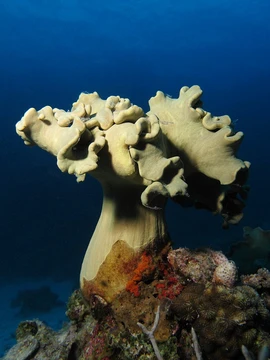
Iridogorgia
Deep-sea soft coral with a spiral axis and iridescent branches.

Iridogorgia is a genus of soft coral in the family Chrysogorgiidae, native to the Atlantic and Pacific Oceans. It is notable for its large spiral shape with long, flexible branches and its occurrence in deep sea environments at depths of 558–2311 meters.
Quick Facts
- Taxon
- Iridogorgia
- Type Species
- Iridogorgia pourtalesii
- Type Species Authority
- Verrill, 1883
Facts from the source article.
Lore & Background
Iridogorgia was first described in 1883 by Verrill from specimens collected during coastal expeditions of the southeastern United States and West Indies, with the original specimen taken from Dominica at a depth of 991 meters. In 1908, Nutting described two species—I. superba and I. bella—from dredge hauls off the main Hawaiian Islands by the US Fish Commission Steamer ‘Albatross’; I. superba was nearly complete, while I. bella was severely damaged with only a few branches left attached.
The genus is characterized by an upright-spiraling monopodial axis with long, flexible, unbranched branches arising from one side of the spiral. Many of these branches have brilliant iridescent features, and the corals are usually large in size. The genus currently contains 16 described species, with species distributed across both the Atlantic and Pacific Oceans; three species—I. magnispiralis, I. fontinalis, and I. splendens—occur in both oceans.
Rhodaniridogorgia is currently considered a taxonomic synonym of Iridogorgia. It was described along with I. magnispiralis by Watling in 2007 based on a wavy axis, but later morphological and phylogenetic analyses support Rhodaniridogorgia (now I. superba) being a synonym of this genus.
Reader's Guide
Iridogorgia holds significance as a deep-sea soft coral genus with a distinctive spiral morphology and iridescent branches, making it notable among chrysogorgiids. Its description in 1883 by Verrill from Atlantic expeditions marks an early record of deep-sea coral diversity, and subsequent work by Nutting in 1908 expanded knowledge of Pacific species from Hawaiian waters. The genus currently comprises 16 described species, with distribution spanning the Atlantic and Pacific Oceans at depths of 558–2311 meters. In the North Atlantic, four species inhabit seamounts: I. pourtalesii, I. magnispiralis, I. splendens, and I. fontinalis. A few species, including I. superba, I. bella, and I. magnispiralis, have been recorded near the Hawaiian islands. The diversity in the western Pacific is poorly known. The synonymy of Rhodaniridogorgia with Iridogorgia, based on morphological and phylogenetic analyses, reflects ongoing taxonomic refinement within the group. The genus's large spiral axis and flexible branches, along with its deep-sea habitat, contribute to its ecological and morphological distinctiveness.
Did You Know?
- Iridogorgia was first described in 1883 by Verrill from a specimen collected off Dominica at 991 meters depth.
- The genus contains 16 described species, with three species found in both the Atlantic and Pacific Oceans.
- Rhodaniridogorgia is considered a taxonomic synonym of Iridogorgia based on morphological and phylogenetic analyses.
- Some species, such as I. superba and I. bella, were collected from Hawaiian waters by the US Fish Commission Steamer ‘Albatross’ in 1908.
More in Soft Corals and Leathers 1-24
Spotted an error? Know more?
Reader corrections go straight into our review queue. Suggest an edit · How this site is sourced