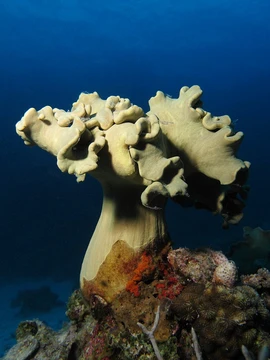
Gorgoniidae
Soft coral family restricted to American coasts with complex spicules.

Gorgoniidae is a family of soft corals belonging to the order Malacalcyonacea. Almost all of its genera and species are found along the Atlantic and Pacific coasts of the Americas. The family was once much broader, covering all horny octocorals, but is now limited to species with calcareous spicules under 0.3 mm long, which are covered in regularly arranged rings of complex warts. Their polyps are mostly unarmed, with only a few flat rods arranged in a chevron pattern beneath each tentacle. The horny axial cylinder is weakly divided, if at all, and has a narrow, chambered central core. Branchlets are typically slender with a thin cortex. The polyps can retract, and the stems contain an axis made of the protein gorgonin surrounding a hollow, cross-chambered central tube. Molecular studies indicate the family is polyphyletic.
The main way to distinguish genera is by the degree and type of spiculation, along with branching patterns and overall colony shape. Colony forms range from simple, unbranched whips to open branches, net-like structures, and leafy fronds seen in *Phyllogorgia* and *Phycogorgia*. Many species live in warm waters off the Atlantic and Pacific coasts of the Americas. Some genera, such as *Lophogorgia*, *Leptogorgia*, and *Eunicella*, are more widespread, occurring in the temperate eastern Atlantic and the Mediterranean. Certain species with unusual canoe-shaped spicules are all found in the Caribbean Sea.
Genera currently listed by the World Register of Marine Species include: *Adelogorgia*, *Antillogorgia*, *Callistephanus*, *Chromoplexaura*, *Eugorgia*, *Gorgonia*, *Leptogorgia*, *Olindagorgia*, *Pacifigorgia*, *Phycogorgia*, *Phyllogorgia*, *Psammogorgia*, and *Pseudopterogorgia*. Genera formerly placed in Gorgoniidae but now moved to other families include: *Eunicella* (now Eunicellidae), *Filigorgia* and *Pinnigorgia* and *Pterogorgia* and *Tobagogorgia* (now Pterogorgiidae), *Guaiagorgia* (now Acanthogorgiidae), *Hicksonella* and *Rumphella* (now Isididae).
Quick Facts
- Taxon
- Gorgoniidae
Facts from the source article.
Lore & Background
Originally the family Gorgoniidae included a much wider range of genera and was used for all horny Octocorallia. It is now restricted to species where calcareous spicules are less than 0.3 mm in length, sculptured with regularly disposed girdles of complicated tubercles ('warts'), and where the anthocodiae are relatively unarmed, at most with a few characteristically shaped flat rods en chevron beneath each tentacle. The horny axial cylinder is weakly loculated if at all, and is perforated by a relatively narrow, chambered central chord. Branchlets are usually quite slender, with a thin cortex.
The polyps are retractable and the stems have an axis of the protein gorgonin surrounding a narrow, hollow, cross-chambered central core. The main feature separating genera is the degree and type of spiculation; other diagnostic features include branching pattern and colony morphology. There is an increase in complexity from unbranched whip forms, open branched forms, reticulate forms, and leafy frond forms which include Phyllogorgia and Phycogorgia.
Many species are native to warm waters around the Atlantic and Pacific coasts of America. Some genera, including Lophogorgia, Leptogorgia and Eunicella, have a more widespread distribution including the temperate eastern Atlantic and the Mediterranean Sea. Certain species have strange canoe-shaped spicules and these are all found in the Caribbean Sea.
Reader's Guide
The family Gorgoniidae is significant as a group of soft corals whose definition has been refined over time, moving from a broad grouping of all horny Octocorallia to a more restricted set based on microscopic spicule morphology and axial structure. The article notes that molecular phylogenetic analyses suggest the family is polyphyletic, indicating that its current classification may not reflect evolutionary relationships. The family's genera are distinguished primarily by spiculation, branching pattern, and colony form, with forms ranging from simple whips to complex leafy fronds. Many species are restricted to warm American coastal waters, though some genera extend into the temperate eastern Atlantic and Mediterranean. The presence of canoe-shaped spicules exclusively in Caribbean species highlights regional variation. The list of genera formerly placed in Gorgoniidae—now reassigned to families such as Eunicellidae, Pterogorgiidae, Acanthogorgiidae, and Isididae—demonstrates ongoing taxonomic revision within the group.
Did You Know?
- Nearly all genera and species of Gorgoniidae are native to the east and west coasts of America.
- The family is polyphyletic according to molecular phylogenetic analyses.
- Certain species have strange canoe-shaped spicules, all found in the Caribbean Sea.
More in Soft Corals and Leathers 1-24
Spotted an error? Know more?
Reader corrections go straight into our review queue. Suggest an edit · How this site is sourced