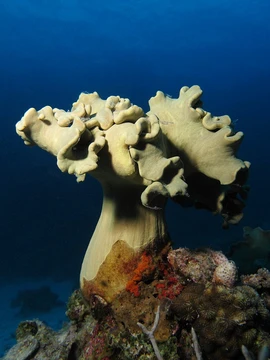
Gersemia rubiformis
A soft coral with red sclerites and no zooxanthellae.

Gersemia rubiformis, called the sea strawberry, is a soft coral belonging to the family Alcyoniidae. It forms erect, branching colonies that grow from a single main stalk, with knobbly clumps. The polyps, which cannot retract into their calyces, cluster near the tips of the narrower branches. These branches are not rigid; they are stiffened by red sclerites—some shaped like tiny capstans—and sway in the current. This coral lacks zooxanthellae, the symbiotic algae found in many other corals.
The species lives in polar to temperate waters of the Arctic Ocean and the northwest Atlantic, from Canada’s coasts down to Cape Hatteras in North Carolina. A separate population exists in the northeast Pacific, off British Columbia and south to California. It settles on sandy or muddy bottoms, rocks, and the hard parts of other invertebrates, like shells.
In its habitat, Gersemia rubiformis shares space with various marine invertebrates. Juvenile basket stars (Gorgonocephalus eucnemis) often cling to the coral or hide in its crevices. The white sea anemone Metridium senile grows nearby, and in California, the rock scallop (Crassadoma gigantea) occupies the same area. In Puget Sound, young basket stars have been observed living, growing, and feeding inside the pharynges of the coral’s polyps, only becoming free-living once large enough to catch their own food.
Research in British Columbia showed that extracts from Gersemia rubiformis have antimicrobial activity in lab tests. Scientists isolated three new diterpenoids from the coral, naming them gersemolide, rubifolide, and epilophodione.
Quick Facts
- Taxon
- Gersemia rubiformis
Facts from the source article.
Lore & Background
Gersemia rubiformis is a colonial coral that grows in erect, knobbly clumps branching from one main stalk. Its polyps are concentrated near the ends of the narrower terminal branches and are non-retractile in their calyces. The branches are not rigid but are stiffened by the presence of sclerites, allowing them to sway gently in the current. The sclerites are red, some being irregular and shaped like miniature capstans.
This species is found in polar to temperate regions of the Arctic Ocean and the northwest Atlantic Ocean from Canada south to Cape Hatteras in North Carolina, with a separate population in the Pacific Ocean off British Columbia and south to California. It occurs on sandy and muddy substrates, on rocks, and on the hard parts of other benthic invertebrates such as shells.
Many other marine invertebrates share its habitat. Juvenile basket stars (Gorgonocephalus eucnemis) are often found clinging to the coral and hiding in the interstices. In Puget Sound, juvenile basket stars have been found living, growing and feeding inside the pharynges of Gersemia rubiformis polyps, only becoming free-living when large enough to catch food for themselves. The white sea anemone Metridium senile often grows nearby, and the rock scallop (Crassadoma gigantea) shares the same habitat in California.
Reader's Guide
Gersemia rubiformis is a soft coral of ecological and biochemical interest. Ecologically, it serves as a microhabitat for juvenile basket stars (Gorgonocephalus eucnemis), which in Puget Sound live and feed inside the coral's pharynges until they are large enough to become free-living. This intimate association highlights the coral's role in the life cycle of another species. Biochemically, researchers in British Columbia found that extracts of Gersemia rubiformis showed antimicrobial activity in vitro, leading to the identification of three novel diterpenoids: gersemolide, rubifolide, and epilophodione. These compounds represent a potential source of natural products. The coral's distribution across both the Atlantic and Pacific Oceans, from polar to temperate regions, and its occurrence on diverse substrates—sand, mud, rocks, and shells—underscore its adaptability. Its lack of zooxanthellae distinguishes it from many other soft corals that rely on symbiotic algae.
Did You Know?
- Gersemia rubiformis does not contain the symbiotic alga zooxanthella.
- Its sclerites are red, some shaped like miniature capstans.
- Juvenile basket stars (Gorgonocephalus eucnemis) have been found living inside the pharynges of its polyps in Puget Sound.
- Three novel diterpenoids—gersemolide, rubifolide, and epilophodione—were identified from its extracts.
More in Soft Corals and Leathers 1-24
Spotted an error? Know more?
Reader corrections go straight into our review queue. Suggest an edit · How this site is sourced