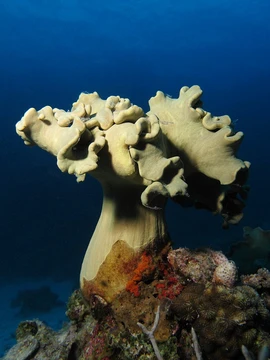
Gersemia fruticosa
A deep-sea soft coral studied for prostaglandin synthesis.

Gersemia fruticosa, a soft coral belonging to the family Alcyoniidae, lives in deep, cold waters. Its range spans the boreal northwest Atlantic, from off Delaware north to Baffin Bay and the Davis Strait, as well as the northeast Atlantic’s Barents Sea. Because deep-sea corals are so hard to observe, little is known about their reproduction. However, researchers brought this species to the surface and kept it in a lab with flowing seawater. There, it released planula larvae between April and June, coinciding with the peak of phytoplankton in the water. These larvae measured 1.5 to 2.5 mm long and settled, undergoing metamorphosis anywhere from 3 to 70 days after release. Three months later, the new primary polyps stood up to 10 mm tall with a stalk 1 mm wide. Although the juveniles were kept for over a year, no budding occurred, suggesting the coral grows very slowly. In the lab, Gersemia fruticosa has also been used to study prostaglandin synthesis. It demonstrated in vitro biosynthesis of these compounds, a feat not seen in other coral species studied, possibly involving a novel lipoxygenase pathway or a new cyclooxygenase isozyme.
Quick Facts
- Taxon
- Gersemia fruticosa
Facts from the source article.
Lore & Background
Gersemia fruticosa is a deep sea soft coral with a boreal distribution, occurring in the northwest Atlantic Ocean from off the coast of Delaware northward to Baffin Bay and the Davis Strait, as well as in the northeast Atlantic Ocean in the Barents Sea. Little is known of the reproduction of deep sea corals, especially soft corals, because observation is so difficult at the depths at which they live. However, specimens of Gersemia fruticosa were brought to the surface and maintained in the laboratory under flow-through conditions. Planula larvae were released between April and June, at the time of year when the greatest quantity of phytoplankton was present in the water. The larvae were between 1.5 and 2.5 mm long and settled and underwent metamorphosis between 3 and 70 days after release. Three months later, the new primary polyps were up to 10 mm high with a stalk diameter of 1 mm. These juveniles were maintained for over a year but no budding took place, which suggests that this species grows very slowly.
Reader's Guide
Gersemia fruticosa has been used in the laboratory to study the synthesis of prostaglandins by corals. It has been possible to demonstrate the biosynthesis in vitro in this coral but not in other species studied, and a novel LO pathway or a new COX-isozyme may be involved. This makes the species significant for biochemical research, as it provides a unique model for understanding prostaglandin production in marine organisms. The slow growth observed in laboratory-maintained juveniles, with no budding over a year, further underscores its distinct biology. Its deep-sea habitat and boreal distribution add to its ecological interest, though much remains unknown about its reproduction and life history due to the challenges of observing deep-sea corals.
Did You Know?
- Gersemia fruticosa is a deep sea species with a boreal distribution in the northwest and northeast Atlantic Ocean.
- Its planula larvae are released between April and June, coinciding with peak phytoplankton abundance.
- Juveniles grew to up to 10 mm in height after three months, but no budding occurred in over a year, suggesting very slow growth.
- This coral has been used to demonstrate prostaglandin biosynthesis in vitro, a process not observed in other studied coral species.
Frequently Asked Questions
What is Gersemia fruticosa?
It is a soft coral classified in the family Alcyoniidae, living in deep, cold-water environments. It is not a stony coral or an anemone but a true Alcyonacea member found across the boreal Atlantic.
Where can you find Gersemia fruticosa in the wild?
Its known range stretches from off Delaware's coast northward to Baffin Bay and the Davis Strait in the northwest Atlantic, and it also appears in the Barents Sea of the northeast Atlantic. All of these are deep, cold habitats rather than shallow tropical reefs.
How does Gersemia fruticosa reproduce?
In a lab experiment using flowing seawater, colonies shed planula larvae from April through June, a window that lines up with the seasonal phytoplankton bloom. Each larva was roughly 1.5 to 2.5 millimeters long at the time of release.
What happens after the larvae are released?
The planulae settled and completed metamorphosis anywhere from three to seventy days after release. Juveniles that survived to the three-month mark could grow to a height of up to 10 millimeters.
Why do researchers study Gersemia fruticosa?
Beyond its ecological role in deep-sea communities, this coral has been examined for its capacity to synthesize prostaglandins, making it of interest to biochemistry and pharmacology. Because it lives in deep, cold water and is hard to observe in situ, most of its known biology comes from controlled laboratory work.
More in Soft Corals and Leathers 1-24
Spotted an error? Know more?
Reader corrections go straight into our review queue. Suggest an edit · How this site is sourced