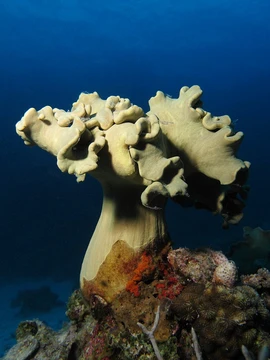
Dendronephthya hemprichi
A soft coral with daily spawning and clonal propagation.

Dendronephthya hemprichi is a soft coral common from the Red Sea to the Western Pacific. It typically appears pink or orange, with a transparent trunk, and can reach 70 centimeters in length. This species is gonochoric, meaning individual colonies produce either eggs or sperm. For sexual reproduction, it engages in broadcast spawning, releasing gametes into the water for fertilization. Unlike most soft corals at higher latitudes, which spawn annually, D. hemprichi follows a daily spawning pattern. Polyps expand and contract in response to water current speed, and gamete release occurs only when flow rates are between 3 and 25 centimeters per second. To improve fertilization chances, the coral anchors eggs to the polyp mouth with a mucus thread for a short time, allowing sperm from nearby male colonies to reach them. Asexually, it reproduces through clonal propagation via fragmentation. Small fragments, 2 to 5 millimeters long and containing a few polyps, break off from the parent colony over about 20 hours; hundreds may detach at once. These fragments have root-like structures at their base, are negatively buoyant, and tend to attach to the upper surfaces of horizontal substrates or, less often, to vertical surfaces—many of which are artificial structures like oil jetties near Eilat. Although more fragments settle on horizontal surfaces, colonies on vertical artificial surfaces have higher survival rates due to stronger water currents that deliver phytoplankton, the coral’s main food source.
D. hemprichi is a passive suspension filter feeder, consuming phytoplankton. Each polyp has eight tentacles lined with pinnules, increasing surface area for filtration. Evidence that phytoplankton is its primary energy source comes from fluorescence microscopy, measurements of phaeopigment levels (catabolites of phytoplankton), and observations of phytoplankton accumulation in the gut of starved specimens. Depletion of phytoplankton in water downstream of colonies further supports this.
The coral is found on steep slopes in the benthic zone at depths of 1 to 32 meters in the Red Sea, where strong wind-driven currents occur. Another species, D. sinaiensis, shares depths between 11 and 32 meters but has longer, denser pinnules, limiting it to smaller phytoplankton. D. hemprichi has larger sclerites in its exoskeleton, making it less flexible.
Quick Facts
- Taxon
- Dendronephthya hemprichi
Facts from the source article.
Lore & Background
Dendronephthya hemprichi was filmed in May 2023 on the Mediterranean coast of Israel at Sdot Yam and later photographed in Byblos, Lebanon. It is usually pink or orange with a transparent trunk and grows up to 70 cm. The smallest unit of this coral is a polyp. It is gonochoric, with colonies releasing either eggs or sperm, and participates in mass spawning events. Unlike most soft corals at high latitudes that spawn annually, D. hemprichi follows a diurnal spawning pattern, releasing gametes every day. Polyps expand and contract in response to water currents, releasing gametes only when flow rates are between 3–25 cm/s. To increase fertilization success, the egg is anchored to the polyp's mouth with a mucus thread for a short period. Asexually, it reproduces via clonal propagation through fragmentation: a small piece 2–5 mm long breaks off over about 20 hours, and a parent colony may have hundreds of fragments detaching simultaneously. These fragments have root-like processes at their base, are negatively buoyant, and attach more commonly to upper surfaces of horizontal substrata or vertical surfaces. Fragments on artificial vertical surfaces have higher survival rates due to strong currents supplying phytoplankton, the coral's main energy source.
Reader's Guide
Dendronephthya hemprichi is significant as an azooxanthellate soft coral that dominates zooxanthellate environments through rapid aggregation of biomass via asexual reproduction. Its diurnal spawning pattern is unusual among high-latitude soft corals. The species is a passive suspension filter feeder, ingesting phytoplankton using eight tentacles with pinnules that maximize filtration. Its presence on artificial vertical surfaces, such as oil jetties near Eilat, shows adaptation to human-altered habitats. Human impact from diving and industrial activities causes coral breakage, particularly in benthic and branching corals like D. hemprichi. Artificial reefs have been constructed with this species, sea urchins, and Stylophora pistillata to reduce diving pressure on natural reefs. On artificial reefs, D. hemprichi attaches to the bottom surface of horizontal plates because S. pistillata outcompetes it for the upper surface, which requires light for photosynthesis. This niche allows D. hemprichi to avoid algal growth and sedimentation. Understanding its optimal niches aids future transplantation to artificial reefs to remedy human impact.
Did You Know?
- D. hemprichi releases gametes every day, unlike most high-latitude soft corals that spawn annually.
- Its polyps release gametes only when water flow is between 3–25 cm/s.
- Fragments of D. hemprichi are 2–5 mm long and detach over about 20 hours.
More in Soft Corals and Leathers 1-24
Spotted an error? Know more?
Reader corrections go straight into our review queue. Suggest an edit · How this site is sourced