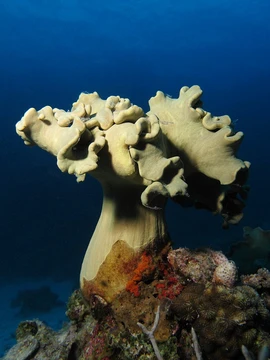
Coralliidae
Precious corals with red skeletons, harvested for jewelry and artifacts.

Coralliidae, commonly called precious corals, is a family of soft corals within the order Scleralcyonacea (phylum Cnidaria). These stationary corals dominate hard-bottomed seafloor habitats like seamounts, canyons, and continental shelves. The family contains 69 descendant species, each helping to create living spaces for many other marine organisms. Their distinctive red calcium carbonate skeleton is harvested for handcrafted amulets, jewelry, and other valuable items, which earned them the name "precious corals." This trade makes the family vulnerable to overharvesting.
**Description**
Coralliidae are sedentary, colonial polyps with a simple cup-shaped body made of two cell layers, sloping peripheral platforms, and wide axial pits. Each polyp has eight unpaired, feather-like tentacles and eight mesenteries used for filter feeding and defense. All species have numerous tiny calcium carbonate structures called sclerites, 3 to 5 mm long, scattered across the surface in many directions. The internal skeleton consists of small stick-like calcium carbonate rods that fuse into a rigid framework, colored red, pink, or white. Polyps within a colony may be roughly equal in size and evenly spaced, or unevenly distributed and varying in size. Generally, older colonies have proportionally larger polyps and greater height.
Traditionally, the family was split into three genera based on polyp distribution: *Corallium*, *Hemicorallium*, and *Paracorallium*. After a revision of the Octocorallia, genera from the families Paragorgiidae, Sibogagorgiidae, and some from Alcyoniidae were added. The current genera are: *Carotalcyon*, *Corallium*, *Hemicorallium*, *Minabea*, *Mollecorallium*, *Notodysiferus*, *Paragorgia*, *Paraminabea*, *Pleurocorallium*, *Sibogagorgia*, *Sphaerasclera*, and the subfamily Anthomastinae (which includes *Anthomastus*, *Bathyalcyon*, *Heteropolypus*, and *Pseudoanthomastus*).
**Distribution**
Coralliidae species live in tropical, subtropical, and temperate oceans worldwide. Unlike shallow-water corals, these precious corals are found at depths of 60 to 2,000 meters (200 to 6,560 feet). Most species are abundant in the west and central Pacific, including seas around New Caledonia, Taiwan, Japan, and the Hawaiian Archipelago. Species diversity is lower in the Atlantic, Indian, and eastern Pacific oceans.
Quick Facts
- Taxon
- Coralliidae
Facts from the source article.
Lore & Background
Members of family Coralliidae are sedentary, colonial polypoids with a simple cup-shaped body consisting of two layers of cells, sloping peripheral platforms, and wide axial pits. Each polyp has 8 unpaired, pinnate tentacles and 8 mesenteries used for filter feeding and defense. The endoskeleton is composed of tiny stick-like calcium carbonate rods that fuse to form a rigid structure colored red, pink, or white. Sclerites on the surface range from 3 mm to 5 mm and diverge in many directions. Corals within a colony may be evenly distributed and equal in size, or unevenly distributed and varying in size, with a general positive relationship between colony age and polyp height.
Traditionally divided into three genera (Corallium, Hemicorallium, Paracorallium) based on polyp distribution, the family was later revised to include genera previously placed in families Paragorgiidae, Sibogagorgiidae, and some from Alcyoniidae. The current list of genera includes Carotalcyon, Corallium, Hemicorallium, Minabea, Mollecorallium, Notodysiferus, Paragorgia, Paraminabea, Pleurocorallium, Sibogagorgia, Sphaerasclera, and the subfamily Anthomastinae (containing Anthomastus, Bathyalcyon, Heteropolypus, Pseudoanthomastus).
Reader's Guide
Coralliidae species inhabit tropical, subtropical, and temperate oceans at depths of 60 to 2,000 meters. Most species are found in large numbers around the west and central Pacific, including the seas of New Caledonia, Taiwan, Japan, and the Hawaiian Archipelago. Species diversity is lower in the Atlantic, Indian, and eastern Pacific oceans. Hemicorallium and Paracorallium genera are abundant around seamounts near Japan and China, while Corallium species are widespread along the Mediterranean and neighboring Atlantic coasts. High levels of species diversity and exploited populations have been reported in the Mediterranean Sea and adjacent Atlantic, together with the Northern Pacific Ocean.
Feeding involves tentacles and pinnules capturing food in a raptorial manner: tentacles enter a preparatory feeding position, flex toward the mouth to suck in food, then flex outward again. For larger prey like brine shrimp, several tentacles work together. Reproduction occurs via broadcast spawning (releasing sperm and eggs into the water) or internal/external incubation on the maternal colony. Fertilization produces a planula larva that floats for several days before attaching to a hard surface and budding into a colony. Reproductive strategies can vary by location, as seen in Corallium rubrum: Indo-Pacific populations use broadcast spawning, while Mediterranean populations release planulae. Reproductive activity is higher from May to August.
Defense mechanisms include nematocysts, allelochemicals, and sclerites, making these corals rarely predated upon; they also have low nutritional value. Coral fisheries have caused detrimental effects. Before the 1970s, extraction used net-attached dredges or small sailboats; after the 1970s, motorized boats with longer metal dredges caused greater damage. Slow growth rates mean corals cannot keep up with harvesting rates, leading to overexploitation. The Mediterranean Ocean experienced declining yields in the 1980s, prompting the United Nations to place guidelines and ban dredging in 1994. Ongoing population declines led the EU and US to include Coralliidae in CITES Appendix II to regulate trade.
Did You Know?
- Coralliidae are also known as 'precious corals' due to their red calcium carbonate skeleton used for jewelry and amulets.
- These corals inhabit depths of 60 to 2,000 meters, primarily in the west and central Pacific, Mediterranean, and adjacent Atlantic.
- The family was revised to include genera from Paragorgiidae, Sibogagorgiidae, and Alcyoniidae.
- Reproductive strategies can vary by location; for example, Corallium rubrum uses broadcast spawning in the Indo-Pacific but releases planulae in the Mediterranean.
More in Soft Corals and Leathers 1-24
Spotted an error? Know more?
Reader corrections go straight into our review queue. Suggest an edit · How this site is sourced