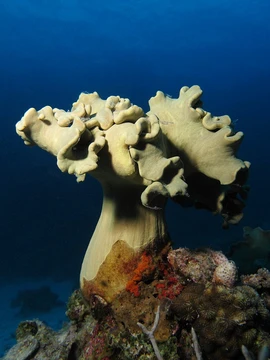
Clavulariidae
Soft coral family with retractable polyps and sclerite-stiffened tissues.

Clavulariidae is a family within the soft coral order Malacalcyonacea. Its colonies are built from individual polyps that can retract, each sprouting from a horizontal, encrusting stolon or basal membrane. The tissues are given rigidity by sclerites.
The World Register of Marine Species currently lists three genera in this family: *Clavularia*, *Hanabira*, and *Knopia*. Prior to a 2022 taxonomic revision of Octocorallia, the family also included *Azoriella*, *Bathytelesto*, *Carijoa*, *Cryptophyton*, *Cyathopodium*, *Denhartogia*, *Inconstantia*, *Incrustatus*, *Moolabalia*, *Paratelesto*, *Phenganax*, *Pseudocladochonus*, *Rhodelinda*, *Rolandia*, *Sarcodictyon*, *Schizophytum*, *Scleranthelia*, *Scyphopodium*, *Stereosoma*, *Stereotelesto*, *Telesto*, *Telestula*, and *Tesseranthelia*.
Quick Facts
- Taxon
- Clavulariidae
Facts from the source article.
Lore & Background
The family Clavulariidae belongs to the order Malacalcyonacea. Its colonies are characterized by separate retractable polyps that arise from a horizontal, encrusting stolon or basal membrane. The tissues are stiffened by sclerites, which are small calcareous elements. The World Register of Marine Species currently includes three genera: Clavularia, Hanabira, and Knopia. Before a 2022 taxonomic revision of Octocorallia, the family also contained 22 additional genera, including Azoriella, Bathytelesto, Carijoa, Cryptophyton, Cyathopodium, Denhartogia, Inconstantia, Incrustatus, Moolabalia, Paratelesto, Phenganax, Pseudocladochonus, Rhodelinda, Rolandia, Sarcodictyon, Schizophytum, Scleranthelia, Scyphopodium, Stereosoma, Stereotelesto, Telesto, Telestula, and Tesseranthelia.
Reader's Guide
Clavulariidae is notable as a family of soft corals within the order Malacalcyonacea, defined by its distinctive colony structure of separate retractable polyps growing from an encrusting stolon or basal membrane. The presence of sclerites stiffening the tissues is a key anatomical feature. The family's taxonomic history reflects a significant revision in 2022, which reduced its included genera from 25 to 3, moving many former members elsewhere. This revision highlights ongoing refinement in octocoral classification. The three currently accepted genera—Clavularia, Hanabira, and Knopia—represent the core of the family as understood today. The 22 former genera, such as Carijoa and Telesto, are now placed in other families, underscoring the dynamic nature of coral systematics. The family's description as having retractable polyps and sclerites provides a clear morphological basis for identification, though the taxonomic boundaries have shifted substantially.
Did You Know?
- Clavulariidae is in the order Malacalcyonacea.
- Its polyps are retractable and grow from a horizontal, encrusting stolon or basal membrane.
- The family currently contains three genera: Clavularia, Hanabira, and Knopia.
- Before a 2022 taxonomic revision, 22 additional genera were included in the family.
More in Soft Corals and Leathers 1-24
Spotted an error? Know more?
Reader corrections go straight into our review queue. Suggest an edit · How this site is sourced