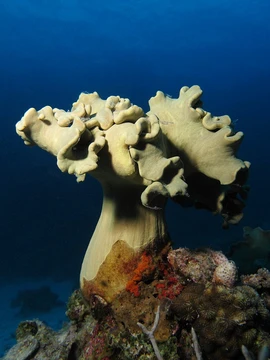
Chrysogorgia elegans
A rare deep-water soft coral used solely for research.

Chrysogorgia elegans belongs to the soft coral family Chrysogorgiidae. This species is rarely spotted in the ocean and has not been thoroughly studied; when it is found, it is used only for research.
This coral lives in the Gulf of Mexico, the Mediterranean Sea, and the North Atlantic Ocean. Most sightings have occurred along the northern and eastern Gulf of Mexico, the Florida Keys, and northwestern Cuba. About three-quarters of the known individuals inhabit deep waters. They settle on both hard bottoms and soft sediments.
Like other soft corals, Chrysogorgia elegans has no hard external skeleton. Its body grows around a central axis made of scleroprotein and non-spicular crystalline calcium carbonate arranged in concentric layers. The polyps, which are connected by a sheet of tissue called coenosarc, measure 1–3 mm across. This species grows slowly, matures late, and lives a long time.
Reproduction can be sexual or asexual. Asexual reproduction, called budding, occurs when a new polyp grows from an existing one—this is the most common method for this species. Sexual reproduction happens through spawning, where females release eggs and males release sperm, or through brooding, where a female polyp captures sperm while already holding eggs.
Chrysogorgia elegans depends on a symbiotic relationship with Zooxanthellae, an alga that lives inside the coral. This partnership allows photosynthesis to produce energy. The coral also absorbs phytoplankton, zooplankton, and other small algae.
Soft corals are toxic to humans because they contain palytoxin, a poisonous chemical.
Quick Facts
- Taxon
- Chrysogorgia elegans
Facts from the source article.
Lore & Background
Chrysogorgia elegans lacks a hard external skeleton. This species originated around an axis made up of scleroprotein with non-spicular crystalline calcium carbonate arranged in concentric layers. Polyps are connected by a sheet of tissue called coenosarc and range in size from 1–3 mm in diameter. Soft coral is categorized by slow growth, late maturity, and longevity. The species has been reported only in a few locations, mostly on the northern and eastern coast of the Gulf of Mexico, the Florida Keys, and on the northwestern coast of Cuba. They are prevalent in deep waters, with about 75% of this species discovered there, and can be found on both hard bottoms and soft sediments.
Reader's Guide
Chrysogorgia elegans is a rare species that has yet to be studied in depth due to the lack of spotting of this species in the oceans. As of now, the sole purpose upon discovery of this species is for research purposes. The species reproduces both sexually and asexually; budding is the most common method, but sexual reproduction also occurs via brooding or spawning. Its diet depends on a symbiotic relation with Zooxanthellae, an alga that allows photosynthesis, as well as ingestion of phytoplankton, zooplankton, and other small algae through absorption. Soft corals are toxic to humans, containing a chemical called palytoxin. The species is found in the Gulf of Mexico, the Mediterranean Sea, and the North Atlantic Ocean, with most records from deep waters off the Florida Keys and northwestern Cuba.
Did You Know?
- About 75% of this species have been discovered in deep waters.
- Budding is the most common reproduction method among Chrysogorgia elegans.
- Soft corals contain palytoxin, which is poisonous to humans.
More in Soft Corals and Leathers 1-24
Spotted an error? Know more?
Reader corrections go straight into our review queue. Suggest an edit · How this site is sourced