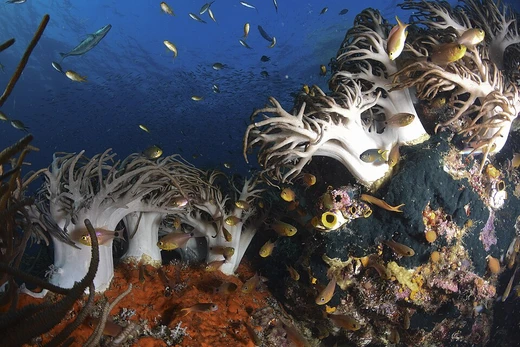
Pseudoplexaura porosa
A large, flexible Caribbean octocoral with bioactive secondary metabolites.

The porous sea rod, also known as the porous false plexaura, is a gorgonian octocoral from the family Plexauridae. It lives in the Caribbean Sea and the Gulf of Mexico. This coral forms large, upright, tree-like colonies that can grow to about 2.25 meters tall, with a trunk up to 5 centimeters thick. The branches fork repeatedly into equal pairs, are smooth, and end in long, slightly tapered tips about 4 millimeters thick. These tips are soft and slimy. The polyps have eight tentacles each, project from large, crowded apertures arranged in a spiral up the branches, and overlap one another. The colony’s color ranges from pale yellow to tan or reddish-purple.
The species is found from Bermuda and Florida down to Colombia, typically on reefs between 3 and 6 meters deep, though it has been recorded as deep as 280 meters. It thrives in strong currents, and its flexible branches sway with the water. The polyps extend their tentacles day and night to feed on plankton and organic particles. The coral hosts photosynthetic zooxanthellae (single-celled protists) in its tissues, which provide nutrients. The polyps can retract defensively and are armed with nematocysts. Few predators feed on it; these include the flamingo tongue snail, nudibranchs, butterflyfish, and some angelfish.
Colonies are either male or female. On nights about five days after a full moon in summer, regulated by the lunar cycle, mature colonies release gametes into the water. Fertilized eggs develop into planula larvae, which sink to the seabed five days later and metamorphose into new colonies. These new colonies are soon colonized by zooxanthellae and grow by budding. Pieces of coral can also detach and attach to the substrate to form new colonies. The species can live for several decades, and its main cause of death is detachment from the seabed during tropical storms.
Several substances have been isolated from its tissues, including crassin acetate, a diterpene lactone first obtained from this coral and found in very high concentrations in its zooxanthellae. Other diterpenoids from *Pseudoplexaura porosa* show cytotoxic antitumor activity when tested against human tumor cells.
Quick Facts
- Genus
- Pseudoplexaura
- Species
- porosa
Facts from the source article.
Lore & Background
Pseudoplexaura porosa is a large, tree-like octocoral that grows from a thick trunk and branches dichotomously into pairs of equal-sized branches. The end branches are long, slightly tapered, and smooth, with soft and slimy tips. The apertures for the polyps are large, crowded, and arranged spirally up the branches, with each polyp having eight tentacles. The colony is some shade of pale yellow, tan, or reddish-purple. It thrives in areas with strong currents, and its branches are flexible, swaying with water movement, in contrast to stony corals. It is found on reefs between 3 and 6 m deep, but has been recorded at depths as great as 280 m.
Reader's Guide
Pseudoplexaura porosa is significant as a source of crassin acetate, a diterpene lactone first obtained from this species and found in very high concentrations in its zooxanthellae. Additionally, diterpenoids isolated from this coral show cytotoxic antitumour activity when screened against human tumour cells. The species reproduces both sexually, with gamete release on nights about five days after a full moon in summer, and asexually, through budding and fragmentation. Its polyps feed on plankton and organic particles day and night, aided by symbiotic zooxanthellae that provide nutrients through photosynthesis. The polyps can retract defensively and are armed with nematocysts. Predators include the flamingo tongue snail, nudibranchs, butterflyfish, and some angelfish. The greatest cause of mortality is detachment from the seabed during tropical storms, though colonies can live for several decades.
Did You Know?
- Pseudoplexaura porosa can grow to a height of about 2.25 m (7 ft 5 in).
- Crassin acetate, a diterpene lactone, was first obtained from this species and is found in very high concentrations in its zooxanthellae.
- The polyps of P. porosa are armed with nematocysts and can be retracted into the branches defensively.
- Individual colonies are either male or female, and gamete release occurs about five days after a full moon in summer.
More in Soft Corals and Leathers, Part 2 1-24
Spotted an error? Know more?
Reader corrections go straight into our review queue. Suggest an edit · How this site is sourced