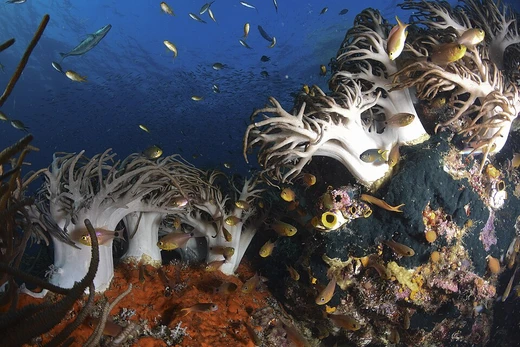
Eunicella cavolini
A fan-shaped soft coral common in the Mediterranean Sea.

Eunicella cavolini, the yellow gorgonian or yellow sea whip, is a common colonial soft coral from the Gorgoniidae family. It lives in the eastern Atlantic Ocean, the Mediterranean Sea, and the Ionian Sea.
This coral grows as a fan-shaped, much-branched structure up to about 50 cm tall. Its irregular, cylindrical branches are mostly arranged in a single plane. The stem has a widened base that attaches to the substrate, and the branches are smooth, short, and roughly 3 mm thick. A thin, yellowish-orange fleshy covering, the coenenchyme, coats the stiff skeleton. The polyps are white to yellow, about 2 mm long, and line up in four rows. It can be mistaken for the warty gorgonian (Eunicella verrucosa), which has rougher branches, or Leptogorgia sarmentosa, which has straighter, thinner branches and smaller polyps.
Throughout the Mediterranean, Eunicella cavolini is common. It typically grows between 10 and 30 m deep, though it can be found as deep as 150 m. It usually occupies a shallower zone than the violescent sea-whip (Paramuricea clavata). It often grows alongside other soft corals, sponges, polychaete worms, bryozoans, barnacles, and winged oysters.
To feed, the polyps extend their tentacles to capture zooplankton. Food fragments move to the mouth and then into the gut for digestion. Nutrients travel through channels in the living branch matrix to all parts of the colony. The fan usually aligns perpendicular to the current to maximize prey capture.
Colonies are either male or female, and breeding happens in summer. Male colonies release sperm into the water; eggs are fertilized inside the gastric chambers of female polyps in other colonies. The embryos develop into planula larvae, which are released into the sea. After drifting as plankton for one to four weeks, they settle on a suitable surface and metamorphose into new polyps. These grow into new colonies by budding. Growth is slow, about 1 to 2 cm per year.
Quick Facts
- Taxon
- Eunicella cavolini
Facts from the source article.
Lore & Background
Eunicella cavolini is a much-branched soft coral growing to a height of about 50 cm (20 in). It is fan-shaped with irregular, cylindrical branches largely growing in a single plane. The stem has an enlarged base fixed to the substrate, and the branches are smooth, short, and about 3 mm (0.12 in) thick. The coenenchyme (the thin fleshy covering of the stiff skeleton) is yellowish-orange, while the polyps are white to yellow, about 2 mm (0.08 in) long, and arranged in four rows.
This species can be confused with the warty gorgonian (Eunicella verrucosa), but that sea fan has rougher branches, or with Leptogorgia sarmentosa, but that species has straighter, more slender branches with smaller polyps. It is normally found in a shallower zone than the violescent sea-whip (Paramuricea clavata) and often grows in association with other soft corals, sponges, polychaete worms, bryozoans, barnacles, and winged oysters.
Colonies are either male or female, and breeding takes place during the summer. Polyps in male colonies liberate sperm into the water, and eggs are fertilised inside the gastric chambers of female polyps in other colonies. The embryos develop into planula larvae, which are released into the sea and drift as plankton for one to four weeks before settling on suitable surfaces and undergoing metamorphosis into new polyps. Growth is slow, at about 1 to 2 cm (0.4 to 0.8 in) per year.
Reader's Guide
Eunicella cavolini is a notable species of soft coral due to its common occurrence throughout the Mediterranean Sea and its distinctive fan-shaped, much-branched morphology. Its significance lies in its ecological role as a filter feeder, with polyps expanding their tentacles to catch zooplankton. The fan is usually orientated perpendicular to the current to maximise prey capture, and nutrients are transferred throughout the colony via channels in the living matrix of the branches. The species is also notable for its slow growth rate of about 1 to 2 cm per year, which underscores its vulnerability to disturbance. Its breeding strategy involves external fertilisation and a planktonic larval stage lasting one to four weeks, allowing for dispersal. The species can be confused with similar gorgonians such as Eunicella verrucosa and Leptogorgia sarmentosa, but is distinguished by its smooth branches and polyp arrangement. It is often found in association with other marine organisms, including sponges, polychaete worms, and barnacles, indicating its role in a diverse benthic community. Its depth range of 10 to 30 m, with occurrences down to 150 m, places it in a shallower zone than the violescent sea-whip.
Frequently Asked Questions
What is Eunicella cavolini?
Eunicella cavolini is a colonial soft coral belonging to the Gorgoniidae family, commonly known as the yellow gorgonian or yellow sea whip. It is one of the more frequently encountered fan-shaped soft corals in Mediterranean reef communities.
What does Eunicella cavolini look like?
It forms a much-branched, fan-shaped colony up to roughly 50 cm tall, with short, smooth, cylindrical branches about 3 mm thick arranged mostly in a single plane. A thin yellowish-orange fleshy layer (the coenenchyme) covers the rigid internal skeleton, and small white-to-yellow polyps around 2 mm long dot the surface.
Where can you find Eunicella cavolini in the wild?
This species inhabits the eastern Atlantic, the Mediterranean Sea, and the Ionian Sea, typically at depths between 10 and 30 metres, though individuals have been recorded as deep as 150 metres. It anchors itself to the substrate through a widened stem base.
How fast does Eunicella cavolini grow and how large does it get?
Colonies reach a maximum height of about 50 cm (20 in) and put on roughly 1 to 2 cm of new growth each year. Branches stay relatively slender, around 3 mm in diameter, giving the coral its characteristic whip-like appearance.
Why is Eunicella cavolini ecologically important?
As a common fan-shaped soft coral in Mediterranean habitats, it provides three-dimensional structure that shelters small fish, crustaceans, and other invertebrates. Its steady, slow growth also makes it a useful indicator of reef stability and long-term environmental conditions in its range.
More in Soft Corals and Leathers, Part 2 1-24
Spotted an error? Know more?
Reader corrections go straight into our review queue. Suggest an edit · How this site is sourced