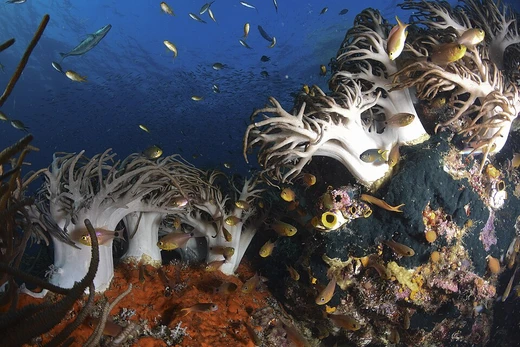
Antillogorgia elisabethae
A commercially harvested Caribbean soft coral with analgesic properties.

Antillogorgia elisabethae is a soft coral species from the Caribbean Sea, shaped like a sea plume or sea whip. It lives at depths of 25 to 30 meters, often near reef drop-offs. Its feathery branches are arranged in a pinnate, distichous pattern with radial symmetry, and they align with the ocean current. The coral ranges from 0.3 to 2 meters in size. It is commercially harvested for analgesics and cosmetic creams, with the compound Pseudopterosin A—a diterpene glycoside—believed to provide selective pain relief. It is also used in the pet trade for fish tanks. Its conservation status is Least Concern.
For reproduction, females place eggs on their reproductive polyps, where they are exposed to the water current. Sperm fertilizes the eggs, and within one to two days, a planula larva develops. The larvae stay on the parent colony for two to four days before becoming free-swimming. These larvae are ciliated and bilaterally symmetric. Because they are negatively buoyant, they sink to the ocean floor and usually settle near the parent, growing into adults. This makes the mating system polygynandrous. Peak reproduction occurs between November and January.
Quick Facts
- Taxon
- Antillogorgia elisabethae
Facts from the source article.
Lore & Background
Antillogorgia elisabethae resides at reef drop-offs in the Caribbean Sea, from depths of 25 to 30 metres. It appears as a plume of feathery appendages with radial symmetry, and its branches are pinnate and distichous, orienting themselves in the direction of the ocean current. The species ranges in size from 0.3 to 2 metres.
Reproduction involves the female exposing eggs on her reproductive polyps to the water current. Sperm contacts the eggs, and fertilized eggs develop into planulae in 1–2 days. Larvae form a colony on the parent for two to four days before becoming free-swimming. The free-swimming larvae are ciliated and bilaterally symmetric, and due to negative buoyancy they sink and settle near the parent organism. The mating system is polygynandrous, with peak reproduction between November and January.
Reader's Guide
Antillogorgia elisabethae holds significance as a commercially important soft coral harvested for analgesics and cosmetic creams. The compound believed to cause its beneficial effects is Pseudopterosin A, a diterpene glycoside that acts as a selective analgesic. Additionally, the species is used in fish tanks as part of the commercial pet industry. Its conservation status is Least Concern, indicating that current harvesting does not threaten its populations. The coral's reproductive strategy, with negatively buoyant larvae settling near the parent, suggests localized recruitment. Its orientation of branches toward ocean currents reflects adaptation to its environment. The species' dual use in medicine and the aquarium trade underscores its economic value, while its Least Concern status suggests sustainable management. The peak reproductive period from November to January may inform harvesting regulations to protect spawning events.
Did You Know?
- Antillogorgia elisabethae is harvested for analgesics and cosmetic creams.
- The compound Pseudopterosin A is a selective analgesic found in this coral.
- Its larvae are ciliated and bilaterally symmetric before settling.
Frequently Asked Questions
What is Antillogorgia elisabethae?
Antillogorgia elisabethae is a soft coral species native to Caribbean waters, recognised for its plume-like or whip-like silhouette. It sits within the broader group of sea whips and plumes that characterise tropical reef communities.
Where and how deep does Antillogorgia elisabethae live?
The coral typically occupies depths of 25 to 30 metres, favouring the edges of reef drop-offs in the Caribbean Sea. Its feathery branches orient themselves along the prevailing current to maximise filter-feeding.
What does Antillogorgia elisabethae look like and how large does it grow?
Its branches follow a pinnate, distichous arrangement with radial symmetry, producing a distinctive two-row, feathered profile. Individual specimens range from about 0.3 metres up to 2 metres in overall size.
Why is Antillogorgia elisabethae harvested commercially?
It is collected for the diterpene glycoside Pseudopterosin A, a compound studied for its selective analgesic properties and incorporated into pain-relief formulations and cosmetic creams. The species also appears in the ornamental aquarist trade for reef aquariums.
What is the conservation status of Antillogorgia elisabethae and when does it reproduce?
The species is currently listed as Least Concern, indicating no immediate threat to its population. Its peak reproductive window runs from November through January.
More in Soft Corals and Leathers, Part 2 1-24
Spotted an error? Know more?
Reader corrections go straight into our review queue. Suggest an edit · How this site is sourced