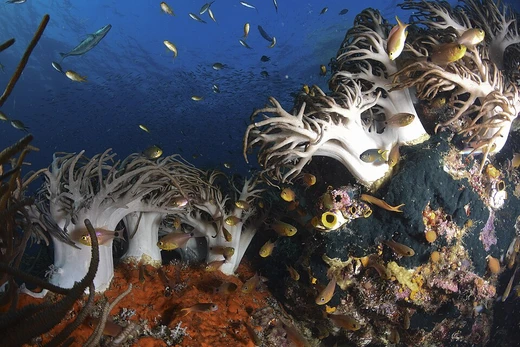
Primnoa
A keystone soft coral genus providing habitat in cold waters.

Primnoa, or red tree coral, is a genus of soft corals that serves as the type genus for the family Primnoidae. These sessile, benthic cnidarians inhabit the North Pacific, North Atlantic, and Subantarctic South Pacific. They are ecologically significant as keystone species, offering habitat and refuge for the megafauna in those regions.
The name *Primnoa* comes from the Greek *Prymno*, an Oceanid, with the root *prymnos* meaning "last," "lowest," or "deepest." Jean Vincent Félix Lamouroux first described the genus in 1812. While many species were proposed in the 19th and 20th centuries, most were originally placed in other genera within Primnoidae. Today, only five valid species and one variety are recognized.
Colonies are bushy and heavily branched, with a hidden main stem and dichotomous branching—each fork splits into two equal branches. The large, non-retractile polyps are protected by six overlapping rows of calcitic scales; adaxial scales are smaller or absent. Polyps are distinct, usually appressed and downward-facing, arranged randomly but close together. Most have small, thorny tentacles and a well-developed operculum. Primnoa are monomorphic, having only one polyp type, and their internal anatomy matches other gorgonian corals. Species differ mainly in scale shape and number, with colors ranging from pink to reddish-orange.
These corals are ahermatypic, not building reefs, but they form large clusters. Unlike many octocorals that use aragonite, Primnoa use calcite, a more stable form of calcium carbonate that is less soluble in seawater. They anchor to hard substrates with calcareous discoid holdfasts, reinforced by calcite layers at the colony base.
Reproduction is poorly understood. Primnoa are gonochoristic, with each colony being male or female. They reproduce via broadcast spawning with external fertilization, but show no evidence of reproductive periodicity or synchronized mass spawning.
Primnoa are azooxanthellate, lacking symbiotic *Symbiodinium*. They are primarily carnivorous filter-feeders, obtaining nutrition from sinking particulate organic matter and zooplankton. Their downward-facing polyps may also allow them to eat resuspended meiofauna.
As keystone species, foundation species, and ecological engineers, Primnoa provide shelter and substrate for many animals.
Quick Facts
- Taxon
- Primnoa
Facts from the source article.
Lore & Background
The name Primnoa derives from the Greek word Πρυμνὼ (Prymno), the name of an Oceanid, itself from πρυμνός meaning 'last', 'lowest', and by extension 'deepest'. The genus was first described by Jean Vincent Félix Lamouroux in 1812. In the 19th and 20th centuries, several species were proposed as members of Primnoa, but most were originally described as members of other genera within Primnoidae. Currently, only five valid species and one variety are recognized.
Primnoa colonies are typically bushy, heavily branched with a main stem, and dichotomously branch into two equally sized branches at each point. They have large, non-retractile polyps protected by six overlapping rows of calcitic scales, with adaxial scales smaller or absent. Polyps are individually distinct, appressed, downward facing, and randomly arranged. They are monomorphic, with only one polyp type. Their internal anatomy is consistent with other gorgonian corals. Species differ primarily in body scale shape and number. Colors range from pink to reddish-orange. They are ahermatypic, not reef-building, but form large structures and clusters. They use calcite (more stable than aragonite) and anchor to hard substrates with calcareous discoid holdfasts.
Primnoa are gonochoristic, with each colony either male or female, and reproduce via broadcast spawning with external fertilization. Unlike most corals, there is no evidence of reproductive periodicity or synchronized mass spawning. They are azooxanthellate, lacking symbiotic Symbiodinium, and are primarily carnivorous filter-feeders, consuming sinking particulate organic matter and zooplankton; the possibility of eating resuspended meiofauna has been proposed due to their downward-facing polyps.
Reader's Guide
Primnoa species are ecologically important as keystone species, foundation species, and ecological engineers. Their complex branching and large size provide shelter and substrate for many animals. Suspension feeders such as crinoids, basket stars, anemones, and sponges use the branches to elevate themselves and collect nutrients, reported at depths greater than 300 m. Crabs, shrimps, and rockfish seek shelter among the polyps or beneath the branches; some use the coral for reproductive purposes, hidden from predators.
Predators include sea stars, nudibranchs, and snails, with sea stars being primary predators—one study found them responsible for 45–34% of polyp consumption. Primnoa require hard substrates like rocky outcrops or boulders, allowing them to live in strong currents that increase food capture. Despite being deep-water corals, they can occur in shallow water due to deep-sea emergence, where retreating glaciers expose bedrock and create cool temperatures mimicking deep-water conditions. One study noted atypical growth forms (ecomorphs) due to stress from turbidity and increased water temperature.
The Aleutian Islands host 19 species of Primnoidae, and 25 of 69 documented coral species there are endemic, including P. wingi. Diversity increases west of 169°W. Some scientists believe the Aleutian Islands serve as an evolutionary cradle for cold-water soft corals. The largest threat is from fisheries and net trawling, which uproot and destroy corals. Nearly 39% of the Aleutian seafloor shows disturbance from bottom-contact fishing gear. Because of their vital interactions with megafauna, fisheries must integrate coral conservation to avoid industry disruption.
Did You Know?
- Primnoa are ahermatypic, using calcite instead of aragonite for their skeletons.
- They are gonochoristic and reproduce via broadcast spawning with no evidence of synchronized mass spawning.
- Sea stars are their primary predators, responsible for 45–34% of polyp consumption.
- In the Aleutian Islands, 25 of 69 documented coral species are endemic, including P. wingi.
Frequently Asked Questions
What is Primnoa?
Primnoa, commonly called red tree coral, is a genus of soft corals that serves as the type genus for the family Primnoidae. These sessile, benthic cnidarians display colors ranging from pink to reddish-orange and are found in cold-water marine environments.
Where and how deep does Primnoa live?
Primnoa inhabits the North Pacific, North Atlantic, and the Subantarctic South Pacific. Its bathymetric range spans from 6 meters down to 1,020 meters, placing it well into the mesopelagic zone.
Why is Primnoa considered a keystone species?
Primnoa provides essential structural habitat and refuge for megafauna in the cold-water ecosystems where it thrives. Removing these coral colonies would disrupt shelter and feeding grounds for a wide array of larger marine animals.
Who first described Primnoa and where does the name come from?
Jean Vincent Félix Lamouroux first described the genus in 1812. The name derives from the Greek word 'prymnos,' meaning 'last,' 'lowest,' or 'deepest,' and is linked to the Oceanid Prymno.
What is the biggest natural threat to Primnoa colonies?
Sea stars are the primary predators of Primnoa, responsible for between 34 and 45 percent of polyp consumption. No other predator group matches their impact on individual coral colonies.
More in Soft Corals and Leathers, Part 2 1-24
Spotted an error? Know more?
Reader corrections go straight into our review queue. Suggest an edit · How this site is sourced