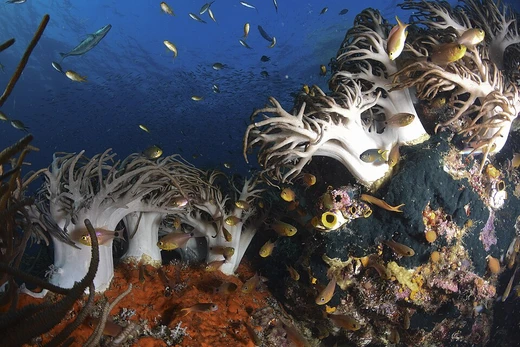
Narella
Deep-sea soft coral with nostril-like polyps and global distribution.

Narella is a genus of deep-sea soft corals in the family Primnoidae. They are sessile, bottom-dwelling organisms with a branching appearance and a cosmopolitan distribution across all ocean basins. The genus is notable for being the most species-rich in Primnoidae and for its high rate of adaptive radiation, leading researchers to believe many species remain undiscovered.
Quick Facts
- Taxon
- Narella
Facts from the source article.
Lore & Background
The name Narella is believed to derive from the Latin 'nares', meaning nostril, due to the resemblance of the rows of polyps to small noses. The genus was described in 1870 by John Edward Gray, but the first species, Primnoa regularis (now Narella regularis), was described in 1860. In 1887, Edward Wright and Théophile Studer discovered several new species but placed them in the new genera Stachyodes and Calypterinus. Between 1906 and 1919 many more species were discovered, though again described under Stachyodes or Calypterinus. It was only in 1951 that Frederick Bayer synonymized these genera with Narella, establishing them as junior synonyms.
Narella are distinguished from other Primnoidae by their conspicuous polyps with very distinct large scales (sclerites). Most species have 16–18 sclerites arranged in pairs. The eight opercular scales covering the polyp tip are also paired, giving a symmetrical appearance. Physical differences among species primarily involve the shape and texture of the scales, which are difficult to identify in the field, so broader identification guides focus on branching instead. The axis of the corals is made of aragonite, while their spicules are high Mg calcite. They anchor to hard substrates using calcareous discoid holdfasts.
Narella species are found worldwide, but each region generally has a distinct group of sympatric species, with only a few species occurring in multiple regions. This pattern, combined with high adaptive radiation, suggests many undiscovered species exist.
Reader's Guide
Narella holds significance as the most species-rich genus within Primnoidae, reflecting its evolutionary success in deep-sea environments. Its cosmopolitan distribution across all ocean basins, from the Atlantic and Pacific to the Hawaiian Islands, Indian Ocean, Galápagos, and Antarctic waters, underscores its ecological breadth. The genus's history of taxonomic confusion—with many species originally described under the now-synonymized genera Stachyodes and Calypterinus until Frederick Bayer's 1951 revision—highlights the challenges of deep-sea coral classification. The morphological reliance on scale shape and texture for species identification, combined with the practical use of branching patterns in field guides, illustrates the balance between detailed taxonomy and accessible identification. The high rate of adaptive radiation and the tendency for each region to host distinct sympatric species suggest that Narella's true diversity is likely much greater than the over 50 currently recognized species, making it a key group for future deep-sea biodiversity research.
Did You Know?
- The name Narella is believed to derive from Latin 'nares' meaning nostril, due to the polyp rows resembling small noses.
- The first species in the genus, Primnoa regularis, was described in 1860, a decade before the genus itself was named in 1870.
- Many Narella species were originally placed in the genera Stachyodes and Calypterinus until Frederick Bayer synonymized them in 1951.
Frequently Asked Questions
What is Narella?
Narella is a genus of deep-sea soft corals classified in the family Primnoidae, formally established by Gray in 1870. It is a sessile, bottom-dwelling group recognized for its branching growth form and small nostril-like polyps.
Where can Narella be found?
Narella species have a cosmopolitan range, occurring across all major ocean basins worldwide. They are strictly deep-sea organisms that attach to the seafloor.
How many species are in Narella?
More than 50 species are currently recognized, making Narella the most species-rich genus within Primnoidae. Because of its rapid adaptive radiation, scientists believe a significant number of additional species likely remain undescribed.
What is Narella's type species?
The type species is Narella regularis, which was first described in 1860 under the older name Primnoa regularis before being transferred into the genus Narella.
Which genera were merged into Narella?
In 1951, Frederick Bayer synonymized both Stachyodes and Calypterinus into Narella, folding those former genera into the broader Narella grouping.
More in Soft Corals and Leathers, Part 2 1-24
Spotted an error? Know more?
Reader corrections go straight into our review queue. Suggest an edit · How this site is sourced