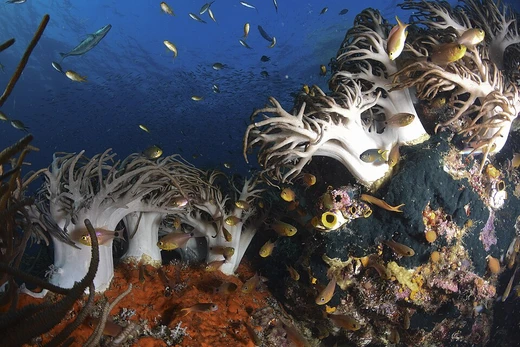
Callogorgia
Deep-sea soft coral genus forming habitats for diverse fauna.

Callogorgia is a genus of soft corals in the family Primnoidae, known for their fan-shaped body structure that serves as a habitat for various organisms. They are deep-sea corals found at depths ranging from 750 to 8200 feet in the Gulf of Mexico, Pacific Ocean, and Caribbean Sea, and are notable for their commensal relationships with brittle stars, cat sharks, and copepods.
Quick Facts
- Taxon
- Callogorgia
Facts from the source article.
Lore & Background
Callogorgia reproduce both sexually and asexually. Mature eggs enter the body cavity and are spawned via the mouth, developing into a planktonic disc-shaped larva. Early growth of tentacles, body cavity, and mouth begins their transformation into adults, and they cling to a hard substrate in the water as they mature. Callogorgia are found in the upper bathyal region between 750 and 8200 feet deep, inhabiting parts of the Atlantic and Indo-Pacific. Species such as Callogorgia verticillata occur in the Mediterranean Sea, while C. americana is found in the Atlantic. They can reside in brackish water and form dense colonies, each species occupying unique ecological parameters.
Reader's Guide
Callogorgia is significant as a habitat-forming genus in deep-sea environments. Its fan-shaped colonies provide elevation for brittle stars, allowing them to suspension feed in a commensal relationship. Cat sharks use Callogorgia as a nursery habitat by depositing egg cases on its branches. Associations also include copepods, zoanthids, and scale worms. One zoanthid, Isozoanthus primnoidus, exhibits a parasitic relationship, benefiting from the coral's support and sclerites while consuming its tissue. Threats to Callogorgia include damage from fishing gear and trawling, which alter the seafloor environment. The corals are highly sensitive to climate change and ocean acidification, which hinder their growth. Because they grow very slowly, any change affecting growth rate has profound effects that can linger for decades. Research on this genus is relatively recent, with most studies occurring in the last 40 years, and new species continue to be discovered.
Did You Know?
- Callogorgia can reproduce both sexually and asexually.
- Cat sharks deposit their egg cases on Callogorgia branches as a nursery habitat.
- The zoanthid Isozoanthus primnoidus has a parasitic relationship with Callogorgia, consuming its tissue.
Frequently Asked Questions
What is Callogorgia?
Callogorgia is a genus of deep-sea soft corals classified in the family Primnoidae, easily recognized by its broad, fan-shaped colony form. Rather than growing as a single polyp, it builds an intricate branching framework that functions as a living structure in the deep ocean.
Where and how deep can you find Callogorgia?
Specimens have been documented from roughly 750 feet down to about 8,200 feet, spanning the Gulf of Mexico, the Pacific Ocean, and the Caribbean Sea. That enormous vertical range makes it one of the more widely distributed soft coral genera in deep-water settings.
What animals live alongside Callogorgia?
The fan's dense branching supports commensal communities that include brittle stars, cat sharks, copepods, zoanthids, and scale worms. These organisms use the coral structure for shelter, a feeding platform, or a surface to attach to, without harming the host.
How does Callogorgia reproduce?
The genus employs both sexual and asexual strategies, meaning colonies can grow by budding or fragmentation as well as by releasing gametes into the water column. This dual approach helps populations persist across such a vast depth range where conditions shift dramatically.
Why does Callogorgia matter ecologically?
In the featureless open ocean floor, the rigid fan of a Callogorgia colony creates three-dimensional habitat that would otherwise not exist. By offering attachment surfaces and micro-refuges, it underpins local biodiversity and supports food webs far beyond its own tissue.
More in Soft Corals and Leathers, Part 2 1-24
Spotted an error? Know more?
Reader corrections go straight into our review queue. Suggest an edit · How this site is sourced