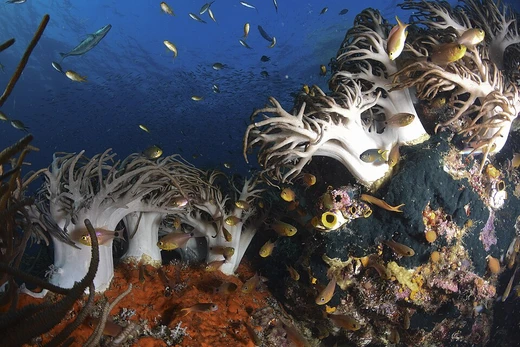
Primnoa pacifica
A deep-water keystone species forming dense benthic thickets.

Primnoa pacifica, or red tree coral, is a soft coral species from the family Primnoidae that lives in the deep waters of the North Pacific Ocean. It is a key part of benthic ecosystems. The coral grows both upward and outward, building skeletons made of calcite and gorgonin, which create dense underwater thickets. Taxonomically, Primnoidae are soft corals mostly found in the deep sea. Because sunlight does not reach these depths, species like *Primnoa pacifica* lack zooxanthellae symbionts. Unlike many shallow-water corals, Primnoidae do not have a typical calcium carbonate skeleton; many soft corals have no hard support at all. However, some, including red tree coral, have a more flexible skeleton of calcite and gorgonin. *Primnoa pacifica* stands out in its family due to its spinose basal scales, narrower medial scales, and large marginal scales, which give it a distinct shape. Anatomically, red tree corals grow on hard surfaces. They have a holdfast base that attaches to the substrate, an internal skeleton made of gorgonin and calcite that extends bilaterally, and colonies of polyps covering that skeleton. This coral is a deep-water species, with some surviving at depths as great as 6 kilometers and temperatures as low as 30 °F. It is typically found along the outer continental shelves and inner continental slopes of the North Pacific, between 150 and 900 meters deep. It is especially abundant off Alaska. In 2010, it was discovered in the Tracy Arm fjord at depths of 20 to 100 feet, including under glaciers. A large population also lives in British Columbia's Knight Inlet, as shallow as 15 meters on the crest of a sill between Hoeya Head and Prominent Point. Since 2010, it has also been found in waters around Japan. Red tree corals prefer to attach to bedrock and rougher seabeds over smooth ones. Without photosynthetic symbionts, red tree corals feed mostly on microscopic organisms and detritus. Their thickets are preyed upon by the spiny sea star *Hippasteria phrygiana*, the nudibranchs *Tochuina gigantea* and *Tritonia tetraquetra*, and *Calliostoma* snails. Growth rates are not well established. Earlier studies reported radial growth between 0.33 and 0.74 millimeters per year and axial growth between 2.41 and 6.39 centimeters per year.
Quick Facts
- Taxon
- Primnoa pacifica
Facts from the source article.
Lore & Background
Primnoa pacifica is a species of soft coral in the family Primnoidae, which consists of soft corals mostly found in the deep sea. Unlike many shallow-water corals, deep-sea members of Primnoidae lack zooxanthellae symbionts due to the inaccessibility of sunlight below the photic zone. Primnoa pacifica is distinct from other corals in its family because of its spinose basal scales, narrower medial scales, and large marginal scales, giving it a distinct shape. The coral's anatomy consists of a holdfast base attached to a hard substrate, a bilaterally extending internal skeleton of gorgonin and calcite, and polyp colonies covering the skeleton. Red tree corals are typically found along North Pacific outer continental shelves and inner continental slopes at depths as great as 6 kilometers and temperatures as low as 30 °F.
Reader's Guide
Primnoa pacifica is a keystone species, meaning the ecosystem is dependent on it and would undergo significant changes if removed. The dense bottom thickets formed by red tree corals serve as main sources of habitat for bottom-dwelling organisms in areas such as the Gulf of Alaska. A multitude of fish and crab species depend on these thickets as breeding, feeding, and nursery grounds, including juvenile rockfish. The corals shelter them from predators and currents. Studies have shown that coral thickets in this area, coupled with sponge colonies, serve as a keystone species, their presence directly corresponding to biodiversity. Rockfish are very strongly associated with red tree coral thickets. However, the massive thickets are also relatively rare, making Primnoa pacifica crucial only to a number of communities.
Anthropogenic impacts such as bottom trawling pose large-scale threats to these rare benthic habitats. Trawl nets and fishing hooks can easily damage or uproot the delicate gorgonian skeleton, effectively killing large amounts of coral. The red tree coral's large size and tangle of tree-like branches make it especially susceptible to human-caused damage. After a disturbance event, red tree corals will not return to their original state for tens to hundreds of years. In an effort to conserve the population, once a location of these deep sea oases is established, legislation protects the habitats by prohibiting bottom commercial activity in the surrounding waters. Rising global temperatures and oil spills also threaten red tree coral populations.
Did You Know?
- Red tree corals are gonochoric, with separate sexes, unlike the more common hermaphroditic corals.
- Their radial growth rates have been measured between 0.14 and 0.57 millimeters per year in recent studies.
- They have been found as shallow as 15 meters deep in British Columbia's Knight Inlet.
Frequently Asked Questions
What is Primnoa pacifica and what family does it belong to?
Primnoa pacifica, commonly called red tree coral, is a soft coral species classified within the family Primnoidae. It inhabits the deep waters of the North Pacific Ocean and is recognized as a keystone component of benthic habitats at depth.
At what depths can you find Primnoa pacifica, and what temperature range does it tolerate?
This coral typically occupies a depth band from roughly 150 meters (about 490 ft) down to 900 meters (about 3,000 ft), though records extend to a maximum of 6 kilometers. It can survive in water as cold as 30 °F, making it well adapted to the frigid deep-sea environment.
How fast does Primnoa pacifica grow, and in which directions?
Recent measurements show a radial (outward) growth rate of only 0.14 to 0.57 millimeters per year, while axial (upward) growth reaches 1.60 to 2.32 centimeters per year. The coral extends both vertically and laterally, gradually constructing dense, thicket-like structures over centuries.
Why doesn't Primnoa pacifica host zooxanthellae like many reef corals?
Because it lives at depths where sunlight cannot penetrate, there is no photosynthetic energy available to support a symbiotic relationship with zooxanthellae. Instead, the coral relies on capturing plankton and organic particles from the surrounding water column for nutrition.
What makes Primnoa pacifica ecologically important in deep-sea ecosystems?
As a keystone species, it builds massive calcite-and-gorgonin frameworks that form dense underwater thickets, providing critical three-dimensional habitat for a wide array of benthic organisms. Without these structures, the biodiversity and structural complexity of deep North Pacific seafloor communities would be dramatically reduced.
More in Soft Corals and Leathers, Part 2 1-24
Spotted an error? Know more?
Reader corrections go straight into our review queue. Suggest an edit · How this site is sourced