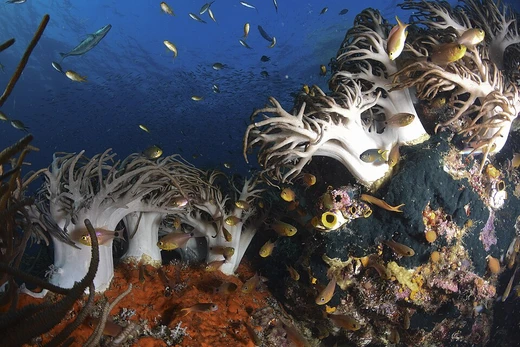
Antillogorgia bipinnata
A Caribbean soft coral with cytotoxic cembranoids and symbiotic algae.

Antillogorgia bipinnata, also called the bipinnate sea plume, is a colonial soft coral belonging to the family Gorgoniidae. It lives in the Caribbean Sea. The species was originally named Pseudopterogorgia bipinnata in 1864 by American zoologist Addison Emery Verrill. In 2012, Williams and Chen moved all Atlantic species of Pseudopterogorgia into the genus Antillogorgia.
This coral grows as a bipinnate fan, usually in a single plane. It can reach about 57 cm tall and a slightly smaller width. A main stem gives rise to several branches, which bear regularly spaced pairs of branchlets. These branchlets are stiff, slightly flattened, and typically 25 to 40 mm long and 1 to 1.5 mm wide. They are spaced about 5 mm apart and project at roughly a 65° angle from the branch. Small, slit-like apertures, from which the polyps emerge, are arranged in staggered double rows along each side of the branchlets. The fan is usually violet or purple, but may also be yellow or whitish.
The species is found on shallow water reefs in the Bahamas, South Florida, and the Caribbean Sea. It typically grows at depths of 9 to 20 m, but can occur as deep as 27 m.
Mature individuals host symbiotic unicellular algae called zooxanthellae in their tissues. These algae are not present in the planula larvae or the polyp that develops from them. Researchers raised these larvae in algae-free environments and then tried to infect the resulting polyps with different strains of dinoflagellate. Some strains were attracted to the polyps and actively swam into their open mouths; successful infection occurred with certain strains but not others.
Several secondary metabolites have been isolated from this coral, including the cytotoxic cembranoids bipinnatin A through D, and the diterpene bipinnatin J.
Quick Facts
- Taxon
- Antillogorgia bipinnata
Facts from the source article.
Lore & Background
Antillogorgia bipinnata was first described in 1864 as Pseudopterogorgia bipinnata by the American zoologist Addison Emery Verrill. In 2012, Williams and Chen transferred all Atlantic species of Pseudopterogorgia to Antillogorgia. The species grows as a colonial soft coral forming a bipinnate fan, usually in a single plane, reaching about 57 cm in height. Its branchlets are stiff, slightly flattened, and spaced about 5 mm apart, projecting at an angle of about 65° from the branch. The polyps protrude from small, slit-like apertures arranged in staggered double rows. The color is typically violet or purple, but may be yellow or whitish. It inhabits shallow water reefs in the Bahamas, South Florida, and the Caribbean Sea, typically at depths of 9 to 20 m, but can occur as deep as 27 m. Mature specimens contain symbiotic zooxanthellae, though these are absent in larvae and early polyps. Researchers successfully infected polyps with certain strains of dinoflagellate, which actively swam into the polyps' open mouths.
Reader's Guide
Antillogorgia bipinnata is significant as a source of several secondary metabolites, including the cytotoxic cembranoids bipinnatin A to D and the diterpene bipinnatin J. These compounds have been isolated from the coral and are of interest for their biological activity. The species also contributes to understanding coral-algal symbiosis, as researchers demonstrated that planula larvae reared in algae-free environments could be infected with specific dinoflagellate strains, with some strains actively swimming into the polyps' mouths. This work highlights the specificity of symbiotic relationships. Additionally, the taxonomic revision by Williams and Chen in 2012, which moved the species from Pseudopterogorgia to Antillogorgia, reflects ongoing refinement of coral classification. The coral's bipinnate growth form and typical violet or purple coloration make it a recognizable component of Caribbean reef communities.
Did You Know?
- Antillogorgia bipinnata was originally described as Pseudopterogorgia bipinnata in 1864 by Addison Emery Verrill.
- The species contains symbiotic zooxanthellae in mature specimens but not in planula larvae.
- Secondary metabolites isolated from this coral include bipinnatin A to D and bipinnatin J.
Frequently Asked Questions
What is Antillogorgia bipinnata?
It is a colonial soft coral in the family Gorgoniidae, commonly known as the bipinnate sea plume. It is a Caribbean species that grows as a flat, fan-shaped colony.
What does Antillogorgia bipinnata look like?
It forms a single-plane bipinnate fan in which a central stem sends out several branches, each carrying regularly spaced pairs of small branchlets measuring roughly 25 to 40 mm. The whole colony can reach about 57 cm in height and a slightly smaller span.
Where and how deep does Antillogorgia bipinnata live?
It is found in Caribbean waters, most commonly between 9 and 20 meters (30–66 ft) below the surface. Records also place it at depths of up to 27 meters (89 ft).
Who first described Antillogorgia bipinnata and when?
American zoologist Addison Emery Verrill originally named the species Pseudopterogorgia bipinnata in 1864. In 2012, Williams and Chen transferred all Atlantic Pseudopterogorgia species into the genus Antillogorgia, giving it its current name.
What makes Antillogorgia bipinnata chemically interesting?
The coral produces cytotoxic cembranoid compounds as a chemical defense and also harbors symbiotic algae within its tissues. These traits help it compete and survive in its Caribbean reef habitat.
More in Soft Corals and Leathers, Part 2 1-24
Spotted an error? Know more?
Reader corrections go straight into our review queue. Suggest an edit · How this site is sourced