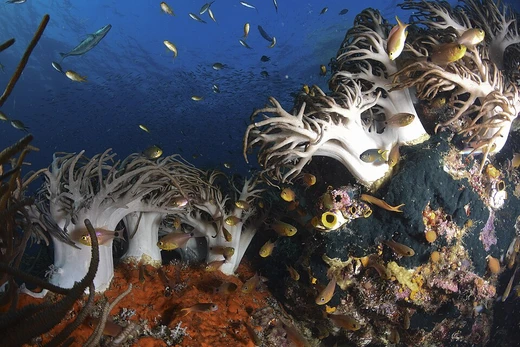
Isis hippuris
A bamboo coral studied for potential anti-cancer applications.

Isis hippuris, commonly known as sea bamboo, is a species of bamboo coral found in the Western Pacific Ocean, particularly near the coasts of Indonesia. It is notable for producing Hippuristanol, a molecule that could potentially have anti-cancer applications, and for its distinctive bamboo-like structure composed of nodes and internodes.
Quick Facts
- Genus
- Isis
- Species
- hippuris
Facts from the source article.
Lore & Background
Isis hippuris has been identified for centuries by its bamboo or bony-looking structure, composed of nodes and internodes stacked on top of each other, giving it the nickname sea bamboo. Its physical structure can appear skinny or thick, often resembling a spine, leading to the alternative name 'the stony horse-tail'. The coral displays yellow-green coloration and thick stalks with a fuzzy appearance.
A 2015 study within Wakatobi Marine National Park (WMNP), Indonesia, suggested that I. hippuris may display multiple phenotypes depending on environmental factors such as sediment thickness, height, and color. One phenotype had shorter, stockier branches, while another had longer, thinner branches. It remains unclear whether these differences indicate distinct phenotypes or separate species.
I. hippuris is found in tropical coral reefs in the Indo-Pacific region, particularly off Indonesia and India. It prefers areas with loose substrates and strong water flow, and is one of many Gorgonian corals that act as centerpieces in benthic communities. Specimens with longer stalks are commonly found at reef flats, while shorter, more horizontal specimens are found at reef crests.
Reader's Guide
Isis hippuris is significant for its production of Hippuristanol, a polyoxygenated molecule that continues to be studied as a hypothetical approach to leukemia treatment. Researchers have broken down the chemical makeup of I. hippuris to determine if there is a correlation between Hippuristanol and reduced numbers of T-cell leukemia cells in exposed organisms. While no actual conclusion regarding Hippuristanol has been published, ongoing research may ultimately result in a major medical breakthrough.
The species is highly sought after globally as a symbol of beauty, and has been collected for medicinal purposes. This has contributed to its endangerment, alongside the overall destruction of coral reefs by human activity. The Indonesian government has placed a protective ban on collection of I. hippuris to allow the species to re-flourish, though protection within Wakatobi Marine National Park is not properly enforced, and local communities lack education about the coral's ecological importance.
Did You Know?
- Isis hippuris reproduces asexually, spawning small larvae that quickly metamorphose and take root in sediment.
- The coral's structure is composed of nodes and internodes, giving it a bamboo-like appearance.
- Hippuristanol, a molecule found in I. hippuris, is being studied for its potential to target T-cell leukemia.
Frequently Asked Questions
What is Isis hippuris?
Isis hippuris is a species of bamboo coral commonly called sea bamboo, recognized for its segmented, bamboo-like branching structure made up of distinct nodes and internodes. It belongs to the broader group of soft corals and leathers found in tropical reef environments.
Where can you find Isis hippuris in the wild?
This coral is native to the Western Pacific Ocean, with its range centered around the coastal waters of Indonesia. It typically inhabits reef environments in that region.
How large does Isis hippuris typically grow?
Most specimens reach a height of roughly 30 to 40 centimeters and a width of 10 to 20 centimeters, though exceptional individuals can stretch to about 100 centimeters in either dimension.
Why is Isis hippuris important to medical research?
The coral produces a compound called Hippuristanol, which researchers have identified as a candidate for potential anti-cancer applications. This makes it a subject of ongoing pharmacological interest beyond the aquarium hobby.
How does Isis hippuris reproduce?
Unlike many other coral species that rely on sexual spawning events, Isis hippuris reproduces asexually. New colonies arise through fragmentation or budding rather than gamete release.
More in Soft Corals and Leathers, Part 2 1-24
Spotted an error? Know more?
Reader corrections go straight into our review queue. Suggest an edit · How this site is sourced