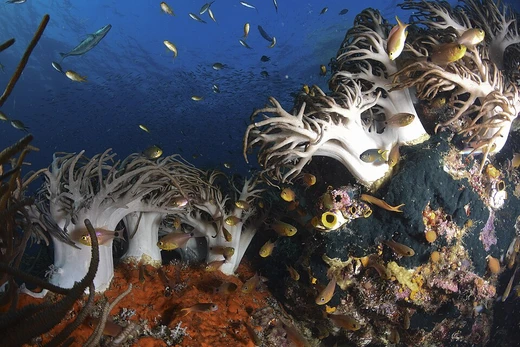
Callogorgia elegans
A deep-sea soft coral with dichotomous branching and whorled polyps.

Callogorgia elegans is a species of soft coral in the family Primnoidae, found in the north-western Pacific Ocean. Like other coral species, it is bottom-dwelling and sessile, or immobile. It is notable for its colonial, dichotomous growth form and its role as a habitat-forming deep-sea coral.
Quick Facts
- Taxon
- Callogorgia elegans
Facts from the source article.
Lore & Background
Callogorgia elegans belongs to the phylum Cnidaria, class Anthozoa, and subclass Octocorallia, which is characterized by 8-fold symmetry. It is classified within the family Primnoidae, which is defined by colony and branch formation, dichotomous arrangement of polyps, and sclerite form and number. The species was previously and incorrectly sorted into the genus Callicella before being transferred to the genus Callogorgia in 1878.
Defining features include a colonial, dichotomous growth form that branches off in opposite directions. Its polyps face upwards, forming whorls of four polyps each, with 9 polyps per centimeter. The species has a tessellate sclerite pattern that decreases from the abaxial to adaxial polyp side, with thick polygonal scales up to 0.12 millimeters thick. The adaxial surface is protected by polyps that bend inward, while the abaxial surface is more prone to predator attacks. Numerous tubercules cover the central inner surface of the scales, anchoring them in the mesoglea.
C. elegans is found at benthic depths of 280-480 meters in the southern area of the Hawaii-Emperor seamount chain. Like all cnidarians, it possesses nematocysts used for capturing prey and defense. Its prey includes algae that reside on its polyps and fish that hide within its branches. Reproduction in the genus Callogorgia has yet to be studied, though species in the family Primnoidae are known for coral spawning where gametes are released into the water and eventually settle at the ocean floor.
Reader's Guide
Callogorgia elegans is significant as a deep-sea soft coral that forms habitats within the benthic zone of the north-western Pacific Ocean. Its colonial, dichotomous growth form and whorled polyps provide shelter for small fish, which hide from larger predators among its branches. The species' nematocysts are used both to capture prey—including algae and fish—and for defense. Its sclerite pattern, with thick polygonal scales and tubercules anchoring in the mesoglea, offers structural support and protection, with the adaxial surface further shielded by inward-bending polyps. As a member of the family Primnoidae, it contributes to the understanding of deep-sea coral ecosystems, though its specific reproductive biology remains unstudied. The species was reclassified from the genus Callicella to Callogorgia in 1878, reflecting taxonomic refinement within the Primnoidae. Its presence in the Hawaii-Emperor seamount chain highlights the distribution of primnoid corals in tropical and warm temperate regions, where they are known to form habitats at depths of 280-480 meters.
Did You Know?
- Each whorl on its branches contains four polyps, with 9 polyps per centimeter.
- Its sclerites are thick polygonal scales up to 0.12 millimeters thick, with a tessellate pattern that decreases from abaxial to adaxial sides.
Frequently Asked Questions
What is Callogorgia elegans?
Callogorgia elegans is a deep-sea soft coral belonging to the family Primnoidae, native to the north-western Pacific Ocean. It lives as a sessile, bottom-dwelling organism and forms colonies through repeated dichotomous branching.
At what depths can Callogorgia elegans be found?
This species inhabits the mesophotic to upper bathyal zone, typically between 280 and 480 meters below the surface. It anchors itself to the seafloor and does not move once settled.
What does the colony structure of Callogorgia elegans look like?
The coral grows in a colonial form where branches split into two repeatedly (dichotomous branching). Along each branch, tiny polyps—roughly 0.78 to 0.93 millimeters across—are arranged in whorls of four, with about nine polyps per centimeter of branch.
What are the sclerites of Callogorgia elegans like?
Sclerites, the tiny calcareous structures inside the coral tissue, in this species reach a maximum thickness of about 0.12 millimeters. The whorls they help support measure 2.8 to 3.5 millimeters in diameter.
Why is Callogorgia elegans ecologically significant?
As a habitat-forming deep-sea coral, it builds three-dimensional structure on the seafloor that provides shelter and substrate for a variety of associated marine invertebrates. Its colonial, branching architecture creates microhabitats that would otherwise be absent in the open deep-sea environment.
More in Soft Corals and Leathers, Part 2 1-24
Spotted an error? Know more?
Reader corrections go straight into our review queue. Suggest an edit · How this site is sourced