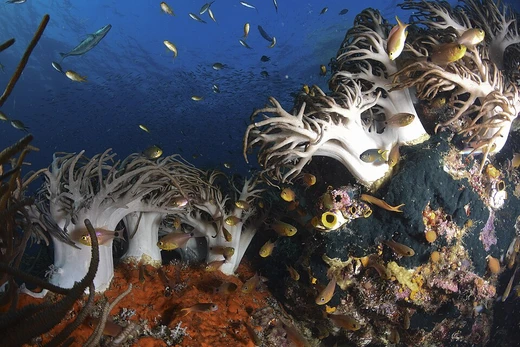
Eunicella singularis
A white branching soft coral of the Mediterranean and Adriatic seas.

Eunicella singularis, also called the white gorgonian, is a colonial soft coral belonging to the family Gorgoniidae. It forms a branching sea fan that can reach about 70 cm in both height and width. The branches rise from a thickened base, with a few nearly vertical stems and some side branches. The branch surfaces are smooth, and the calyces where the polyps emerge are not clearly defined. The overall color is white, while the polyps themselves are translucent and yellowish-brown or olive.
This species lives in the western Mediterranean Sea, the Adriatic Sea, and the Ionian Sea, at depths between 10 and 60 meters. It typically grows on gently sloping rock surfaces that are often partly covered with sediment, but it can also attach to pebbles, shells, or other objects surrounded by sediment. It prefers well-lit locations.
The polyps feed by extending their tentacles to catch zooplankton and organic particles drifting by. This diet is supplemented by energy from symbiotic dinoflagellates living in the coral’s tissues, which produce food through photosynthesis. Reproduction involves releasing planula larvae that drift in the open sea for a few hours to several days. Each larva then settles on the seabed and transforms into a primary polyp within about four days, founding a new colony that grows by budding off additional polyps. Branches lengthen by up to about 33 mm per year, and colonies can live for twenty to thirty years. Predators may eat the coral’s tissues, and epibionts like bryozoans can settle on bare branches, causing further tissue loss. Colonies may eventually be knocked over by currents, possibly because epibionts increase resistance to water flow. In a laboratory study, thermal stress at 24 °C caused polyps to stay closed, reduced respiration, and stopped photosynthesis, though the symbionts remained. The coral survived on its reserves for several weeks before necrosis set in, but it fully recovered when water temperatures dropped.
In the Mediterranean, the soft coral *Alcyonium coralloides* often overgrows *Eunicella singularis*, killing its soft tissues as it spreads along the branches. The nudibranch *Marionia blainvillea* feeds on this sea fan, and where their ranges overlap, so does the whip fan nudibranch *Tritonia nilsodhneri*. The gastropod *Simnia spelta* mimics *E. singularis*, feeding and laying eggs on its branches.
Quick Facts
- Taxon
- Eunicella singularis
Facts from the source article.
Lore & Background
Eunicella singularis was first described in 1791 by the German naturalist Eugenius Johann Christoph Esper. It grows to about 70 cm in both height and width, with a branching structure arising from a thickened base. The branches are nearly vertical with few side branches, and their surface is smooth, with indistinct calyces. The general colour is white, while the polyps are translucent and yellowish-brown or olive.
The species is found in the western Mediterranean Sea and the Adriatic Sea at depths of 10 to 60 metres, mainly on shallowly sloping rock surfaces often partially covered with sediment, but also on pebbles, shells, or other objects surrounded by sediment. It favours well-lit locations. The polyps feed by intercepting zooplankton and organic particles, supplemented by energy from symbiotic dinoflagellates via photosynthesis.
Reproduction involves the release of planula larvae that spend a few hours to several days in the open sea before settling and metamorphosing into a primary polyp within about four days. Colonies grow by budding, with branches increasing in length by up to about 33 mm per year. Predators include the nudibranch Marionia blainvillea and, where ranges overlap, the whip fan nudibranch (Tritonia nilsodhneri). The gastropod Simnia spelta mimics E. singularis and feeds on its branches, leaving bare areas that become colonised by epibionts.
Reader's Guide
Eunicella singularis holds significance as a slow-growing, long-lived soft coral that forms the basis of small biodiverse communities in the Mediterranean and Adriatic seas. The article notes that bare areas where the gastropod Simnia spelta removes coenenchyme tissue soon become colonised by epibionts such as algae, tube worms, bryozoans, and colonial tunicates; the tissue may regrow and form cavities where other organisms flourish. Additionally, epibionts such as bryozoa may take up residence on denuded branches and cause further regression of living tissues, and colonies may eventually be toppled by currents due to increased resistance from epibionts. In the Mediterranean, it is often overgrown by the soft coral Alcyonium coralloides, which kills the sea fan's soft tissues as it spreads. A laboratory study showed that at 24 °C, thermal stress caused polyps to remain unexpanded, respiration decreased, and photosynthesis stopped, though the sea fan could live on reserves for several weeks before necrosis set in, recovering fully when water temperature fell. This species is also notable for being the host of the mimicking gastropod Simnia spelta, which feeds and lays eggs on its branches.
Did You Know?
- Eunicella singularis was first described in 1791 by German naturalist Eugenius Johann Christoph Esper.
- It can grow to a height and width of about 70 cm and lives for twenty to thirty years.
- The gastropod Simnia spelta mimics E. singularis and feeds and lays its eggs on its branches.
- At 24 °C, thermal stress causes the polyps to stop feeding and photosynthesis to cease, though the coral can recover when temperatures fall.
Frequently Asked Questions
Who is Eunicella singularis?
Eunicella singularis, commonly called the white gorgonian, is a colonial soft coral in the family Gorgoniidae that grows into a smooth, branching sea fan. The species was first formally described by Eugenius Johann Christoph Esper in 1791.
What are Eunicella singularis's powers or role?
As a filter feeder, it extends translucent yellowish-brown or olive polyps from its white branches to capture plankton drifting through the water. Its smooth branch surfaces and poorly defined calyces help it sit quietly within the reef while feeding passively.
Why is Eunicella singularis important?
It provides three-dimensional shelter and attachment points for small invertebrates and juvenile fish across its range. As a colonial organism it also adds structural complexity to rocky reef habitats in the western Mediterranean, Adriatic, and Ionian Seas.
Where does Eunicella singularis live?
This white gorgonian anchors on rocky substrates between 10 and 60 metres depth in the western Mediterranean, Adriatic, and Ionian Seas. From a thickened base it sends up a few nearly vertical stems along with shorter side branches, forming a fan roughly 70 cm across at maturity.
More in Soft Corals and Leathers, Part 2 1-24
Spotted an error? Know more?
Reader corrections go straight into our review queue. Suggest an edit · How this site is sourced