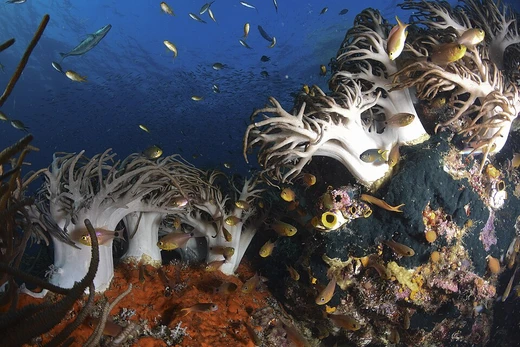
Eunicella verrucosa
A branching soft coral with wart-like polyps, native to the northeastern Atlantic.

The broad sea fan, also called the pink sea fan or warty gorgonian, is a colonial soft coral belonging to the family Gorgoniidae. Its scientific name is *Eunicella verrucosa*. This species is found in the northeastern Atlantic Ocean and the western Mediterranean Sea.
The coral grows a densely branching, fan-shaped stem that usually lies flat in a single plane. It positions itself at a right angle to the direction of water flow. While it can reach a height of 50 centimeters, it more commonly grows to about 25 centimeters. The stems and branches are covered in wart-like bumps, from which the polyps emerge. Its color ranges from red through pink to white.
Its native range stretches from the southwestern coasts of Britain and Ireland down to France, Spain, Italy, Algeria, Morocco, Western Sahara, and Mauritania. A recent genetic study found clear population differences between samples from northwest Ireland, Britain, France, and southern Portugal. It grows on hard surfaces such as rock, timber, metal, or concrete, at depths between 4 and 50 meters. In British waters, this sea fan has become less common, possibly due to damage from dredging, though it may benefit from rising seawater temperatures.
The colony typically orients itself at right angles to the water current. The polyps extend and spread their tentacles to feed, and nutrients are shared throughout the colony via internal channels connecting the polyps. Reproduction in this species has not been studied much. The planula larvae are probably lecithotrophic, meaning they rely on a yolk-sac and can drift for a short time before settling on the seabed to develop into new polyps and colonies. Growth rates vary; in Lyme Bay, southern Britain, some colonies grew 6 centimeters in one year, while in another year they showed no growth at all. The sea fan anemone (*Amphianthus dohrnii*) is often found living on *Eunicella verrucosa*.
Quick Facts
- Taxon
- Eunicella verrucosa
Facts from the source article.
Lore & Background
Eunicella verrucosa grows in a single plane, orientating itself at right angles to water movement. Its stems and branches are covered with wart-like growths from which the polyps protrude, and its colour can vary from red through pink to white. The species is found on rock, timber, metal or concrete at depths of 4 to 50 metres. In British waters it has become scarcer, possibly due to damage from dredging, but may benefit from higher seawater temperatures. The sea fan anemone (Amphianthus dohrnii) is often found living on it.
Reader's Guide
Eunicella verrucosa is a colonial gorgonian soft coral in the family Gorgoniidae, native to the northeastern Atlantic and western Mediterranean. Its range extends from the southwestern coasts of Britain and Ireland to France, Spain, Italy, Algeria, Morocco, Western Sahara and Mauritania. A recent study of genetic connectivity identified marked population structure between samples from northwest Ireland, Britain, France and southern Portugal. The polyps expand tentacles to feed, passing nutrients through internal channels. Reproduction is little studied; planula larvae are likely lecithotrophic and drift briefly before settling. Growth rate varies; in Lyme Bay, some colonies grew 6 cm in one year and not at all in another. The species is notable for its fan-like form and wart-like polyp bases, and for hosting the sea fan anemone.
Frequently Asked Questions
What is Eunicella verrucosa?
Eunicella verrucosa is a colonial soft coral in the family Gorgoniidae, commonly known as the broad sea fan, pink sea fan, or warty gorgonian. It is a branching species native to the northeastern Atlantic Ocean and the western Mediterranean Sea.
What does Eunicella verrucosa look like?
It forms a densely branching, fan-shaped colony that typically spreads flat in a single plane, orienting itself perpendicular to water flow. The stems and branches are dotted with small wart-like bumps from which the polyps extend, and the coral can appear in shades of red, pink, or white.
How large does Eunicella verrucosa grow?
While it can reach a maximum height of about 50 centimeters (20 inches), most specimens in the wild settle around 25 centimeters (10 inches) tall.
Where is Eunicella verrucosa found?
This species ranges along the southwestern coasts of Britain and Ireland through France, Spain, Italy, and down the North African coast to Algeria, Morocco, Western Sahara, and Mauritania. It typically inhabits depths between 4 and 50 metres (roughly 13 to 164 feet).
What does Eunicella verrucosa attach to?
It anchors itself to hard substrates such as rock, timber, metal, or concrete, using its base to grip the surface firmly. This makes it a common sight on both natural reef structures and man-made objects within its range.
More in Soft Corals and Leathers, Part 2 1-24
Spotted an error? Know more?
Reader corrections go straight into our review queue. Suggest an edit · How this site is sourced