Precious coral
A marine coral with a durable red skeleton used for jewelry.

Precious coral, also called red coral, refers to a group of marine corals in the genus *Corallium*. What sets it apart is its hard, vividly colored skeleton—ranging from red to pinkish-orange—that is durable enough to be fashioned into jewelry. The skeleton starts out matte but can be polished to a glossy finish, and its colors span from pale pink to deep red.
These corals grow on rocky seafloors where sediment is scarce, preferring dark spots like deep waters, caves, or crevices. The first species identified, *Corallium rubrum*, is mainly found in the Mediterranean Sea, living at depths of 10 to 300 meters, though shallower areas have been heavily fished out. In the underwater caves near Alghero, Sardinia (known as the "Coral Riviera"), it grows between 4 and 35 meters deep. The same species also appears in the Atlantic near the Strait of Gibraltar, around the Cape Verde Islands, and off southern Portugal. Other *Corallium* species come from the western Pacific, especially near Japan and Taiwan, where they thrive at depths of 350 to 1,500 meters in areas with strong currents.
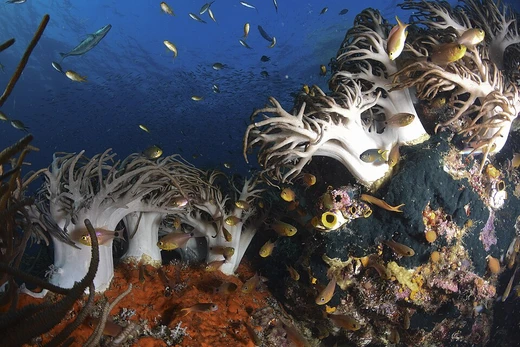
Like other Octocorallia, red corals look like small, leafless bushes and can reach up to a meter tall. Their valuable skeleton is made of tightly packed spicules of hard calcium carbonate, colored red by carotenoid pigments. In living corals, the skeletal branches are covered with a soft, bright red skin, from which many white polyps—able to retract—stick out. These polyps have octameric radial symmetry.
The skeleton is naturally matte but polishes to a glassy shine. Because of its lasting color and gloss, it has been harvested for decoration since ancient times. Coral jewelry has turned up in Egyptian and prehistoric European graves and is still made today, especially popular in the Victorian era. On the Mohs scale, precious coral has a hardness of 3.5. Because it is soft and opaque, it is usually cut into cabochons or made into beads.
In the early 1st millennium, coral was traded heavily between the Mediterranean and India, where it was prized as a sacred, mysterious substance. Pliny the Elder noted that before India’s huge demand, the Gauls used coral to decorate weapons and helmets, but later it became so sought-after in the East that it was rarely seen even where it was produced.
Quick Facts
- Taxon
- Corallium
Facts from the source article.
Lore & Background
Red corals grow on rocky sea bottom with low sedimentation, typically in dark environments such as depths or dark caverns. The first species described, C. rubrum, is found mainly in the Mediterranean Sea, growing at depths from 10 to 300 meters, though shallower habitats have been largely depleted by harvesting. In the underwater caves of Alghero, Sardinia, it grows at depths from 4 to 35 meters. The same species also occurs at Atlantic sites near the Strait of Gibraltar, the Cape Verde Islands, and off southern Portugal. Other Corallium species are native to the western Pacific, notably around Japan and Taiwan, at depths of 350 to 1500 meters in areas with strong currents.
In common with other Octocorallia, red corals have the shape of small leafless bushes and grow up to a meter in height. Their skeleton is composed of intermeshed spicules of hard calcium carbonate, colored red by carotenoid pigments. In living specimens, the skeletal branches are overlaid with soft bright red integument, from which numerous retractable white polyps protrude, exhibiting octameric radial symmetry. The skeleton is usually cut en cabochon or used to make beads due to its softness and opacity.
Reader's Guide
Precious coral has been harvested since antiquity for decorative use, with coral jewelry found in ancient Egyptian and prehistoric European burials. It was especially popular during the Victorian age. At the beginning of the 1st millennium, significant trade in coral existed between the Mediterranean and India, where it was prized as a substance believed to have sacred properties. Pliny the Elder noted that before the great demand from India, the Gauls used it for ornamenting weapons and helmets. Among the Romans, branches of coral were hung around children's necks to preserve them from danger, and it had many attributed medicinal virtues. The belief in coral's potency as a charm continued through the Middle Ages and into early 20th century Italy, where it was worn as protection from the evil eye and as a cure for infertility.
From the Middle Ages onward, securing rights to coral fisheries off African coasts was a source of rivalry among Mediterranean communities. The town of Torre del Greco became closely associated with coral, with a Royal Society of Coral established there in 1790. A code to regulate coral fishing was enacted in 1789 by Ferdinand IV of Bourbon, but it did not have expected success. From 1805, the golden age for coral manufacturing in Torre del Greco began. In Hindu astrology, red coral is associated with the planet Mars and used for pleasing Mars. Among the Yoruba and Bini peoples of West Africa, red precious coral jewelry signifies high social rank. In traditional Dutch culture, red coral necklaces were worn as an indispensable part of traditional costumes. In Ladakh, ornaments made of red coral and turquoise are used in festivals.
Did You Know?
- The Greek word for coral is 'Gorgeia', as Medusa was one of the three Gorgons.
- Precious coral has hardness 3.5 on the Mohs scale.
- The three oldest Mediterranean marine protected areas—Banyuls, Carry-le-Rouet and Scandola—host substantial populations of C. rubrum.
- A branch of red coral figures prominently in the civic coat of arms of Alghero, Italy.
More in Soft Corals and Leathers, Part 2 1-24
Spotted an error? Know more?
Reader corrections go straight into our review queue. Suggest an edit · How this site is sourced