Plexaurella nutans
A tall, uncommon Caribbean soft coral with slit-pore calyces.

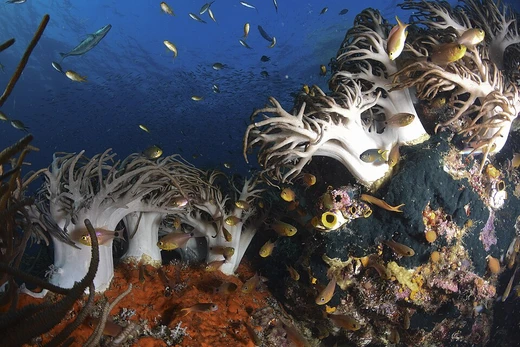
The giant slit-pore sea rod, *Plexaurella nutans*, is a soft coral from the family Plexauridae that stands out for its size. This uncommon Caribbean species can exceed a meter in height, with thick, cylindrical branches that sometimes fork and often have slightly clubbed tips, measuring 10 to 15 centimeters across. Its surface looks dimpled because each cup-shaped calyx sits on a small mound, and the polyps—large and usually extended—emerge from round, oval, or slit-shaped grooves, giving the coral a fuzzy texture. Colors are typically pale brown, gray, or occasionally lavender.
Found in the Caribbean Sea, the Bahamas, and Florida, this coral lives in shallow waters down to 50 meters deep, usually on isolated patch reefs or forereef slopes. Its polyps feed by extending tentacles to capture zooplankton and other tiny drifting invertebrates, sharing the food with neighboring polyps through the gastrovascular cavity inside the skeleton. In one experiment, a radioactive tracer fed to a single polyp was later detected in tissues up to 11 centimeters away.
*Plexaurella nutans* is a zooxanthellate species, hosting large numbers of symbiotic *Symbiodinium* dinoflagellates in its tissues. These photosynthetic algae provide nutrients to the coral while using its waste products. Research showed that different *Symbiodinium* species occur at different depths in this coral and others, and when tissues were cultured in the lab, additional species—previously undetected—emerged, favored by the artificial environment.
Quick Facts
- Taxon
- Plexaurella nutans
Facts from the source article.
Lore & Background
Plexaurella nutans can grow to a height of over a metre, with thick cylindrical branches that occasionally fork and are often slightly clubbed at the tips. The branches have a diameter of 10 to 15 centimetres. The polyps are rather large and protrude from round, oval or slit-shaped grooves in the cup-shaped calyces in the coral skeleton. Each calyx sits on a slight mound, giving the coral a dimpled surface. When the polyps are extended, as they usually are, the coral appears fuzzy. Its color is usually pale brown, grey, or sometimes lavender.
This species is uncommon and occurs at depths down to 50 metres in the Caribbean Sea, the Bahamas, and Florida. It is typically found on isolated patch reefs or on forereef slopes.
The polyps extend their tentacles to feed on zooplankton and other small invertebrates. Food is shared with neighboring polyps via the gastrovascular cavity; in an experiment, radioactive tracer fed to a single polyp was detected in tissues up to 11 centimetres away. Plexaurella nutans is a zooxanthellate species, hosting symbiotic dinoflagellates from the genus Symbiodinium. Different species of Symbiodinium were found at different depths, and when tissues were cultured in the laboratory, other species became apparent, favored by the lab environment, suggesting they were previously undetected.
Reader's Guide
Plexaurella nutans is significant as a relatively uncommon soft coral in the Caribbean region, notable for its large size—over a meter in height—and its distinctive dimpled surface created by calyces on slight mounds. Its polyps, which are usually extended, give the coral a fuzzy appearance, and its color ranges from pale brown to grey or lavender. The species is found on isolated patch reefs or forereef slopes at depths down to 50 metres, contributing to the biodiversity of these habitats.
Its biology reveals interesting features: polyps share food through a gastrovascular cavity, with experimental evidence showing nutrient transport up to 11 centimetres from a feeding site. As a zooxanthellate coral, it relies on symbiotic dinoflagellates (Symbiodinium) for nourishment, and research indicates that different Symbiodinium species occur at different depths, with additional species emerging in laboratory cultures. This underscores the complexity of its symbiotic relationships and the potential for undetected microbial diversity within its tissues. The species thus serves as a model for studying nutrient sharing and symbiont dynamics in soft corals.
More in Soft Corals and Leathers, Part 2 1-24
Spotted an error? Know more?
Reader corrections go straight into our review queue. Suggest an edit · How this site is sourced