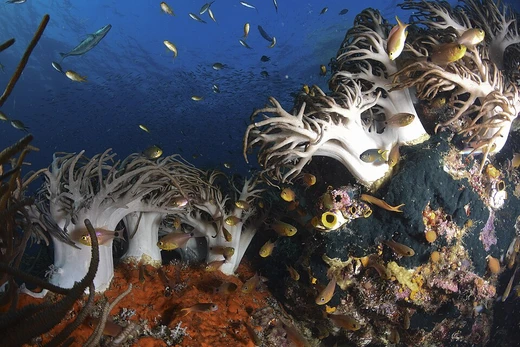
Paragorgia arborea
A deep-sea foundation coral with bulbous branch tips.

Paragorgia arborea, also called tree bubblegum coral, is a member of the family Coralliidae. It was first described by Swedish naturalist Carl Linnaeus in 1758. This coral is a foundation species, meaning it creates habitat for other organisms in deep-sea ecosystems.
The coral can reach 6 meters tall and comes in bright white, red, or salmon colors. It has a tough central trunk with many branches that form a fan shape. The branch tips are bulbous, which gives it the common name bubblegum coral. It has two types of polyps: autozoids for feeding and siphonozoids for reproduction. Growth rates average about 1 centimeter per year, though rates of 2 to 6 centimeters per year have been observed. The coral is long-lived, surviving for decades.
Little is known about its reproduction. Scientists think it is a brooder, meaning fertilization happens on or inside the female colony. Corals can reproduce sexually by spawning or brooding, and once settled, they grow asexually into branched colonies.
Paragorgia arborea is a filter feeder that eats organic matter suspended in currents. It adjusts its feeding to the tidal cycle: polyps extend to feed when tidal currents bring in organic matter, and retract to digest when currents slow. The coral often grows in a concave shape facing into the current, which is thought to improve feeding efficiency.
The coral’s microbiome is not well studied due to the difficulty of accessing deep-sea corals. It has a host-specific microbiome and an external surface mucopolysaccharide layer (SML), a mucus that defends against water-borne pathogens and aids filter feeding. The main bacterial groups in its microbiome are Alphaproteobacteria, Mycoplasmatota, and Spirochaetota.
Paragorgia arborea is found between 30° and 70° latitude in both hemispheres. It grows in the North Atlantic and North Pacific Oceans, typically at depths of 200 to 1,300 meters and temperatures of 3 to 8 °C. It occurs along the entire Norwegian coast and as shallow as 40 meters in Norwegian fjords with poor visibility and abundant plankton. In the western Atlantic, it appears in Nova Scotia waters, Oceanographer Canyon, off Georges Bank, the Grand Banks, Davis Strait, and southern Greenland. It is also found near the Mid-Atlantic Ridge south of Iceland.
Quick Facts
- Taxon
- Paragorgia arborea
Facts from the source article.
Lore & Background
Paragorgia arborea can grow to heights of 6 metres and is brightly colored white, red, or salmon, forming a branching, fan-shaped structure with a tough central trunk. Its branch tips are bulbous, giving it the common name bubblegum coral. It has both specialized feeding polyps (autozoids) and specialized reproductive polyps (siphonozoids). Little is known about its growth rate and lifespan, but it has an average growth rate of 1 cm/yr, with some cases of 2-6 cm/yr, and is long-lived on the scale of decades.
Like other deep-water corals, little is known about its specific reproductive ecology. It is hypothesized that P. arborea is a brooder, with fertilization taking place on or inside the female colony. Corals reproduce sexually by either spawning or brooding, and once settled, reproduce asexually to grow into a many-branched colony. As a filter feeder, it eats organic matter suspended in the current and optimizes nutrient uptake by adjusting its behavior to the tidal cycle—extending polyps to feed during incoming tides and retracting them to digest when currents are weaker. It is often found growing in a concave shape facing into the current to receive food more effectively.
Its microbiome is host-specific and includes an external surface mucopolysaccharide layer (SML) that acts as a defense against water-borne pathogens and aids filter feeding. The main bacterial taxonomic groups found are Alphaproteobacteria, Mycoplasmatota, and Spirochaetota.
Reader's Guide
Paragorgia arborea is a foundation species, serving as a breeding ground, shelter, and feeding space for a wide variety of species and increasing the species richness of the entire deep-sea ecosystem. It is often associated with the Gorgon's Head basket star Gorgonocephalus caputmedusae, which uses it as a perch to catch plankton, and sometimes forms dense coral gardens with other octocorals such as Primnoa resedaeformis, Paramuricea grandis, Keratoisis ornata, and the sea pen Pennatula borealis. It often grows on reefs created by the stony coral Lophelia pertusa.
P. arborea faces anthropogenic threats including trawling by commercial fisheries, offshore oil extraction, deep sea mining, and cable laying. Due to its slow growth rate (~1 cm/yr) and fragile skeleton, it is particularly vulnerable to these disturbances. Destruction of this species has effects that reverberate through multiple trophic levels and affect species richness because it is a foundation species. Ecological niche modeling under a worst-case climate change scenario predicts a high decline rate in the availability of suitable habitat for P. arborea, with no predicted refugia.
Did You Know?
- Paragorgia arborea was first described by Carl Linnaeus in 1758.
- It can grow up to 6 metres tall and has bulbous branch tips that give it the common name bubblegum coral.
- Its average growth rate is about 1 cm per year, though rates of 2-6 cm per year have been observed.
- It is a foundation species that provides habitat for other species in deep sea coral ecosystems.
More in Soft Corals and Leathers, Part 2 1-24
Spotted an error? Know more?
Reader corrections go straight into our review queue. Suggest an edit · How this site is sourced