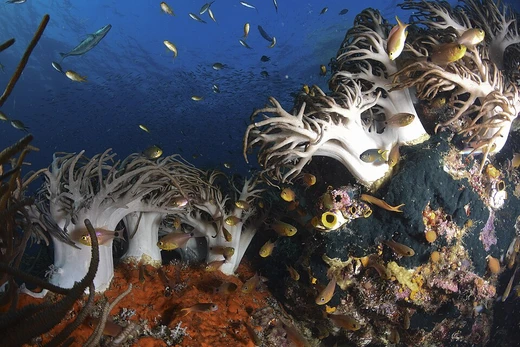
Organ pipe coral
A soft coral with a hard, organ pipe-like skeleton.

The organ pipe coral (Tubipora musica) is an alcyonarian octocoral native to the Indian Ocean and the central and western Pacific Ocean. It is the only known species of the genus Tubipora and is notable for its unique hard skeleton of calcium carbonate that resembles organ pipes, despite being a soft coral. Living colonies are typically green, blue, or purple due to the color of the expanded polyps, which obscure the bright red skeleton.
Quick Facts
- Taxon
- Tubipora musica
Facts from the source article.
Lore & Background
The organ pipe coral is a colonial octocoral that builds a bright red skeleton of calcium carbonate composed of many tubes joined by parallel platforms. Each tube hosts a series of polyps with eight feather-like tentacles, which are usually extended during the day but withdraw swiftly when disturbed. Colonies are typically dome-shaped and can reach up to 3 meters across, while individual polyps are less than 3 mm wide. The skeleton's red color is usually hidden by the polyps, which give the colony a green, blue, or purple appearance. Colonies are often one color, though large colonies may show distinct sections of different colors.
Organ pipe corals are restricted to shallow, sheltered waters with good light, medium to strong currents, and well-oxygenated water. They are found from 2 to 20 m depth, often dominating bedrock and sandy grooves at 8 to 10 m, as well as mid-shelf reefs. Their distribution spans the west Pacific, south of Japan, west to Africa's East Coast, and throughout the Red Sea. The polyps contain zooxanthellae that provide energy, and they also capture prey and organic particles, though dissolved organic matter meets only 13% of their metabolic needs.
The species exhibits limited colonial behavior: when disturbed, a wave of retraction spreads across the colony away from the point of disturbance. This through-conducting response occurs with both electrical and mechanical stimulation. Beyond this, colonial behavior is likely limited because the corals have only one conduction system.
Reader's Guide
The organ pipe coral is listed as near threatened, with over 50% of the population lost in the past 10 years. Its popularity stems from its ease of maintenance in aquariums, higher tolerance compared to most true corals, and its use in jewelry and other commodities. It is one of the fifteen most traded corals in the world, leading to illegal harvesting and smuggling. Observed colonies frequently show signs of collection, and the most flourishing colonies are often found in areas with strong waves, likely due to the difficulty of harvesting there. Scientists are calling for increased protection, including protected areas, awareness campaigns, and investigation into farming the species. The coral also has medical and scientific value, and two recently discovered copepods in Madagascar interact with it. Its unique hard skeleton and vibrant polyp colors make it a notable species in both natural and aquarium contexts.
Did You Know?
- Its skeleton is bright red but usually hidden by green, blue, or purple polyps.
- The species can form dome-shaped colonies up to 3 meters across.
More in Soft Corals and Leathers, Part 2 1-24
Spotted an error? Know more?
Reader corrections go straight into our review queue. Suggest an edit · How this site is sourced