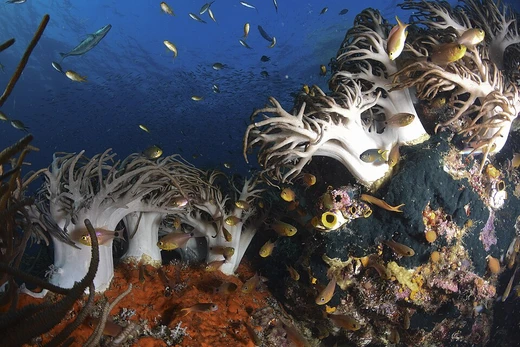
Leptogorgia virgulata
A soft coral with whip-like stems and chemical defenses.

Leptogorgia virgulata, called the sea whip or colorful sea whip, is a soft coral from the family Gorgoniidae. Unlike true corals, it lacks a rigid calcium carbonate skeleton; instead, its upright, whip-like stems are supported by an internal axial skeleton stiffened with sclerites and covered by an outer layer called the coenenchyme. The colony typically reaches about 20 centimeters in height, though adults range from 15 to 60 centimeters and can occasionally grow to 1 meter. The stems branch sparsely near the base and are uniformly colored in shades of white, yellow, orange, red, or mauve. The polyps, which are translucent white, are arranged in rows along both sides of each branch; on older main branches, distinct grooves separate these rows, and the calyces do not protrude when the polyps are retracted. Each polyp has eight tentacles and eight mesenteries, classifying it as an octocorallian, and like all cnidarians, it possesses stinging nematocysts for feeding and defense. The colony has a single siphonoglyph.
This species grows on rocks at depths up to 20 meters along the western Atlantic, from Chesapeake Bay south to the Gulf of Mexico and also in Brazil. It is common on coastal shelves of southern states, on rock and limestone edges, and on shallow reefs. It can also live in estuaries and bays because it tolerates low salinity, though it generally prefers high-salinity environments.
The polyps are carnivorous, extending their tentacles to catch zooplankton carried by currents. Colonies are gonochoristic, meaning each is either male or female. They release gametes into the water for external fertilization. The larvae are planktonic for 3 to 20 days, passing through several stages before settling on a suitable rocky substrate, where they metamorphose into feeding polyps that eventually produce new polyps and form colonies. Mortality among new colonies is high.
Leptogorgia virgulata uses chemical defenses to prevent algae, barnacles, and bryozoans from growing on its stalks, exuding substances that inhibit larval settlement. These compounds are being investigated as potential anti-fouling agents for man-made structures. The snail Simnialena marferula feeds on debris around the coral and takes on the coral’s color by assimilating its pigments.
Quick Facts
- Taxon
- Leptogorgia virgulata
Facts from the source article.
Lore & Background
Leptogorgia virgulata is a colonial soft coral that lacks a rigid calcium carbonate skeleton, instead having an internal axial skeleton stiffened by sclerites and covered by an outer layer called the coenenchyme. Its upright stems are sparsely branching near the base and are uniform in color, ranging from white, yellow, and orange to shades of red and mauve. The polyps are translucent white, each with eight tentacles and eight mesenteries, classifying it as an octocorallian, and they possess stinging nematocysts for feeding and defense.
The species is found growing on rocks along the western fringes of the Atlantic Ocean, from Chesapeake Bay south to the Gulf of Mexico and also in Brazil, at depths down to 20 metres. It occurs on shallow water reefs, estuaries, and bays, tolerating low salinity but typically preferring high salinity environments. Colonies are gonochoristic, releasing gametes into the water column for external fertilization, and the planktonic larvae settle on suitable rocky substrate after 3–20 days.
Leptogorgia virgulata uses chemical defenses to prevent algae, barnacles, and bryozoans from growing on its stalks, exuding substances that inhibit larval settlement. The snail Simnialena marferula feeds on debris around the coral and takes on its color through pigment assimilation. The barnacle Conopea galeata is an obligate commensal, with its larvae settling on snail egg masses, and the coral's coenenchyme grows to enclose the barnacle. The oyster Pteria colymbus is often found attached, and the shrimp Neopontonides beaufortensis and the nudibranch Tritonia wellsi are camouflaged to resemble the coral.
Reader's Guide
Leptogorgia virgulata holds significance as an indicator species for sessile fauna in coastal reefs within its range, particularly in South Carolina where it lives on hard bottom substratum in coastal regions and estuaries. Its abundance in these habitats makes it a representative organism for studying shallow-water reef ecosystems. The species' chemical defenses, which inhibit settlement of algae, barnacles, and bryozoans, have been investigated for potential use as anti-fouling agents on man-made structures, highlighting a practical application of its natural biology. Additionally, the sclerites and secondary metabolites produced by the coral deter predation by fish, with one metabolite having emetic properties that produce a learning response in fish, demonstrating an evolved chemical deterrent. The coral also supports a unique ecological community, including obligate commensals like the barnacle Conopea galeata and camouflaged predators such as the sea whip slug Tritonia wellsi. Its tolerance of low salinity allows it to occupy estuaries and bays, expanding its ecological role beyond typical reef habitats. The species' reproductive strategy, with high mortality among new colonies, underscores the challenges of recruitment in dynamic coastal environments.
Did You Know?
- Leptogorgia virgulata can tolerate low levels of salinity, allowing it to live in estuaries and bays.
- The snail Simnialena marferula takes on the color of the coral stems by assimilating pigments from the coral.
- The barnacle Conopea galeata is an obligate commensal that becomes enclosed by the coral's coenenchyme.
- One of the coral's secondary metabolites has emetic properties that produce a learning response in fish.
More in Soft Corals and Leathers, Part 2 1-24
Spotted an error? Know more?
Reader corrections go straight into our review queue. Suggest an edit · How this site is sourced