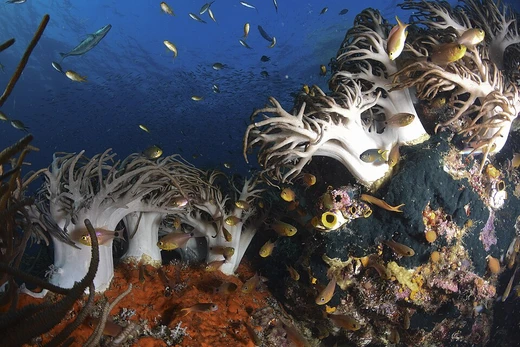
Leptogorgia sarmentosa
A branching sea fan with slender branchlets and variable coloration.

Leptogorgia sarmentosa is a type of colonial soft coral, specifically a sea fan belonging to the family Gorgoniidae. Its natural range covers the eastern Atlantic Ocean and the western Mediterranean Sea, though one colony has been recorded in the eastern Mediterranean.
This coral grows into a branching, tree-like form that can reach up to 60 cm tall. While the branches sometimes lie in a single plane, they more often extend from the main stem in multiple directions. The slender terminal branchlets are either straight or slightly drooping. The sclerites—tiny, rigid structures that stiffen the soft tissues—are dark red, translucent, and needle-shaped. The coenenchyme, the thin fleshy outer layer, is usually orange but can also be yellow, white, red, or purple. The polyps are very small and match the color of the rest of the coral, arranged randomly around the branches. This species can be mistaken for *Eunicella verrucosa*, but that coral has shorter, sturdier twigs and a rough, warty coenenchyme.
The species lives along the Atlantic coasts of Europe and Africa, from the Bay of Biscay to the Gulf of Guinea, as well as in the western Mediterranean and the Adriatic Sea. Its Mediterranean range expanded with the discovery of a colony at Naxos in the Aegean Sea. It typically grows at depths of 10 to 300 meters, on boulders lying on sandy seabeds or on bedrock partly covered by soft sediment. It tolerates a range of current speeds but prefers areas with strong water movement.
*Leptogorgia sarmentosa* is a suspension feeder: its polyps extend tentacles to filter particles from the water passing by. Its diet includes zooplankton such as dinoflagellates, diatoms, and ciliates, along with particles of organic detritus. Colonies are either male or female. Males release sperm into the water, and eggs are fertilized internally within female colonies. Embryos first develop inside the polyps’ gastric cavities, then are released as planula larvae that drift with currents for several weeks. When ready to metamorphose, they settle on suitable surfaces and grow into new polyps. New colonies form through budding, and branches grow at about 2 to 5 cm per year.
Quick Facts
- Taxon
- Leptogorgia sarmentosa
Facts from the source article.
Lore & Background
Leptogorgia sarmentosa forms a branching, tree-like structure that can grow to a height of 60 cm. Although the branches are sometimes in a single plane, more commonly they emerge from the main stem in various directions. The terminal branchlets are very slender, either straight or slightly drooping. The sclerites which give rigidity to the soft tissues are dark red, translucent and needle-like. The colour of the coenenchyme is usually orange but may instead be yellow, white, red or purple. The polyps are very small and are the same colour as the rest of the coral, arranged randomly around the branches. This species can be confused with Eunicella verrucosa but that species has shorter more robust twigs and the coenenchyme is rough and warty.
Leptogorgia sarmentosa is found along the Atlantic coast of Europe and Africa between the Bay of Biscay and the Gulf of Guinea, and in the western part of the Mediterranean Sea and the Adriatic Sea. Its range in the Mediterranean has been extended by the discovery of a colony at Naxos in the Aegean Sea. It typically grows in the depth range 10 to 300 m on boulders lying on sandy areas of the seabed or on bedrock partially overlaid by soft sediment. It is found in a range of current velocities but particularly favours locations with strong water movement.
Leptogorgia sarmentosa is a suspension feeder. The polyps extend their tentacles to filter particles from the water flowing past the colony. The diet includes zooplankton such as dinoflagellates, diatoms and ciliates as well as particles of organic detritus. Colonies are either male or female. Sperm is released into the sea from male colonies and the eggs are fertilised internally inside the female colonies. The embryos develop at first in the gastric cavities of the polyps but are liberated as planula larvae which drift with the currents as part of the plankton for several weeks. When ready to undergo metamorphosis they settle on suitable surfaces and develop into new polyps. The new colonies that form from these grow by budding new polyps. The branches grow at about 2 to 5 cm per year.
Reader's Guide
Leptogorgia sarmentosa is notable as a colonial soft coral that forms tree-like sea fans up to 60 cm tall. Its slender, often multi-directional branches and variable coenenchyme colour—ranging from orange to yellow, white, red, or purple—make it visually distinctive, though it can be confused with Eunicella verrucosa, which has shorter, more robust twigs and a rough, warty surface. The species is distributed along the Atlantic coast of Europe and Africa between the Bay of Biscay and the Gulf of Guinea, and in the western Mediterranean and Adriatic Sea, with a single eastern Mediterranean find at Naxos in the Aegean Sea. It inhabits depths from 10 to 300 m, typically on boulders or bedrock partially covered by soft sediment, and favours locations with strong water movement. As a suspension feeder, it captures zooplankton (including dinoflagellates, diatoms, and ciliates) and organic detritus. Its reproductive strategy involves separate male and female colonies, internal fertilization, and release of planula larvae that drift for weeks before settling and budding into new colonies. Branch growth occurs at about 2 to 5 cm per year. This species contributes to the biodiversity of temperate and subtropical reef and rocky habitats, and its single eastern Mediterranean record suggests potential range expansion or rare occurrence.
More in Soft Corals and Leathers, Part 2 1-24
Spotted an error? Know more?
Reader corrections go straight into our review queue. Suggest an edit · How this site is sourced